The National
pp. 36-37 · Read in the full issue
Development
Climate Change project records a rise in sea level
Tidal Facility (NTF) from Flinders University in Australia has recorded sea-level rise of 0.77 millimetres a year in the Pacific region.
A paper at a climate change conference in the Cook Islands disclosed details of monitoring stations records on sea levels in different parts of the Pacific Islands region.
According to the paper, the overall average relative sea level trend at the Pacific
stations monitored by the university shows a sea level rise of 0.77 millimetres a year.
The university’s gauges are located in several Pacific Islands countries including Marshall Islands, Guam, Federated States of Micronesia, Kiribati, Tahiti, New Caledonia, Hawaii, Johnston Atoll, American Samoa, and Papua New Guinea.
NTF was hired to carry out the Australian government-sponsored South Pacific Sea Level Climate Monitoring Project in 1991 after South Pacific Forum countries raised concerns over the potential impacts of the greenhouse
effect.
The NTF established SEAFRAME (Sea-level Fine Resolution Measuring Equipment) monitoring stations in 11 Pacific countries.
In their presentation, NTF examined records of sea level rise in the region using two sets of data - one from the World Ocean Circulation Experiment (WOCE) Data Centre at the University of Hawaii - and the other from the South Pacific Sea Level Climate Monitoring Project.
According to the NTF paper, the University of Hawaii estimated a relative sea level trend for tide gauge
locations in the Pacific from its archive, which has more than 20 years of hourly observations.
NTF also released their findings on sea level rise in the Pacific Islands region where their SEAFRAME (Sea Level Fine Resolution Acoustic Measuring Equipment) stations are located.
The findings showed that for monitoring stations in Kiribati, Tuvalu and Nauru, there has been significant sea level falls since the start of the project.
Stations in Tonga and PNG have recorded a rise in sea level.
“It is expected that as the effects from the recent El Nino and La Nina events subsides, these locations will also registered much lower rates of sea level change,” the NTF paper said.
According to NTF’s data, the Kiribati station recorded a decrease in sea level of 11.74 cm since monitoring started almost 7 years ago.
For the Tuvalu station, the sea level change was also negative at 8.69 cm over a seven-year period. Similarly the Nauru station recorded a sea level decrease of 10.82 cm since testing began
Continued next page
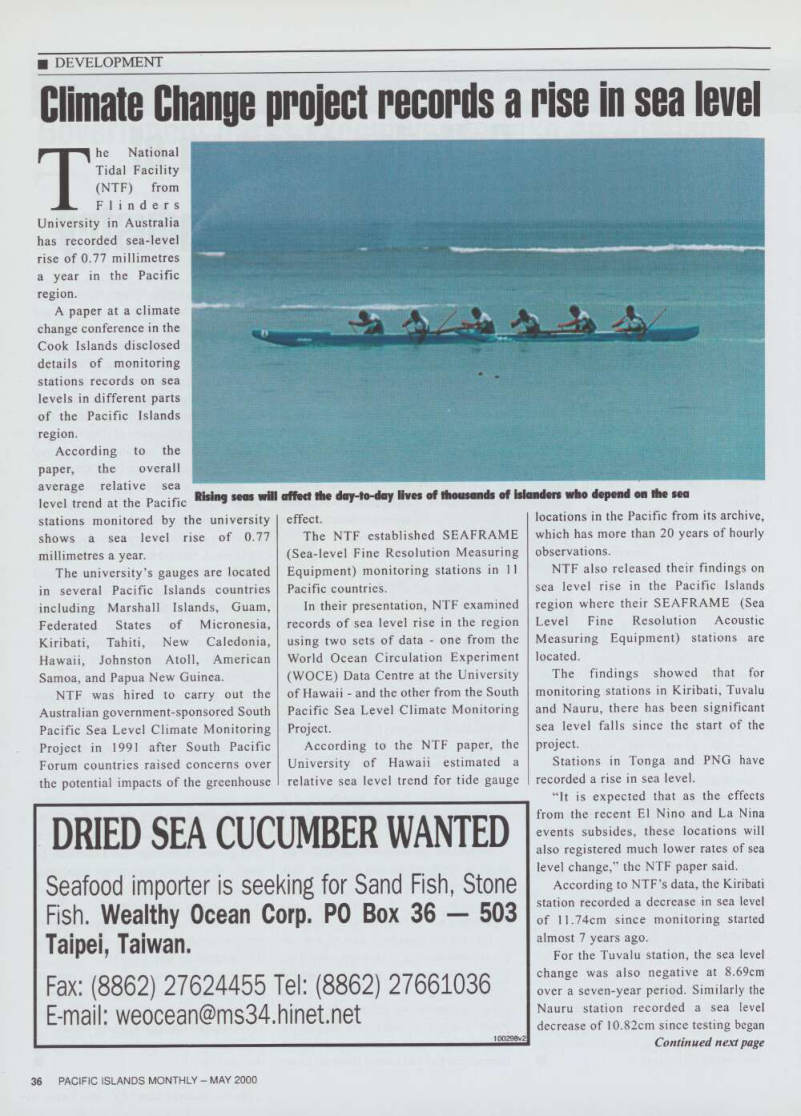
Rising seas will affect the day-to-day lives of thousands of islanders who depend on the sea
Continued from previous page six and half years ago.
The station in Fiji, where testing began just over seven years ago, recorded a sea level rise of I.olcm.
The Vanuatu station recorded a rise of 0.92 cm over a six-year period; the sea level at the Cook Islands station increased by 4.83 cm; the level at the Samoa station was down 3.22 cm; Marshall Islands station recorded a 1.98 cm rise; the sea level at the Solomon Islands station was up 2.87 cm; and the PNG station showed a sea level increase of 5.96 cm.
But, NTF believes that considering the analysis of the time necessary to determine accurate rates of relative sea level rise, it is premature to consider that the current South Pacific Sea Level and Climate Monitoring Project can provide anything other than “noisy estimates of trends”.
“We have examined the long term rates of sea level change as registered on tide gauges in the Pacific region and found that it is difficult to estimate localised rates of change,”
NTF admitted.
“Taking the 27 longest records available, the estimated mean relative sea level rise emerges as +o.Bmm/year.
“This is on the low side of the global rate published in the Intergovernmental Panel on Climate Change (IPCC) Scientific Assessment which in 1995 estimated that the global trend lies between l-2mm per year.”
“Consequently over a major part of the world ocean, which on the one hand includes ocean stations, and on the other a major continental coastline, the indication is that, over recorded history, sea level rise has occurred, but at a rate which falls significantly short of the IPCC world assessment.”
According to NTF, research has shown that it may take as least 30 years to estimate consistent sea level trends based upon the output of conventional tide gauges. PNS ■