of Social Security system
pp. 32-33 · Read in the full issue
Marshalls to begin revamp of Social Security system
By Giff Johnson
Th e
Marshall Islands Social Security program was the subject of two Presidentially appointed commissions of inquiry in 1996 and 1997. The
resulting reports documented mismanagement, and use of Social Security credit cards to pay for hundreds of thousands of dollars in personal
expenses.
Numerous
structural problems
with both the retirement fund and the national health insurance fund that Social Security administers were
also highlighted.
Incredibly,
however, few, if any, of the recommendations for change were acted upon, and the agency became a bellwether of suspicion for mismanagement and
outright corruption.
This was particularly so when the chair, then Health Minister Tom Kijiner - who had
been removed from the chairmanship by President Amata Kabua in early 1996 was put back as chair after Amata’s death. This was when cousin Imata Kabua took over as President in 1997.
The agency also became a prime target of
opposition political leaders who
promised a government cleanup in last year’s national election campaign.
A new board - dominated by private sector representatives - was initially slow to become started after it was appointed in January. But by April, the board had
taken decisive action: the three top administrators were fired, other nonessential personnel in Hawaii terminated, a Guam medical referral
support office closed, and an actuarial firm fired to save money. The intention of the board’s action is to get the Marshall Islands Social
Security
Administration (MISSA) back on track, said board vice chair Yoda
Nysta, a long time
critic of the previous government.
Among the
immediate crises
facing MISSA:
• A nearly $6 million debt to off-island
hospitals for
medical referrals
and to pharmaceutical companies for medicines and supply orders. • Declining retirement fund collections, the result in part of lax collection efforts. • An inability to meet its monthly retiree benefits (about $500,000 monthly) from collections, requiring the agency to take short term loans from banks or to draw on its retirement fund investment reserves. • Although it has about 25 employees, hundreds of thousands of dollars of
computers and software accounting programs, financial consultants and more than $3O million invested in the US stock market, MISSA’s accounts have been unauditable since 1997. • The huge medical debt had off island vendors refusing to send medicines to the Marshalls, resulting in
both Majuro and Ebeye hospitals running
out of essential medicines beginning in November last year.
The medicine inventory was only beginning to stabilise in April.
“The entire breakdown at Social Security is a lack of accounting and organisation, and an inability of the
Continued next page
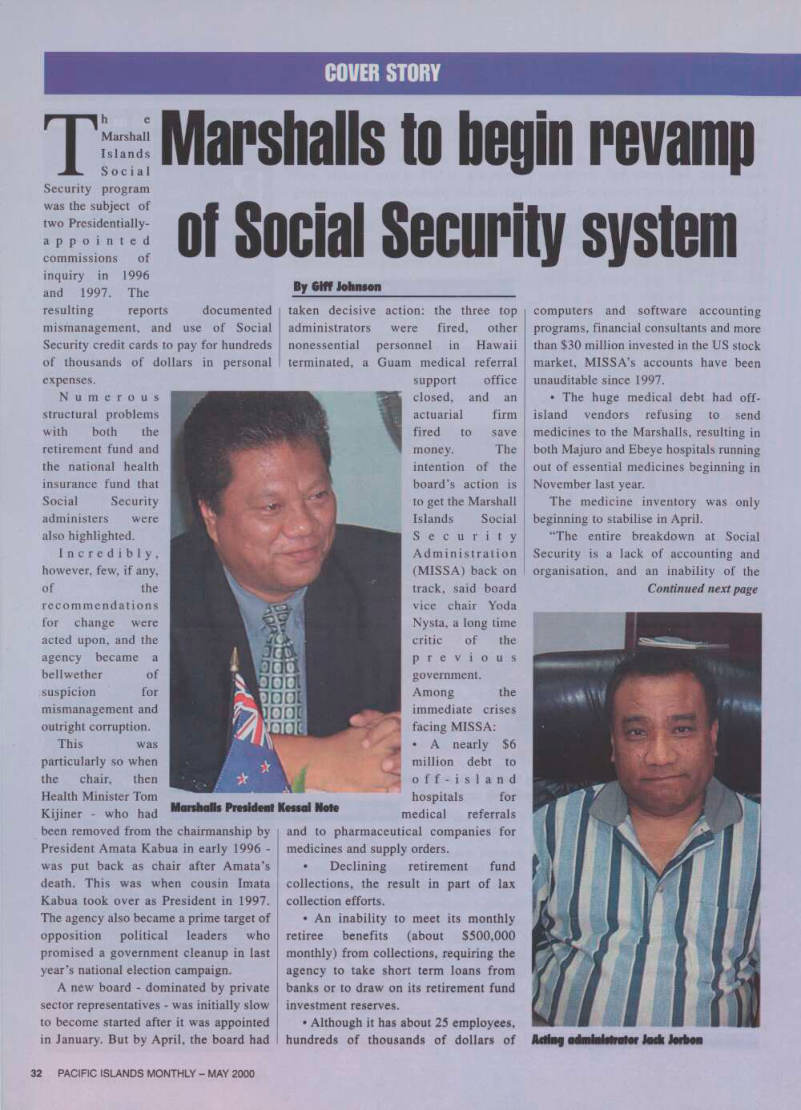
Marshalls President Kessai Note
fluting admiistrator Jack Jorbon
Continued from previous page higher ups to recognize the problem,” said board member Jack Niedenthal.
“Social Security accountants are capable but they’ve had the wrong people
directing them.”
In addition, the previous board had a somewhat different attitude toward public awareness of its activities than the current administration. According to Niedenthal, the previous board did not allow a board-requested audit of MISSA credit card usage by board members and government officials to see the light of day.
Auditing company Deloitte and Touche has been hired to bring Social Security’s record-keeping up to date so that the agency can be audited from 1997 onward, said board chair Grant Labaun, a prominent local executive.
Commenting to the local Chamber of Commerce, Labaun said that “drastic measures” were needed to fix MISSA.
“The priority is to get the books straightened out so that it is auditable,”
Labaun said.
“It’s our goal to rebuild the confidence of citizens in their Social Security system,” said Niedenthal, the liaison agent for the Bikini Island Council and its US$2OO million trust fund.
By June 1, Niedenthal said Social Security would be auditable and would stay that way. Among the new board’s immediate moves; • The administrator, assistant administrator in charge of the health fund, and the tax examiner were terminated, and Jack Jorbon, a local businessman and former administrator of the US-funded health programme for radiation affected Marshallese, was named acting administrator. • A fully qualified chief financial officer was being recruited from overseas to reorganize the accounting system and train staff to operate properly. • An aggressive tax collection policy was established to get the 375 delinquent businesses and local governments to begin payment schedules, or face charges in the High Court. MISSA estimates that
Delinquent tax payers will be given a hand delivered letter that will start a 30-day clock ticking in which they must agree to a payment plan. If any of the 375 businesses, local governments and other entities that haven’t filed taxes do not reply within the 30 day period, Social Security’s attorney will instigate a lawsuit within 14 days
more than $3 million is owed to it by entities that are deducting social security taxes from their employees but not turning in the payments to MISSA. • The board also held meetings in April with Ministry of Health officials to discuss how to begin transferring authority for administration of part or all of the Health Fund to the Ministry to cut
red tape surrounding medicine orders.
Labaun said both the government and the new Social Security board want to transfer the Health Fund back to the Ministry of Health to reduce the overlap.
MISSA has been front page news in the local Marshall Islands Journal for much of March and April, as the board continued to announce initiatives to get
the agency functioning properly.
And, while non-payment has been one of the biggest problems for MISSA, there were some indications that the new board’s announcements were having an
immediate impact.
According to staff and board members, many people who hadn’t been paying regularly showed up to pay their quarterly tax the first week of April.
No doubt this is because delinquent tax payers have been put on notice that they will be sued if they do not work out a payment plan within 30 days.
Board member Maria Fowler said in an interview that the Social Security board in early April adopted a resolution that sets an aggressive collection policy.
Fowler, who is the daughter of the Marshalls first President Amata Kabua, said delinquent tax payers will be given a hand-delivered letter that will start a 30day clock ticking in which they must agree to a payment plan.
If any of the 375 businesses, local governments and other entities that haven’t filed taxes do not reply within
the 30 day period, Social Security’s
attorney will instigate a lawsuit within 14 days.
If people don’t “make an honest effort to make a payment schedule,” they will be sued after one warning, Fowler said of the board’s resolution.
“We need aggressive collections because the Health Fund owes close to US$6 million,” she said.
One piece of good news among the problems is that MISSA’s investment fund has risen in value from about US$5 million in the late 1980 s to more than USS3O million in early 2000.
In addition, said Niedenthal, “Social Security is fixable. It can be made accountable.” ■
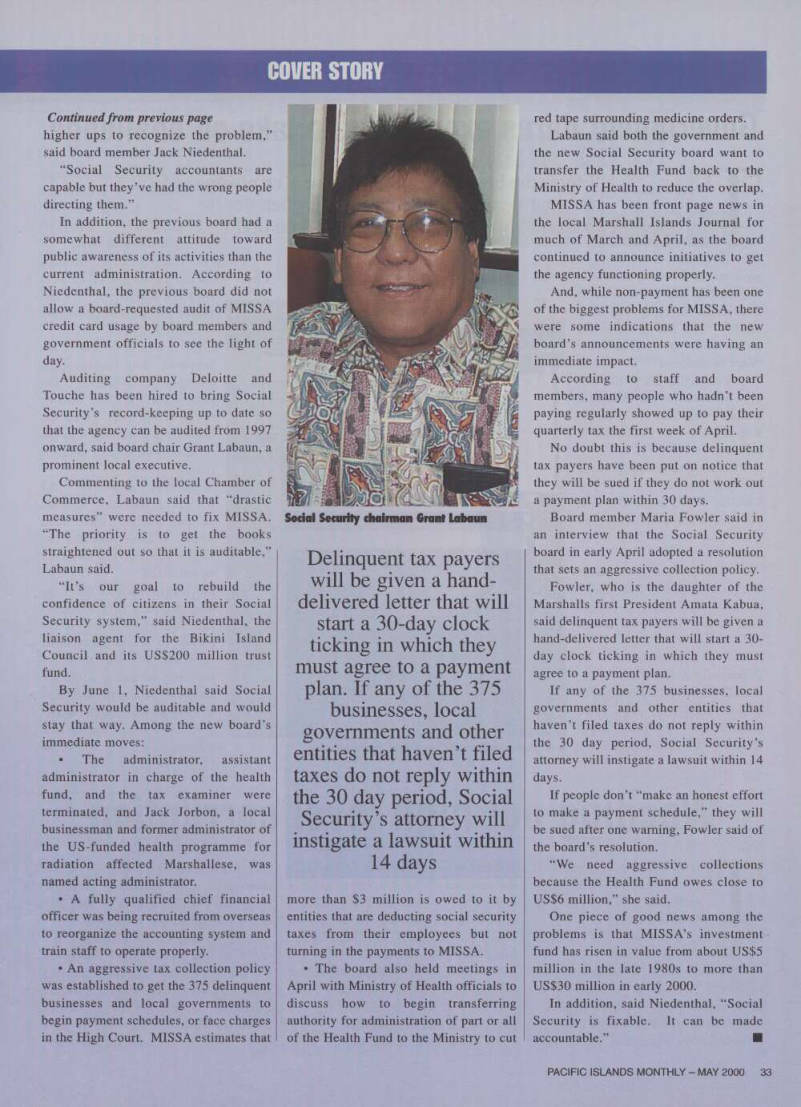
Social Security chairman Grant labaun