Calls for clean-up of superannuation industry
pp. 30-35 · Read in the full issue
Cover Story
By Eileen Tugum-Kolmo
Outraged members told savings may have halved in value
What would you do if your
superannuation fund
manager told you that he (or she) was going to cut your contributions in half? For the workers that contribute to Papua New Guinea’s National Provident Fund, that is exactly what is being proposed, and they are, to put it mildly, very outraged. The NPF is in dire financial straits and has proposed to write down 50 per cent of all its contributors’ total savings, unless help is on its way.
The announcement shocked the fund’s 255,000 contributors who have already lost
substantially through high income tax
deductions, and many of whom are still battling to recoup money invested in pyramid financial schemes. The news has also alarmed other superannuation contributors.
The Fund announced that poor investment decisions of past boards and management have led to losses totaling K 153 million in 1998 and 1999. The losses meant a reduction of funds attributable to members from K 249 million at December 31 1999, to only K 124 million now. The fund’s general manager Rod Mitchell, who took over management of the troubled institution one year ago, said that the Fund has little choice. It has to half the contribution of workers to take into account its current level of assets. “What NPF is doing now is taking into account all the losses, all the assets overstated in the accounts and bringing everything up towards best practice,” he said.
“The members’ account in the assets pool is valued at K24omillion but this has to be written down to K 126 million to reflect the actual position of the fund.” The cut would affect savings up to 31 December 1999 and total about K 56.3 million. He said however that 50 per cent of the money would be lost permanently, unless the government or the World Bank comes to its rescue. Mid-last month PNG prime minister Sir Mekere Morauta told parliament that a
commission of inquiry would be held into the conduct of the National Provident Fund, the country’s largest superannuation fund.
Heading the inquiry is former Chief Ombudsman, Sir Charles Maino. His terms of reference are to find out why K 153 million of workers’ contributions have disappeared in bad investment. He is to: - Report whether, in connection with the management of the fund, there has been illegal or improper conduct by any person, company, business, legal entity or agency between 1995 and 1999, especially by the board of trustees, management, officers of the NPF, public officials including Ministers of State, and any other persons or organizations, in relation to certain investments and activities undertaken by or on behalf of the NPF; - Whether there was any inappropriate intervention by external persons or entities in relation to illegal or unsuitable borrowings and investments, or other
improper actions;
- Whether in connection with any illegality, any trustee or staff member should be referred to the relevant authorities for criminal prosecution or other action; - Whether in connection with any failure to act in good faith, any trustee or staff member should be indemnified, and if not whether any trustee or staff member should be held personally responsible for decisions or outcomes, and whether (and where practicable) what action should be taken to recover lost asset values; and - Whether under the respective act or any other act, the responsible government
agencies, including the Department of
Finance and Treasury, the Auditor General and the Department of Labor and Employment failed in their regulatory,
supervisory or reporting responsibilities and
what was the extent of this failure.
Meanwhile, Mitchell said in the year that his management team had been in office, they
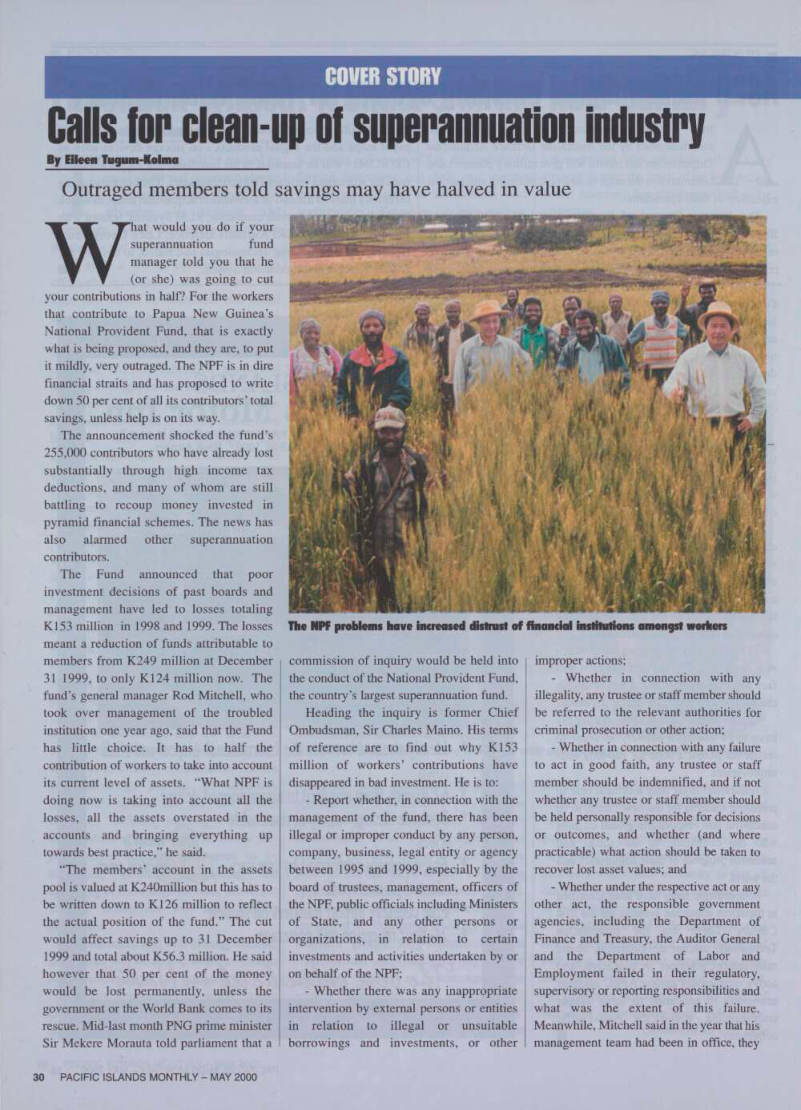
The NPF problems have increased distrust of financial institutions amongst workers
had prevented what would have amounted
to receivership.
According to Mitchell, the previous management had made bad investment decisions and borrowed excessively to fund them. Some of the losses by the NPF resulted from bad investments in resource stocks in 1996 and 1997. Among these are the investments in Steamships Trading and Collins and Leahy Ltd, Highlands Pacific, acquisition of Crocodile Catering, building of the K6O million Deloitte Tower and the K 62 million Poreporena Freeway.
Since the announcement debate has been raging over the legality and the morality of the issue. Union representatives have promised class action to stop the move while contributors have
threatened
widespread civil
unrest if the move is effected.
Former general secretary of the PNG Trade Union
Congress Lawrence
Titimur’s comments reflect the sentiments of the affected: “The NPF Board should look elsewhere to cover the shortfall and leave the members’ contributions alone,” he during an FM 100 radio talk back show.
Titimur who was vice chair of the
NPF Board until he resigned in 1991 said: “The members’ funds cannot be held to cover for the mistakes committed by the management, because the members’ savings are their lifeblood and should not be touched at all.”
“You are looking at the savings of many ordinary Papua New Guinea’s and the board must look to other areas to make up for he shortfall rather than touching the savings of the members.” The World Bank has indicated it is ready to bail out NPF provided the management and the government ensure the mismanagement at
the fund is never repeated. World Bank Resident Coordinator Dan Weise said the bank would only consider any form of assistance to NPF if past trustees were pursued and prosecuted and if sweeping reviews were made to the entire
superannuation industry.
He urged the government to: - Remove all trustees on the current board who were part of the previous boards and investigate the fund’s mismanagement and seek to recover the fund’s financial losses; - Safeguard the current members assets by freezing existing funds and have a full evaluation of members’ assets; - Open a separate new account with the
Central Bank to take in new contributions and for these contributions to be only invested in treasury bills; and - Undertake an immediate review of the superannuation industry to establish a well regulated licensed funds management
industry.
The bank has been interested and involved in the management of all the superannuation funds as part of its current review of government operations. A special NPF reported requested by the bank disclosed the full extent of the fund’s
Continued on page 35
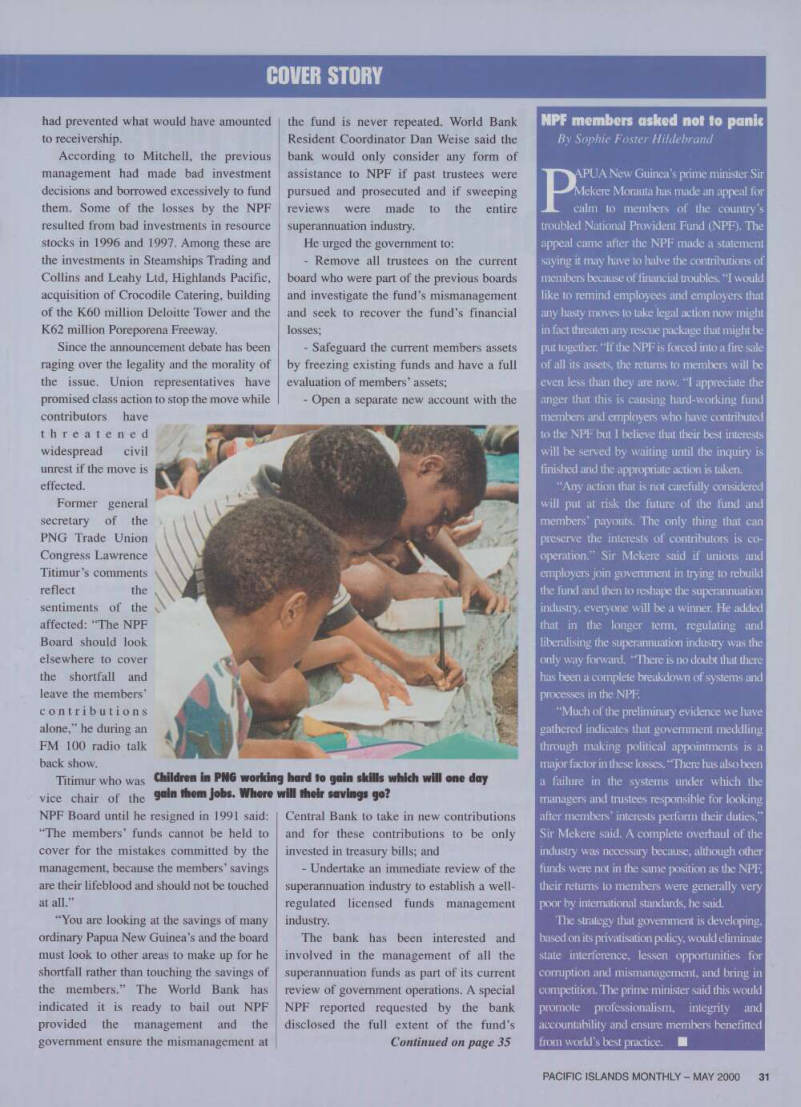
Children in PNG working hard to gain skills which will one day gain them jobs. Where will their sowings go?
financial position. The report found that: - The board and management prior to 1999 breached the Act in that they did not have the power to borrow funds and breached the fund rules which did not permit investment of money offshore; - The return on investment of the fund for the year ended 1999 was appalling but reflected the bad investment decisions of the management and board prior to 1999. - Until recently internal controls required to ensure efficient and effective functioning of the fund in all areas of operation were either non-existent or lacking; The current management has embarked on a debt reduction strategy through asset sales but the fund will not be cash positive or profitable in 2000. The World Bank suggested legislation be enacted to remove the potential for political interference and the chair and managing directors ought not
to be political appointees.
In response, Mitchell said that the NPF is prepared to meet the conditions set by the World Bank to rescue the Fund. And the government on its part has ordered an inquiry into the affairs of the Fund.
Sir Mekere has said that his government will do everything it can to help the Fund to lessen the impact of the fund’s losses on members.
He said his government understands the anger of the members and will work with the NP management to bring to justice those responsible for any illegality and impropriety and to see there is no repeat.
He said the inquiry is part of a wider government strategy to clean up and reform PNG’s superannuation industry. When the review is completed the government would table legislation to reform the sector, possibly as early as next month. He said the NPF inquiry would examine in detail the transactions that had caused financial losses
for the fund, identify failures in investment process that had caused the losses, and inquire into the actions of individuals involved in the transactions.
Individuals whom the Fund has requested for questioning over the affairs of the fund include Pangu Pati leader Chris Haiveta, former managing director Robert Kaul, former chairman of the board of trustees, David Copeland, and former deputy managing director Noel Wright.
Mitchell, who has specifically named these individuals, said Haiveta was the Minister for Finance when NPF invested in a number of business transactions in PNG and abroad. He said the office of the auditor general and the Finance department should also be questioned over their role.
Announcing the inquiry’s terms of reference Sir Mekere said preliminary investigations to assess the severity of the financial problems at NPF earlier in the year had shown evidence of deep financial trouble, possible illegality and impropriety, breaches of at least three acts, and a serious breakdown of accountability and the management, operating systems and processes with NPF.
“Most importantly,” he said, “our investigations raised concerns that government influence over the NPF has provided opportunities for what appears at first glance to be improper behaviour by public officials and government appointees and the people they have hired or used to provide advice and assistance.”
He has directed the Commissioners to provide a preliminary report on May 31 and a final report by July 13, 2000.
Meanwhile, the fund has put its proposed 50 percent cut to member’s contributions on hold until the National Court decides the legality of the move.
The court was expected to hand down its decision May 1. B