Consumers not protected
pp. 24-25 · Read in the full issue
from excesses of free trade
Lunch hour has arrived and John, a machinist with a motor shop in the heart of Port Moresby’s industrial area, could not wait to grab some food at a nearby fast-food outlet.
The outlet is amongst many others operated by
small-time expatriate
businessmen in the PNG capital’s main industrial area.
Although such businesses were legislated by the Government as reserved activities for Papua New Guineans only, expatriates seemed to have dominated the sector in recent years.
John bought two fried sausages, a pie and a soft drink. Being hungry, he did not pick up the foul smell of the sausages until he was about to throw in the last bit.
His stomach started to chum and sharp pains filled his insides.
Fuming, he marched to the store to get even with the owner. However, the owner refused to admit the sausages were bad although he knew they were leftover stock from the day before. He accused John of inventing the complaint.
John walked away defeated with an upset stomach that lasted several days. He found out too late that other consumers had had the same problem with the sausages.
That was in the early 80s.
If that situation had occurred today, it would have been an entirely different story.
And for that, thanks are due to the work of the South Pacific Consumer Pacific Programme in the South Pacific - a globally linked new social movement that is fast
emerging in the region.
As far as the SPCPP is concerned, John was a victim of an unscrupulous trader doing business in an unregulated market place with uninformed and naive consumers.
John’s right and that of other consumers to good quality, safe, and well-labelled goods at a fair price, and other consumer rights have been main thrust of the work of
SPCPP. Through the support of SPCPP, PNG established a Consumer Affairs Council in the early 90s, a body which John could have used to deal with the store owner.
The store owner could have been prosecuted as in the case of two expatriates running fast-food outlets in Port Moresby in March. Consumer Affairs Council officers paid a surprise visit to the outlet where they confiscated out-dated and rotten food following a complaint from consumers.
Although routine checks have always been carried out by the office, the March raid on the fast-food outlet and prosecution of its owners signals the beginning of a new chapter for consumers.
CAC is clamping down on unscrupulous traders, mainly small-time fast foot operators. With the government’s backing, CAC will establish 20 consumer associations throughout the country to help crack down on out-dated items being sold by shops and fast-food outlets in the country. The associations will be supervised by town authorities.
Puri Ruing, Vice Minister for Finance and Treasury and minister responsible for
the affairs of CAC said: “For far too long we did not have the means to express our rights. Through the consumer movements, we will encourage investors to be more competitive so that they provide the best for the people.”
Considering the recent arrests by CAC officers. Ruing said: “The government considers that for the country to develop, the consumer must be fit and healthy,” he said.
Ruing said: “Business and corporate communities must be responsible to deliver safe products to the
consumers. There must be a balance at all times, making sure that businesses do not get the better of the consumer.”
He said the country’s open market economy left consumers vulnerable to abuse.
This, he said, was where government had to intervene.
Ruing said: “The Government has a responsibility and is determined to safeguard and protect the interests of consumers in this country.”
The scope of SPCPP’s work involves a range of strategies to protect Pacific Island consumers from unscrupulous traders.
But SPCPP says there is still little knowledge of the impact of international trade on fragile Pacific Island economies and consumers.
SPCP said free trade, or marketplace liberalisation, without a basic consumer protection framework (of a consumer
protection law, appropriate regulations and
a state agency to enforce the law and educate and inform consumers) is a recipe for the loss of consumer rights.
It has pressed Pacific Island nations to enact consumer protection legislation with
Continued on next page
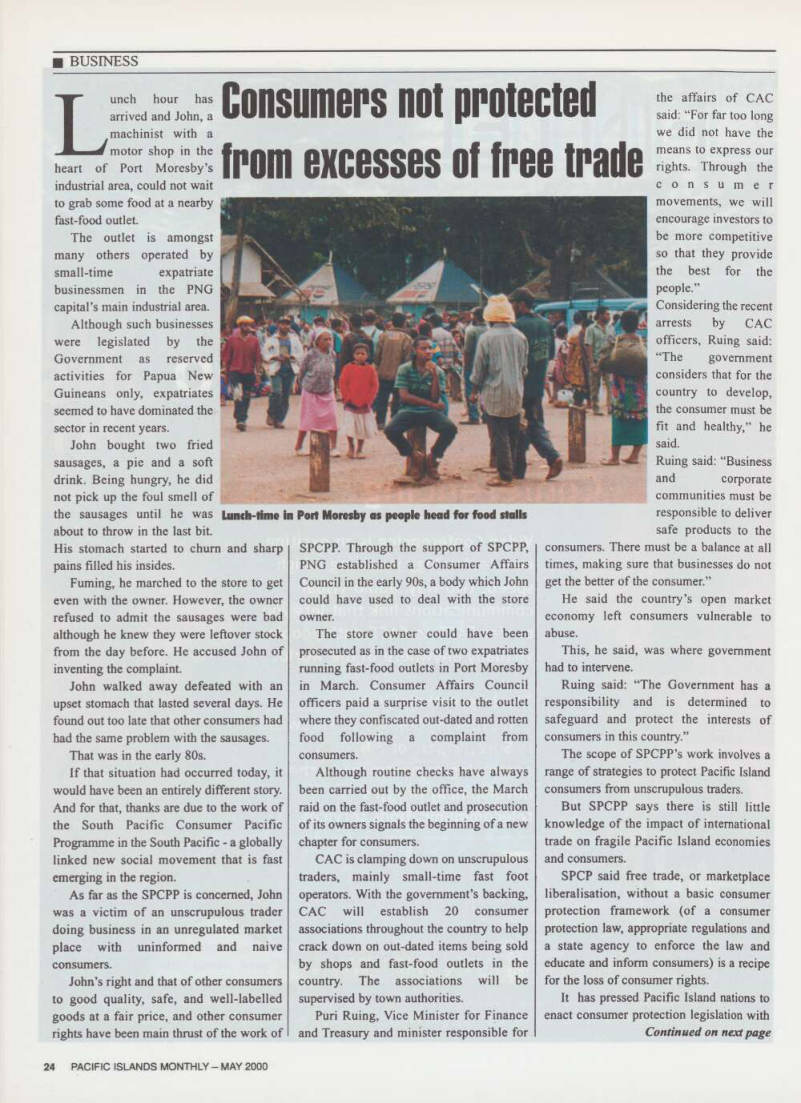
lunch-time in Port Moresby as people head for food stalls
Continued from previous page some success. Six Forum nations have enacted consumer laws in the last five years. However, 10 Pacific nations still have no consumer protection laws.
In 1992, the South Pacific Forum endorsed the United Nations Guidelines for Consumer Protection as the basis for consumer protection in the region.
The SPCPP then drafted a South Pacific Consumer Protection Convention and lobbied members of the South Pacific Forum to adopt the Convention to provide basic consumer protection for all nations in the region.
“Unfortunately support for the Convention has not been forthcoming and consumer rights have not been accorded a high priority. Pacific nations are now considering establishing a Free Trade Area without first protecting basic consumer rights,” SPCPP said.
It has argued that consumer rights must be protected through national laws (and a regional convention) if a free trade regime is to be established. Free trade, without adequate consumer protection measures will lead to greater marketplace abuses and a denial of consumer rights.
SPCPP said this position is in line with Consumers International’s request that the WTO set up formal mechanisms to protect consumers especially in the areas of transparency, food security, food safety, health, competition, services, investment and electronic commerce to ensure a fairer global marketplace.
“Some may argue that consumer rights and free trade are incompatible, however Consumers International’s long term objective is to secure a multilateral trading system that will support and encourage the development of consumer rights prior to further trade liberalisation,” SPCPP says.
It said Pacific Island nations are small players in the global economy and are easily ignored by large nations or trade blocs.
SPCPP said establishing a regional grouping to work together for common policies on trade has a compelling logic, but that logic is flawed if it does not also include enacting effective consumer protection legislation to shield Pacific Island consumers from the excesses of free trade. ■