Disney revives 'Pearl Harbor'
p. 19 · Read in the full issue
By Barry Markowitz
Tora! Tora! Tora!” was a major 1968 film re-creation of the 1941 attack on Pearl Harbor many industry insiders doubted would be restaged again.
That movie told the tale of events leading up to the infamous attack, from both a Japanese and American perspective.
If you excuse the choice of words, due to financial overruns and poor box office sales, it was a real bomb.
Disney felt that with its line-up of stars, modern day special effects, and a love triangle subplot, that a huge investment of US$l35 million would be a guaranteed box office success for its new movie entitled, “Pearl Harbor.”
On a rainy day this March, Academy Award winning actor Cuba Gooding, Jr. (“Jerry McGuire”, “Boyz N the Hood”), popular star Ben Affleck (“Reindeer Games”, “Shakespeare in Love”, “Armageddon”), Josh Hartnett, Kate Beckinsale and prominent director Michael Bay (“Armageddon” and “The Rock”) paid respects to Pearl Harbor attack victims by laying wreaths at the Pearl Harbor/USS Arizona Memorial, and met with media to
express their enthusiasm for Disney’s project which is to film through to the sixth of this month in Oahu, Hawaii.
Despite closed sets and an emphasis on secrecy, hundreds of interested Hawaii residents have taken position in and around Ford
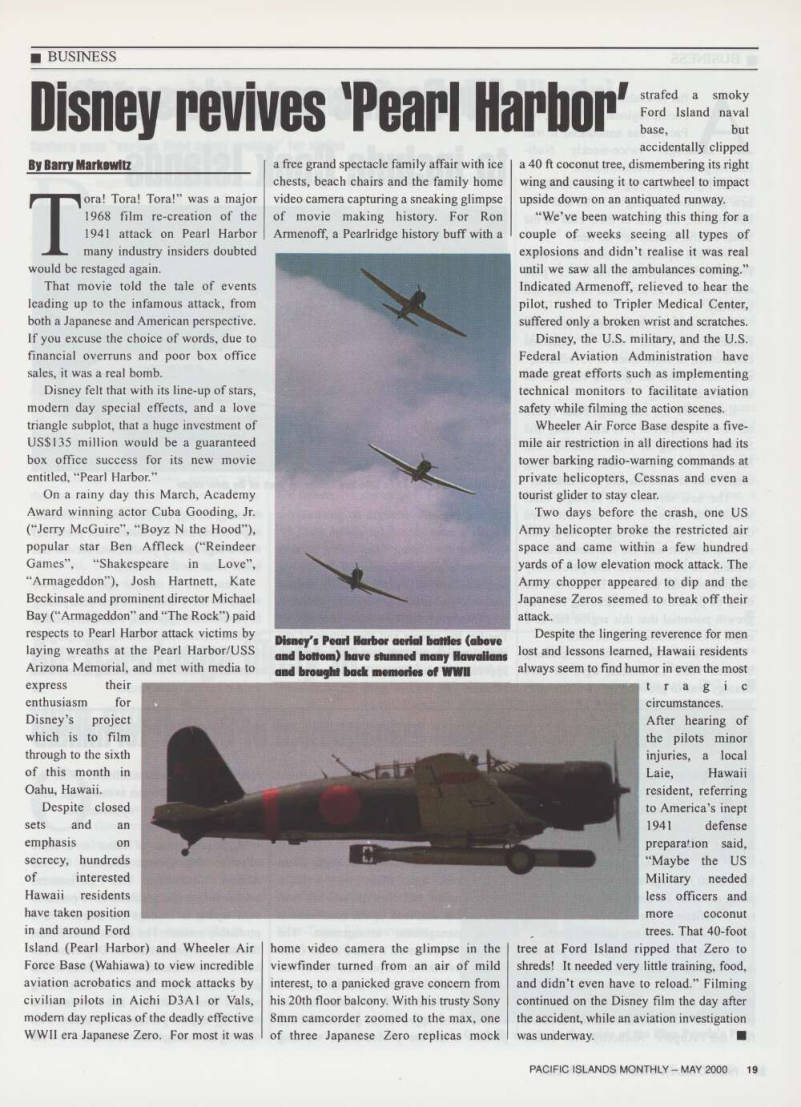
Island (Pearl Harbor) and Wheeler Air Force Base (Wahiawa) to view incredible aviation acrobatics and mock attacks by civilian pilots in Aichi D3AI or Vais, modem day replicas of the deadly effective WWII era Japanese Zero. For most it was
a free grand spectacle family affair with ice chests, beach chairs and the family home video camera capturing a sneaking glimpse of movie making history. For Ron Armenoff, a Pearlridge history buff with a
home video camera the glimpse in the viewfinder turned from an air of mild interest, to a panicked grave concern from his 20th floor balcony. With his trusty Sony Bmm camcorder zoomed to the max, one of three Japanese Zero replicas mock
strafed a smoky Ford Island naval base, but accidentally clipped
a 40 ft coconut tree, dismembering its right wing and causing it to cartwheel to impact upside down on an antiquated runway.
“We’ve been watching this thing for a couple of weeks seeing all types of explosions and didn’t realise it was real until we saw all the ambulances coming.”
Indicated Armenoff, relieved to hear the pilot, rushed to Tripler Medical Center, suffered only a broken wrist and scratches.
Disney, the U.S. military, and the U.S.
Federal Aviation Administration have made great efforts such as implementing technical monitors to facilitate aviation safety while filming the action scenes.
Wheeler Air Force Base despite a five mile air restriction in all directions had its tower barking radio-warning commands at private helicopters, Cessnas and even a tourist glider to stay clear.
Two days before the crash, one US Army helicopter broke the restricted air space and came within a few hundred yards of a low elevation mock attack. The Army chopper appeared to dip and the Japanese Zeros seemed to break off their attack.
Despite the lingering reverence for men lost and lessons learned, Hawaii residents always seem to find humor in even the most
tragic circumstances.
After hearing of the pilots minor injuries, a local Laie, Hawaii resident, referring to America’s inept 1941 defense preparation said, “Maybe the US Military needed less officers and more coconut trees. That 40-foot
tree at Ford Island ripped that Zero to shreds! It needed very little training, food, and didn’t even have to reload.” Filming continued on the Disney film the day after the accident, while an aviation investigation was underway. ■
Disney's Pearl Harbor aerial battles (above and bottom) have stunned many Hawaiians and brought back memories of WWII