Stray rocket crashes near Pitcairn
pp. 16-17 · Read in the full issue
By Michael Held
Maybe Boeing Aircraft
Corporation really do care
about the people of the South Pacific but when they lost a rocket recently, they seemed remarkably indifferent about where it came down.
A Boeing-backed corporation fired the rocket off a floating platform near Kiribati and soon after lost contact over French Polynesia.
Press statements followed explaining the accident - but at no point did they say where the rocket had come down. Four days later - and only after considerable prompting - did they confirm that in fact they very nearly whacked one of the most unusual communities on Earth, the 40 people of Pitcairn Island.
What happened underscored an American view that the Pacific is empty - that it’s okay to do anything they like. Sea Launch Limited Partnership is a tax haven company registered in the Cayman Islands and headquartered at Long Beach, California. Boeing owns 40 per cent. Its other shareholders are RSC Energia of Russia with 25 per cent and Yuzhnoye of Ukraine 15 percent. Kvaemer Maritime of Norway own the other 20 per cent They built a sophisticated command ship and converted an oil platform which was towed out from Long Beach to a point in international waters on the Equator at longitude 154 West, 340 kilometres south-east of Kiribati’s Kiritimati (Christmas) Atoll.
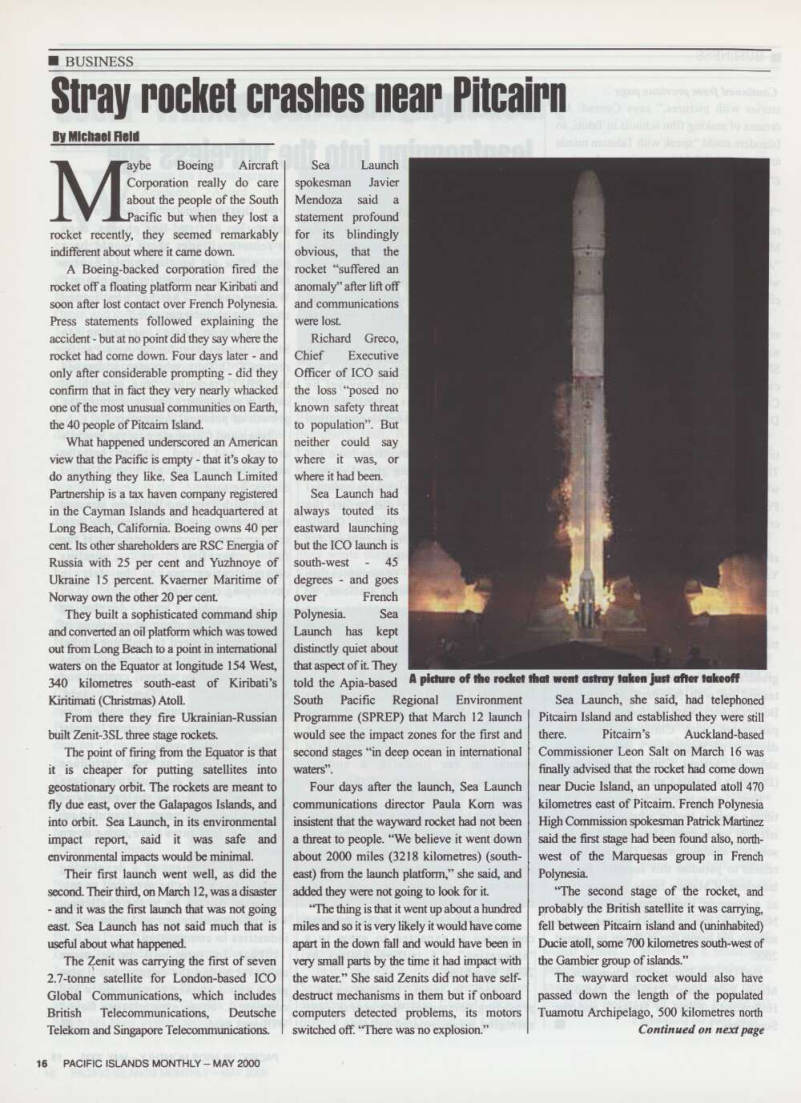
From there they fire Ukrainian-Russian built Zenit-3SL three stage rockets.
The point of firing from the Equator is that it is cheaper for putting satellites into geostationary orbit. The rockets are meant to fly due east, over the Galapagos Islands, and into orbit. Sea Launch, in its environmental impact report, said it was safe and environmental impacts would be minimal.
Their first launch went well, as did the second. Their third, on March 12, was a disaster - and it was the first launch that was not going east. Sea Launch has not said much that is useful about what happened.
The Zenit was carrying the first of seven 2.7-tonne satellite for London-based ICO Global Communications, which includes British Telecommunications, Deutsche Telekom and Singapore Telecommunications.
Sea Launch spokesman Javier Mendoza said a statement profound for its blindingly obvious, that the rocket “suffered an anomaly” after lift off and communications were lost Richard Greco, Chief Executive Officer of ICO said the loss “posed no known safety threat to population”. But neither could say where it was, or where it had been.
Sea Launch had always touted its eastward launching but the ICO launch is south-west - 45 degrees - and goes over French Polynesia. Sea Launch has kept distinctly quiet about that aspect of it. They told the Apia-based
South Pacific Regional Environment Programme (SPREP) that March 12 launch would see the impact zones for the first and second stages “in deep ocean in international waters”.
Four days after the launch, Sea Launch communications director Paula Kom was insistent that the wayward rocket had not been a threat to people. “We believe it went down about 2000 miles (3218 kilometres) (south east) from the launch platform,” she said, and added they were not going to look for it.
“The thing is that it went up about a hundred miles and so it is very likely it would have come apart in the down fall and would have been in very small parts by the time it had impact with the water.” She said Zenits did not have self destruct mechanisms in them but if onboard computers detected problems, its motors switched off. “There was no explosion.”
Sea Launch, she said, had telephoned Pitcairn Island and established they were still there. Pitcairn’s Auckland-based Commissioner Leon Salt on March 16 was finally advised that the rocket had come down near Ducie Island, an unpopulated atoll 470 kilometres east of Pitcairn. French Polynesia High Commission spokesman Patrick Martinez said die first stage had been found also, north west of the Marquesas group in French
Polynesia.
“The second stage of the rocket, and probably the British satellite it was carrying, fell between Pitcairn island and (uninhabited) Ducie atoll, some 700 kilometres south-west of the Gambier group of islands.”
The wayward rocket would also have passed down the length of the populated Tuamotu Archipelago, 500 kilometres north Continued on next page
A picture of the rocket that went astray taken just after takeoff
Continued from previous page east of French Polynesia’s capital, Papeete.
Ducie was ”a pretty desolate place” with only one form of vegetation and millions of birds. Salt said. Last June, a British yacht visiting the atoll was surprised to find an unmarked military Sea Hawk helicopter on the atoll. Although it was photographed there has been no explanation of whose helicopter it was or what it was doing there. The Pacific Forum has twice expressed concern over Sea Launch, and SPREP had a battle to get the Americans to take their concerns seriously.
Boeing’s Marcus Nance and Viola Brady had visited Kiribati and SPREP and told them that if it was not for the “obvious environmental and safety and other issues we could launch right on the beach” in California.
Nance told them launching from sea reduced the environmental effects.
“In Australia, for example, off Cape York, you get a lot of crocodiles. In the ocean you tend to have less of those life forms.”
He said they wanted to launch away from environmentally sensitive areas and said Kiribati was “resilient and relatively low in biological productivity, and far removed from sensitive coastal margins ... All the research we’ve done suggests there are not a lot of higher forms of life there. Fish tend to be in waters that are shallower.”
SPREP said the operation involves laigely untested technology with potential risks to the people and the environment.
“While the proponents could potentially reap significant economic gains from this proposal, there is little demonstrable benefit to Pacific island countries...
“Pacific island countries have taken the stance in regional and international fora that the Pacific should not be used as a dumping
ground.”
Even before this accident there have been concerns about the safety of the Zenit.
Designer Vassily Makarychev wrote in the
AeroSpace Journal last year that the Soviets had long toyed with a sea launch cosmodrome but for reasons he would not specify, never got beyond planning. Zenit, he said, never been fired from sea. It was 21st century technology.
“It is currently the only launch technology capable of accomplishing the vital mission of disposing radioactive wastes in outer space,”
Makarychev said. ■