Oscar-winner still Tahitian at heart
pp. 14-15 · Read in the full issue
By Ed Rampell
Winning the cinematography
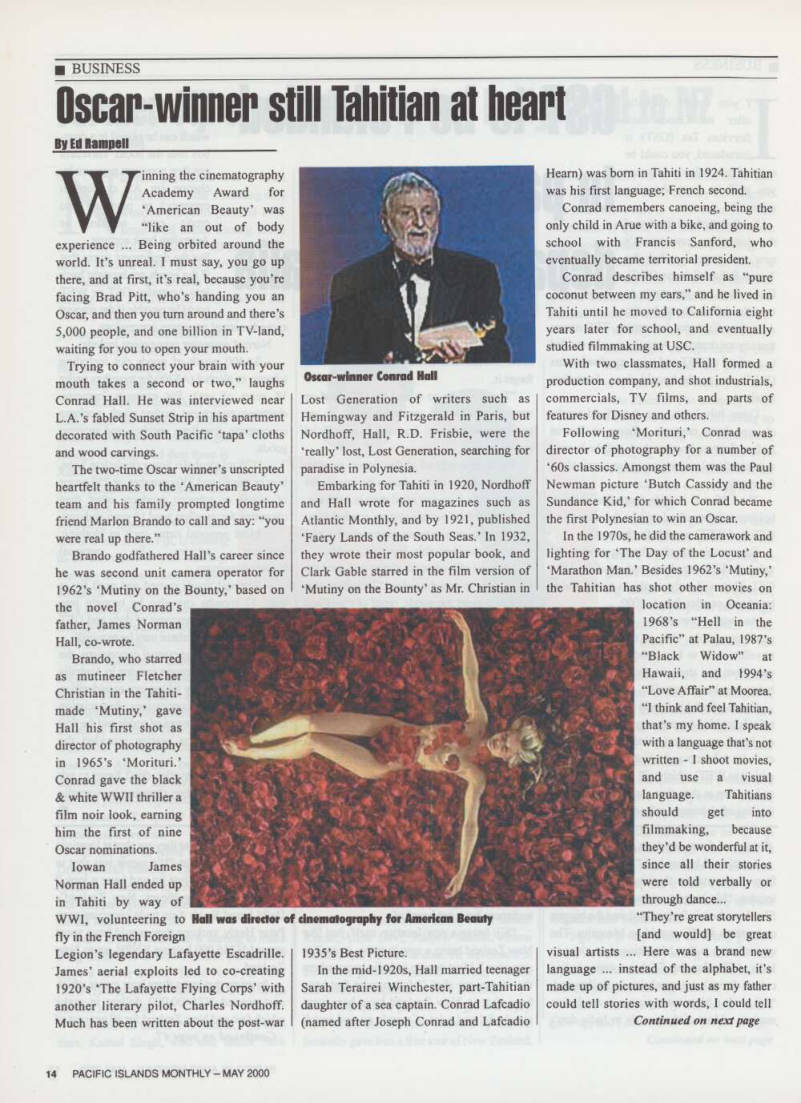
Academy Award for ‘American Beauty’ was “like an out of body experience ... Being orbited around the world. It’s unreal. I must say, you go up there, and at first, it’s real, because you’re facing Brad Pitt, who’s handing you an Oscar, and then you turn around and there’s 5,000 people, and one billion in TV-land, waiting for you to open your mouth.
Trying to connect your brain with your mouth takes a second or two,” laughs Conrad Hall. He was interviewed near L.A.’s fabled Sunset Strip in his apartment decorated with South Pacific ‘tapa’ cloths and wood carvings.
The two-time Oscar winner’s unscripted heartfelt thanks to the ‘American Beauty’ team and his family prompted longtime friend Marlon Brando to call and say; “you were real up there.”
Brando godfathered Hall’s career since he was second unit camera operator for 1962’s ‘Mutiny on the Bounty,’ based on
the novel Conrad’s father, James Norman Hall, co-wrote.
Brando, who starred as mutineer Fletcher Christian in the Tahiti made ‘Mutiny,’ gave Hall his first shot as director of photography in 1965’s ‘Morituri.’
Conrad gave the black & white WWII thriller a film noir look, earning him the first of nine Oscar nominations. lowan James Norman Hall ended up in Tahiti by way of WWI, volunteering to fly in the French Foreign
Legion’s legendary Lafayette Escadrille.
James’ aerial exploits led to co-creating 1920’s ‘The Lafayette Flying Corps’ with another literary pilot, Charles Nordhoff.
Much has been written about the post-war
Lost Generation of writers such as Hemingway and Fitzgerald in Paris, but Nordhoff, Hall, R.D. Frisbie, were the ‘really’ lost. Lost Generation, searching for paradise in Polynesia.
Embarking for Tahiti in 1920, Nordhoff and Hall wrote for magazines such as Atlantic Monthly, and by 1921, published ‘Faery Lands of the South Seas.’ In 1932, they wrote their most popular book, and Clark Gable starred in the film version of ‘Mutiny on the Bounty’ as Mr. Christian in
1935’s Best Picture.
In the mid-19205, Hall married teenager Sarah Terairei Winchester, part-Tahitian daughter of a sea captain. Conrad Lafcadio (named after Joseph Conrad and Lafcadio
Heam) was bom in Tahiti in 1924. Tahitian was his first language; French second.
Conrad remembers canoeing, being the only child in Arue with a bike, and going to school with Francis Sanford, who eventually became territorial president.
Conrad describes himself as “pure coconut between my ears,” and he lived in Tahiti until he moved to California eight years later for school, and eventually studied filmmaking at USC.
With two classmates, Hall formed a production company, and shot industrials, commercials, TV films, and parts of features for Disney and others.
Following ‘Morituri,’ Conrad was director of photography for a number of ‘6os classics. Amongst them was the Paul Newman picture ‘Butch Cassidy and the Sundance Kid,’ for which Conrad became the first Polynesian to win an Oscar.
In the 19705, he did the camerawork and lighting for ‘The Day of the Locust’ and ‘Marathon Man.’ Besides 1962’s ‘Mutiny,’ the Tahitian has shot other movies on
location in Oceania: 1968’s “Hell in the Pacific” at Palau, 1987’s “Black Widow” at Hawaii, and 1994’s “Love Affair” at Moorea.
“I think and feel Tahitian, that’s my home. I speak with a language that’s not written - I shoot movies, and use a visual language. Tahitians should get into filmmaking, because they’d be wonderful at it, since all their stories were told verbally or
through dance...
“They’re great storytellers [and would] be great
visual artists ... Here was a brand new language ... instead of the alphabet, it’s made up of pictures, and just as my father could tell stories with words, I could tell Continued on next page
Oscar-winner Conrad Hall
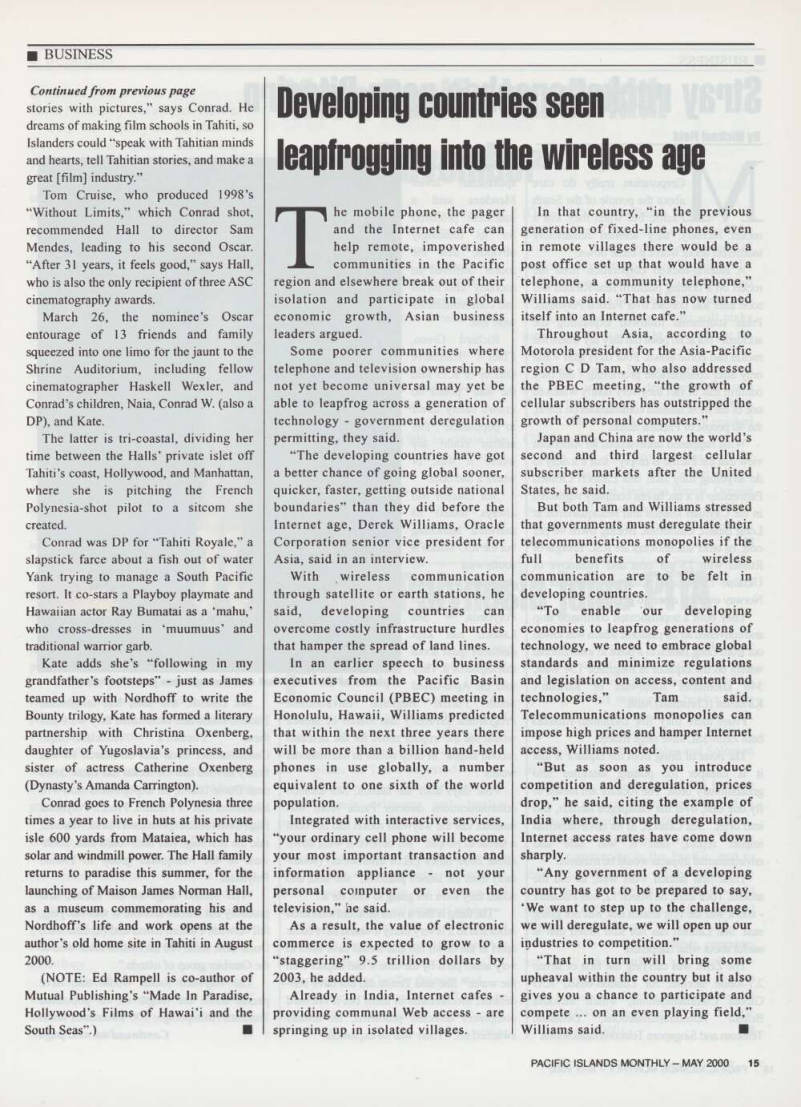
Hall was director of cinematography for American Beauty
Continued from previous page stories with pictures,” says Conrad. He dreams of making film schools in Tahiti, so Islanders could “speak with Tahitian minds and hearts, tell Tahitian stories, and make a great [film] industry.”
Tom Cruise, who produced 1998’s “Without Limits,” which Conrad shot, recommended Hall to director Sam Mendes, leading to his second Oscar.
“After 31 years, it feels good,” says Hall, who is also the only recipient of three ASC cinematography awards.
March 26, the nominee’s Oscar entourage of 13 friends and family squeezed into one limo for the jaunt to the Shrine Auditorium, including fellow cinematographer Haskell Wexler, and Conrad’s children, Naia, Conrad W. (also a DP), and Kate.
The latter is tri-coastal, dividing her time between the Halls’ private islet off Tahiti’s coast, Hollywood, and Manhattan, where she is pitching the French Polynesia-shot pilot to a sitcom she created.
Conrad was DP for “Tahiti Royale,” a slapstick farce about a fish out of water Yank trying to manage a South Pacific resort. It co-stars a Playboy playmate and Hawaiian actor Ray Bumatai as a ‘mahu,’ who cross-dresses in ‘muumuus’ and traditional warrior garb.
Kate adds she’s “following in my grandfather’s footsteps” - just as James teamed up with Nordhoff to write the Bounty trilogy, Kate has formed a literary partnership with Christina Oxenberg, daughter of Yugoslavia’s princess, and sister of actress Catherine Oxenberg (Dynasty’s Amanda Carrington).
Conrad goes to French Polynesia three times a year to live in huts at his private isle 600 yards from Mataiea, which has solar and windmill power. The Hall family returns to paradise this summer, for the launching of Maison James Norman Hall, as a museum commemorating his and Nordhoff’s life and work opens at the author’s old home site in Tahiti in August 2000. (NOTE: Ed Rampell is co-author of Mutual Publishing’s “Made In Paradise, Hollywood’s Films of Hawai’i and the South Seas”.) ■