The race card
Editorial
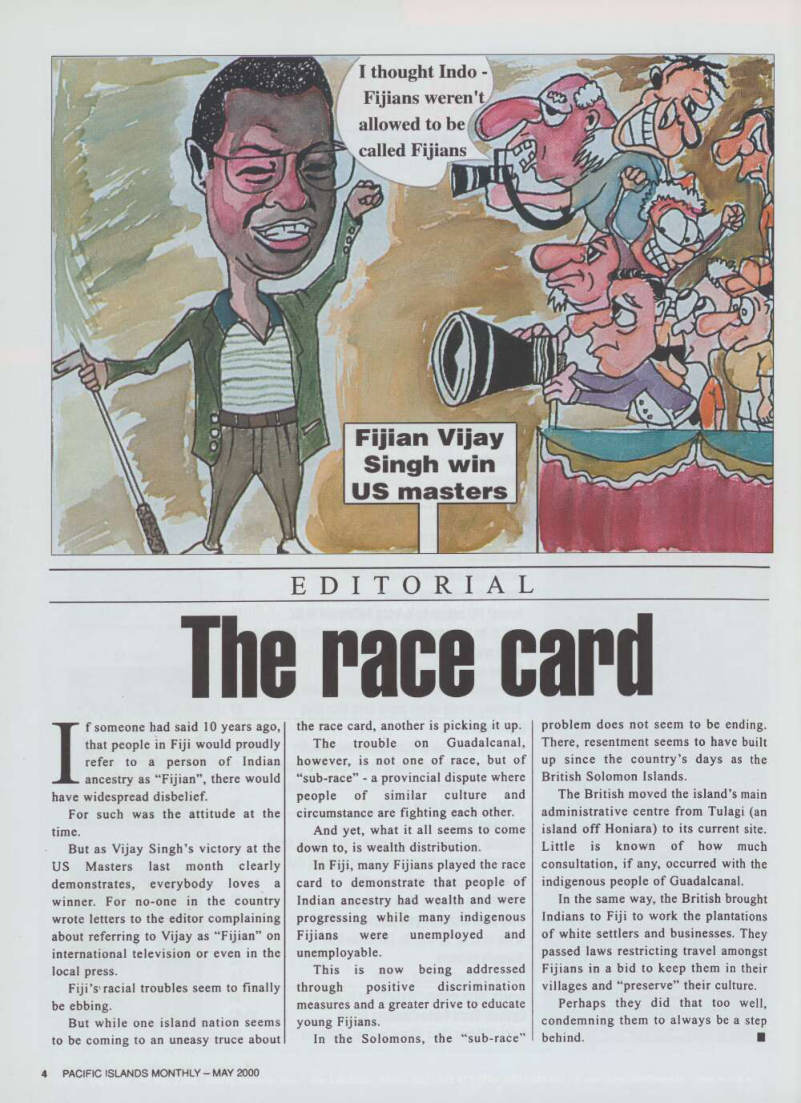
If someone had said 10 years ago, that people in Fiji would proudly refer to a person of Indian ancestry as “Fijian”, there would have widespread disbelief.
For such was the attitude at the time.
But as Vijay Singh’s victory at the US Masters last month clearly demonstrates, everybody loves a winner. For no-one in the country wrote letters to the editor complaining about referring to Vijay as “Fijian” on international television or even in the local press.
Fiji’s'racial troubles seem to finally
be ebbing.
But while one island nation seems to be coming to an uneasy truce about
the race card, another is picking it up.
The trouble on Guadalcanal, however, is not one of race, but of “sub-race” - a provincial dispute where people of similar culture and circumstance are fighting each other.
And yet, what it all seems to come down to, is wealth distribution.
In Fiji, many Fijians played the race card to demonstrate that people of Indian ancestry had wealth and were progressing while many indigenous
Fijians were unemployed and
unemployable.
This is now being addressed
through positive discrimination
measures and a greater drive to educate young Fijians.
In the Solomons, the “sub-race”
problem does not seem to be ending.
There, resentment seems to have built up since the country’s days as the British Solomon Islands.
The British moved the island’s main administrative centre from Tulagi (an island off Honiara) to its current site.
Little is known of how much consultation, if any, occurred with the
indigenous people of Guadalcanal.
In the same way, the British brought Indians to Fiji to work the plantations of white settlers and businesses. They passed laws restricting travel amongst Fijians in a bid to keep them in their villages and “preserve” their culture.
Perhaps they did that too well, condemning them to always be a step behind. ■