Coward’s crossing
pp. 54-55 · Read in the full issue
Yachting
Stories and Pictures by Sally Andrew
Americans and their weather windows exclaimed Kiwi friend Chris, eavesdropping on an exchange between cruisers.
All of us were puzzling over a weather fax posted outside Noumea’s marina office and wondering what the weather gods had in store. We wanted good conditions for sailing across the Coral Sea to Australia.
“Well, hey, Chris,” I protested in self defence. “I want and wait for good weather - a weather window - every time I put to sea. What’s wrong with that? You think I’m a coward or something?”
A few months later I found out the truth.
Waiting for a “weather window” could try one’s patience to the max. For 22 (yes, 22) days, we sheltered in tiny Eden on the southeast coast of New South Wales.
Fronts, with daily wind shifts from northwest to southwest and back again, marched across Bass Strait. Whenever a promising high materialised, it lived just long enough to squeeze through Bass Strait like a capricious pip - vaulting from the Bight into the Tasman, with no lingering to do us any favours.
Westward and southward-bound boats began piling up. Soon there were 20 of us, waiting for weather. Some stayed tied to the
dock, while others began doing the Twofold Bay Shuffle. Weather reports kept us on our toes, with winds constantly switching direction and increasing in intensity. But being anchored in Eden (midway between Wreck and Disaster Bays) was paradise compared to the alternative of bashing across Bass Strait.
(Jetting to Twofold Bay had been easy.
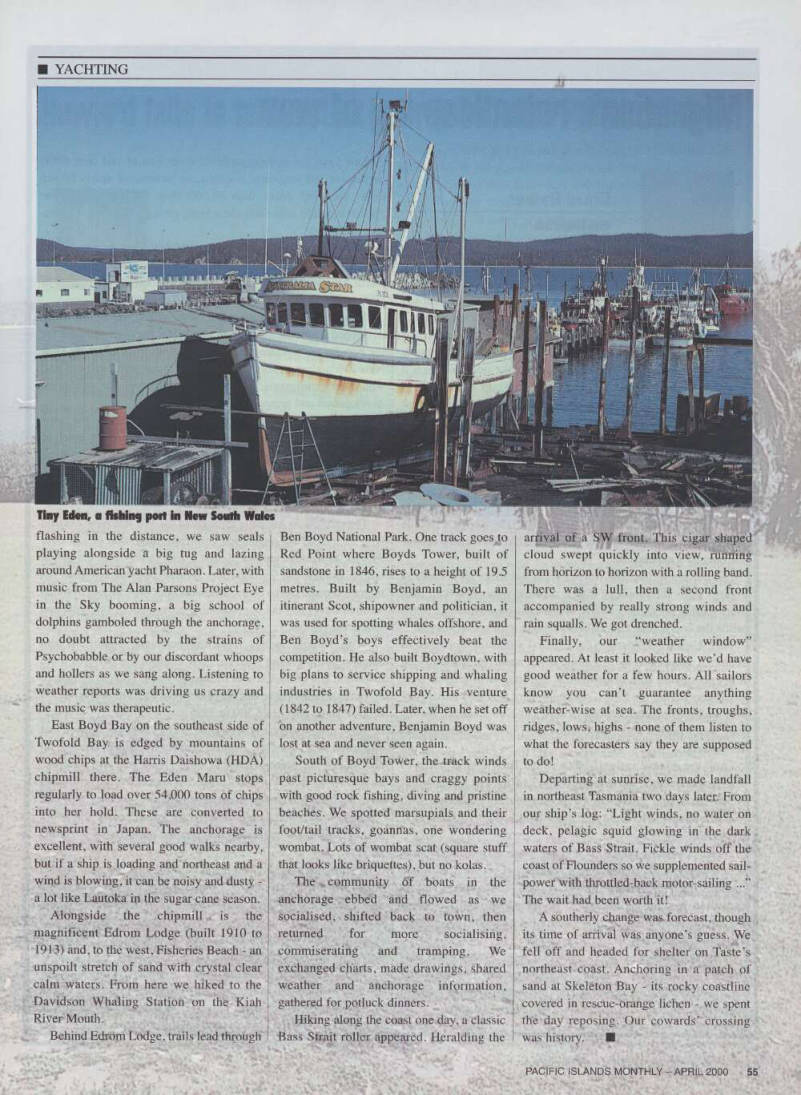
Fellowship sailed out of Sydney Harbour at sunset and had her hook down, in Eden, 36 hours later. The southbound East Australian Coast current was not as strong at this higher latitude but it helped. After anchoring, breakfasting, and catching up on lost sleep, we explored town.
Twofold Bay is a good deep water harbour with several anchorages of reasonable holding and depth. Eden Coastal Patrol heads up the welcoming committee, is a fountain of information ami offers showers to all visitors. The Fishermans Club offers showers too, and cheap meals.
In town, we found a newsagent, bank, post office, library, two grocery stores and a hotel. The public dock has water and rubbish facilities.
The skeleton of Old Tom, a remarkable killer whale and local hero - loved by the whalers because he used to herd sperm whales into the bay like a sheepdog - is kept at the Killer Whale Museum. Although Eden was once the centre of Australia’s whaling industry, by 1930, the whaling was closed.
Marine life abounds inside Twofold Bay.
On a flat and misty day with thunderstorms
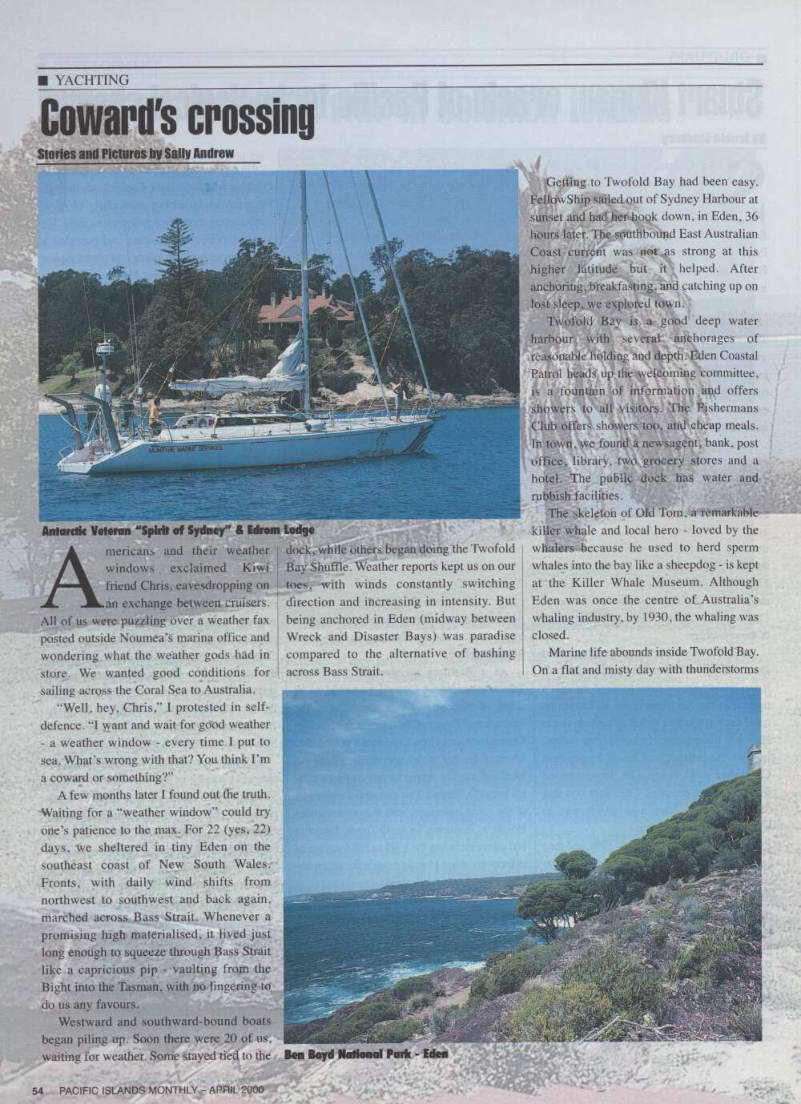
Antarctic Veteran "Spirit of Sydney" & Edrom lodge
Ben Boyd Notional Park-Eden
flashing in the distance, we saw seals playing alongside a big tug and lazing around American yacht Pharaon. Later, with music from The Alan Parsons Project Eye in the Sky booming, a big school of dolphins gamboled through the anchorage, no doubt attracted by the strains of Psychobabble or by our discordant whoops and hollers as we sang along. Listening to weather reports was driving us crazy and the music was therapeutic.
East Boyd Bay on the southeast side of Twofold Bay is edged by mountains of wood chips at the Harris Daishowa (HDA) chipmill there. The Eden Maru stops regularly to load over 54,000 tons of chips into her hold. These are converted to newsprint in Japan. The anchorage is excellent, with several good walks nearby, but if a ship is loading and northeast and a wind is blowing, it can be noisy and dusty a lot like Lautoka in the sugar cane season.
Alongside the chipmill is the magnificent Edrom Lodge (built 1910 to 1913) and, to the west, Fisheries Beach - an unspoilt stretch of sand with crystal clear calm waters. From here we hiked to the Davidson Whaling Station on the Kiah River Mouth.
Behind Edrom Lodge, trails lead through
Ben Boyd National Park. One track goes to Red Point where Boyds Tower, built of sandstone in 1846, rises to a height of 19.5 metres. Built by Benjamin Boyd, an itinerant Scot, shipowner and politician, it was used for spotting whales offshore, and Ben Boyd’s boys effectively beat the competition. He also built Boydtown, with big plans to service shipping and whaling industries in Twofold Bay. His venture (1842 to 1847) failed. Later, when he set off on another adventure, Benjamin Boyd was lost at sea and never seen again.
South of Boyd Tower, the track winds past picturesque bays and craggy points with good rock fishing, diving and pristine beaches. We spotted marsupials and their foot/tail tracks, goannas, one wondering wombat. Lots of wombat scat (square stuff that looks like briquettes), but no kolas.
The community of boats in the anchorage ebbed and flowed as we socialised, shifted back to town, then returned for more socialising, commiserating and tramping. We exchanged charts, made drawings, shared weather and anchorage information, gathered for potluck dinners.
Hiking along the coast one day, a classic Bass Strait roller appeared. Heralding the
arrival of a SW front. This cigar shaped cloud swept quickly into view, running from horizon to horizon with a rolling band.
There was a lull, then a second front accompanied by really strong winds and rain squalls. We got drenched.
Finally, our “weather window” appeared. At least it looked like we’d have good weather for a few hours. All sailors know you can’t guarantee anything weather-wise at sea. The fronts, troughs, ridges, lows, highs - none of them listen to what the forecasters say they are supposed to do!
Departing at sunrise, we made landfall in northeast Tasmania two days later. From our ship’s log: “Light winds, no water on deck, pelagic squid glowing in the dark waters of Bass Strait. Fickle winds off the coast of Flounders so we supplemented sail power with throttled-back motor-sailing ...”
The wait had been worth it!
A southerly change was forecast, though its time of arrival was anyone’s guess. We fell off and headed for shelter on Taste’s northeast coast. Anchoring in a patch of sand at Skeleton Bay - its rocky coastline covered in rescue-orange lichen - we spent the day reposing. Our cowards’ crossing was history. ■
Tiny Eden, a fishing port in New South Wales