Hokule'a's return: epic protocol schizophrenia
pp. 48-49 · Read in the full issue
Story and Pictures by Barry Markowitz
For the Hawaiian people, its been a matter of going retro to move forward. While most of the Pacific’s indigenous peoples were just on the verge of acquiring Western technology such as electricity, television, and telephone service to villages, and some aspects of foreign cultures (Western and Asian), Hawaii was launching the Hokule’a Polynesian voyaging canoe in 1975, a process to seek to restore lost culture, confirm Hawaiian’s ancient mariner prowess and to reach out to the unique sense of being Hawaiian.
The journeys have included impressive voyages through many of the Polynesian triangle’s island nations, such as Tahiti, the Marquesas, The Cook Islands, New Zealand, Samoa, American Samoa, and the Kingdom of Tonga. While island cultures within the “triangle” such as Wallis and Futuna, Nuie, Rotuma, and New Caledonia have yet to be visited, the Polynesian Voyaging Society (PVS) which is the managing entity for the Hokule’a concurred that the difficulty of the journey to Rapa Nui (a Territory of Chile) against unfavourable winds would answer many questions about the transmigration of
Pacific pioneers.
Hawaii’s US Senator Daniel Inouye said, “Hokule’a will continue forever because I am convinced it is so important to the culture here. For one thing, it has made Hawaiian
men and women stand taller, and made their hearts beat with pride. And this is what any people need, self esteem and pride.”
After a grueling eight- month 9000 mile journey of commitment and fortitude the Hokule’a arrived to an enthusiastic multicultural reception of 3000 people (including almost 100 former crew members) at the ancient voyaging port and spiritual center at Apua, Oahu (Hawaii) known to most as Kualoa Beach Park.
The arrival ceremonies consisted of several segments, the ho’okipa (disembarkation ceremonies including calls of greeting, chants, songs and dances), the ho’ola’a (serving of kava and ceremonial food), the ho’omaika’i (greetings by the host Hakipu’u Ghana, close friends and international delegations), the ho’okupu (offering of a symbolic gift to the ahu, a traditional altar), ka’i (procession to the formal programme), formal programme
(speeches by government dignitaries, and a
planting ceremony), and a joyful time of fun and dancing during the concluding ho’olaule’a.
The definitive moment that seemed to characterize the intended spirit of the ceremonies was the spontaneous long standing ovation given to the legendary Micronesian navigator Mau Piailug. It was as if the inner circle invited guests, the crew members, and those peering from outside
restraining fences became one to honor the man who preserved and passed down the lost art of Polynesian celestial navigation.
Reactions to the ceremonies were mixed, depending on what was the cultural orientation of the eyes that viewed the day’s events. Jackie Kaho’okele Burke, a Hawaiian and co-editor of The Hawaiian News said, “I was overjoyed that so many of our young people participated in the kava ceremony.
The ceremonies were so meaningful to us (Hawaiians).”
Senator Inouye, commented by shifting his perspective, to compare the Hawaiian kava ceremony at hand to the great humility and dignity he observed by Samoans in their American Samoa kava ceremonies. “I wish the Hawaiians could see how much the Samoan’s humbled themselves to recognize me, as one of their chiefs. I was given a title by American Samoan chiefs before they had elected representation to the US Congress.”
Old While Senator Inouye was praising Samoan adherence to traditional ways, some Samoans were fluctuating between emotions of anger and pity. “Eni (US Congressman, Faleomavaega Eni Hunkin), the Samoan, was the dark sheep. He wasn’t given any courtesy.” indicated former East/West Center fellow and Pacific Island specialist, Papaliitele Dr. Failautysi Avegalio referring to Faleomavaega’s chiefly status as well as his prominent elected position, not being recognized appropriately early on and not being served kava until near the end of the ceremony.
Maori and master waka (canoe) builder, Tom Rosa was excited about joining his Maori contigent for a haka, until Polynesian Voyaging Society security in red and yellow T-shirts demanded to see his invitation. Rosa indicated that he did not have one. He was informed he could not join his group. When asked what happened next Rosa said, “I knew I was supposed to be with my Maori people, I knew that our culture demands that we show respect at a time like this, so I simply ignored the security and walked past the metal restraining fence. Nobody bothered me after that.”
Continued next page
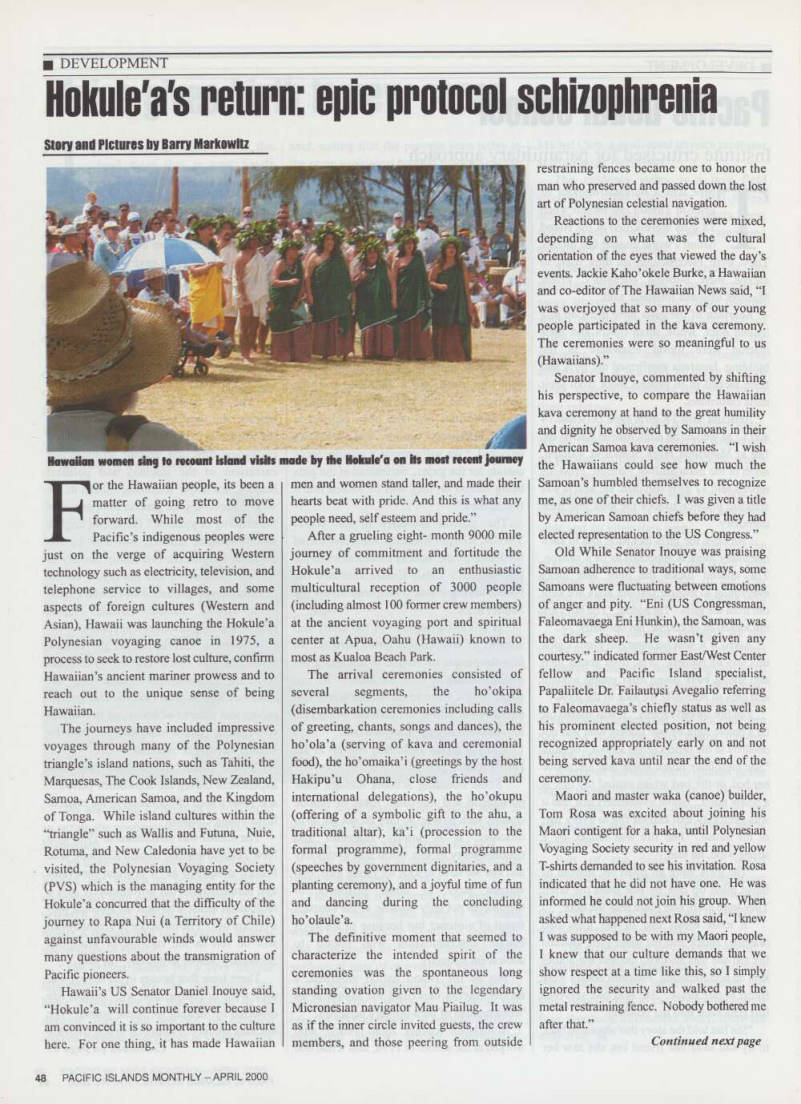
Hawaiian women sing to recount island visits made by the Hokule'a on its most recent journey
Continued from previous page
Several Samoans were similarly advised that they were not welcome to join the ceremony until Kupuna Ahi Logan (whose family has direct lineage to that Apua beach) told security “They are with me. Let them in here.” TV Samoa’s Albert Ainu’u struggled to shoot behind the designated media area because he had no special PVS media credentials. The last two arrivals of the Hokule’a (‘95 Kualoa, ‘97 Kahana Bay)
required no special credentials.
Elise Yadao, Executive Director of the Polynesian Voyaging Society attributed these confrontations to an overall misconception of the nature of the event. “The ceremony was not public, it was private. The Hokule’a is a physical manifestation of Hawaii’s spirituality” said traditional healer and youth adviser, Bula Logan, “For the Polynesian Voyaging Society to declare the arrival ceremonies a private gathering was an insult to Hawaiians of our district, and particularly to our kupuna. The protocol was more like the pageantry of a Waikiki tourist show. The PVS’s claim that they are bringing us together is a joke. Its all about money for them now.” Bula’s father Ahi, a traditional leader, revered for his generosity to Hawaiian causes and efforts to promote Hawaiian culture in Koolauloa, was never offered kava during the ceremony.
Tears came from one Hawaiian kupuna of the Big Island when the ahu built on the beach was immediately dismantled after the ceremonies. “The ceremony was poho (wasted). It was just dust, blown away by the wind. Everything they tried to do was undone. It was just an exercise for the media.
These people do not understand the depth of our Hawaiian culture.” This author video taped an unusual occurrence as Lincoln Siu, a ranking member of The Order of Kamehameha, being served food and having
it immediately pulled back by the server.
Papaliitele Dr. Failautusi Avegalio reflected the day after the ceremonies, “Protocol originating from outside the village or district cannot truly be Polynesian protocol. We as a Samoan group would not put our stones on the temporary ahu (altar) as did the others. We agreed that we would support our leader, Congressman Faleomavaega Eni Hunkin, by escorting him to the malae (staging area for the Formal Program). You do it on the malae once! So we waited ‘til everything else was finished. We made our speeches and offered our sacred stones (pohaku) of Samoa and American Samoa. Awkwardly we waited as no one replied to our presentation.
We waited, and we waited for a ranking person or orator. The lack of a reply, was a lack of respect.” Koolauloa resident and Maori, Bodie Campbell sympathised with the concerns. “I was with the Rapa Nui people at their special dinner the night before.
Even though I went to church on Sunday, instead of the Hokule’a arrival, after hearing about the problems I would say just one thing about the protocol...It must be from the heart.” Asked if any long term good came from the protocol errors, Bula Logan said, “The Hokule’a arrival ceremonies gave us
a good indication of the level we are at in the Hawaiian Renaissance...and yes we have much to set right. We cannot just wake up every Friday, call it Aloha Friday, wear an aloha shirt and think we are Hawaiians. We have to live and breath our culture every day like the Samoans, Tongans and Maori.
Nainoa Thompson and I will be meeting soon about this. He and all the crew members that have been to Tahiti, Marquesas, Tonga and Samoa know better.”
“It would be unheard for outsiders to arrive in any Samoan village and dictate protocol by committee and exclude people of the district from participating.” added Dr.
Avegalio who suggested a completely different approach for Hawaiians if they really want to make the most of their Hokule’a experience, leam proper protocol and return to their roots, “You cannot rebuild your culture upon sand, it must be restored upon bones, if I may use a metaphor. Some Hawaiian groups have based their very existence upon mission statements.. .you can argue with principles and mission statements...you cannot argue with bones or with one’s genealogy and lineage.
They need to strengthen ties and relationships, and to remind people that we all belong to one family.” ■
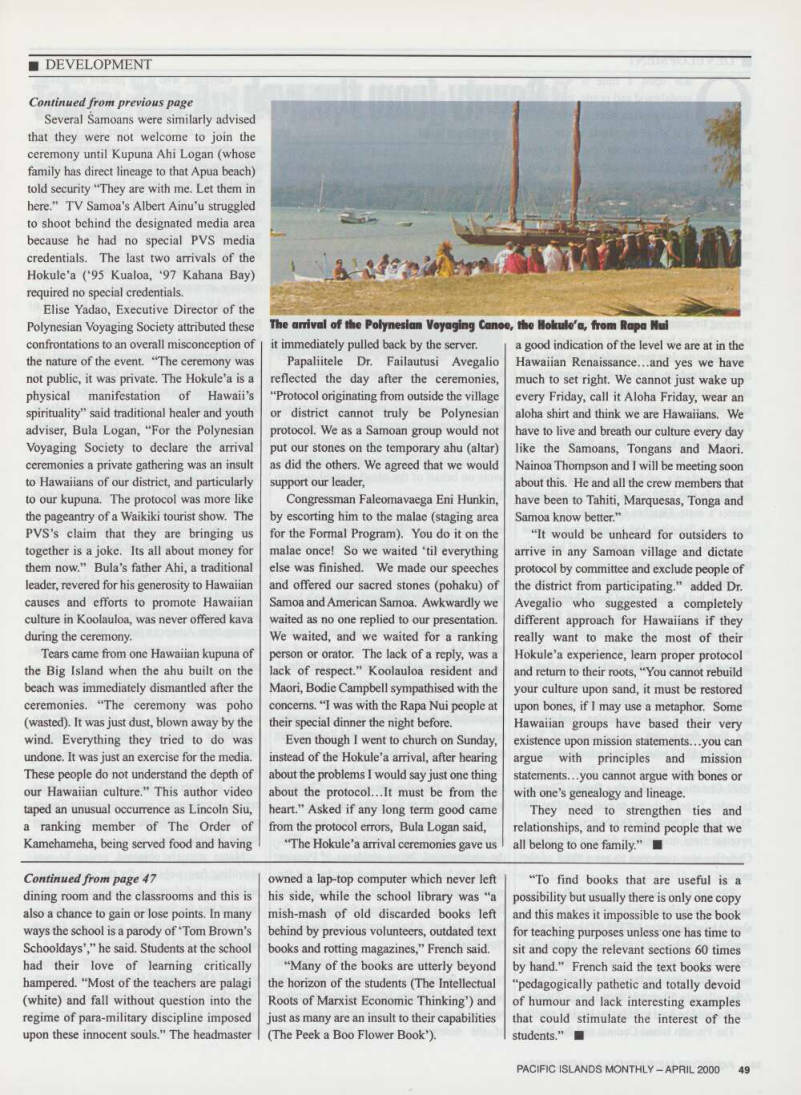
The arrival of the Polynesian Voyaging Canoe, the Hokule'a, from Rapa Nui