A fair deal for access to genetic resources
p. 42 · Read in the full issue
Senior representatives from 14
Pacific Island countries met in Fiji last month to discuss regional
guidelines for regulating the
access of local and overseas companies to the Pacific’s genetic resources and how to share the benefits arising from their use.
The week-long workshop in Nadi was jointly organised by the conservation organisation, WWF, the South Pacific Regional Environment Program (SPREP), the Foundation for International Environmental Law and Development (FIELD) and the Commonwealth Secretariat.
“Until now, when overseas companies have profited from the use of the Pacific’s genetic resources, few of the benefits have been returned to Pacific Islanders,” said Cedric Schuster of WWF. “Now Pacific Island governments want to secure their
rights through an appropriate legal and administrative framework that works for the whole region.”
Under the international Convention on Biological Diversity, CBD, (to which 14 Pacific Island countries have signed up), there are provisions aimed at ensuring the sustainable use of the Earth’s remaining genetic resources and the equitable sharing of benefits arising from their use.
Schuster said the Pacific has long been a region from which genetic resources have been extracted for analysis and profit making overseas but with little recourse to compensation by the often indigenous owners of the resources. He pointed to the case of kava, derived from the roots of a pepper plant and consumed as a drink throughout the Pacific for ceremonial and social purposes.
In recent years, European and
American pharmaceutical,
beverage and herb companies have developed a range of products from kava for the
treatment of stress, pain and sleeplessness, amongst other complaints. While farmers in the Pacific are receiving around SUSI per kilogram of kava root, it is reportedly selling on the European and American markets for up to $22 per kilogram. There is no evidence of these profits returning to the Pacific.
Participants at the workshop exchanged their experiences of how genetic resources have been accessed in their countries, suggest edways to share the benefits more fairly, and discussed ways to improve training of local people in adding value to local genetic resources.
The workshop emphasised formalising a set of access and benefit sharing guidelines for national legislation in the region so that there is no competition between Pacific Island countries with significant plant, animal and microbial species in common.
The meeting also provided a forum for Pacific Island countries to prepare as a region for the upcoming fifth conference of parties to the Convention on Biological Diversity to be held in Nairobi, Kenya in next month. Issues of concern to the Pacific at the CBD meeting include: • Access and benefit sharing; • Protection of traditional knowledge; • Financing the implementation of National Biodiversity Strategy Action Plans; and • Marine and coastal biodiversity programs and sustainable use of biodiversity.
The 14 countries represented at the Nadi meeting were: Federated States of Micronesia; Marshall Islands; Palau; Kiribati; Tuvalu; Nauru; PNG; Vanuatu; Solomon Islands; Fiji; Samoa; Cook Islands; Tonga; and Niue. ■
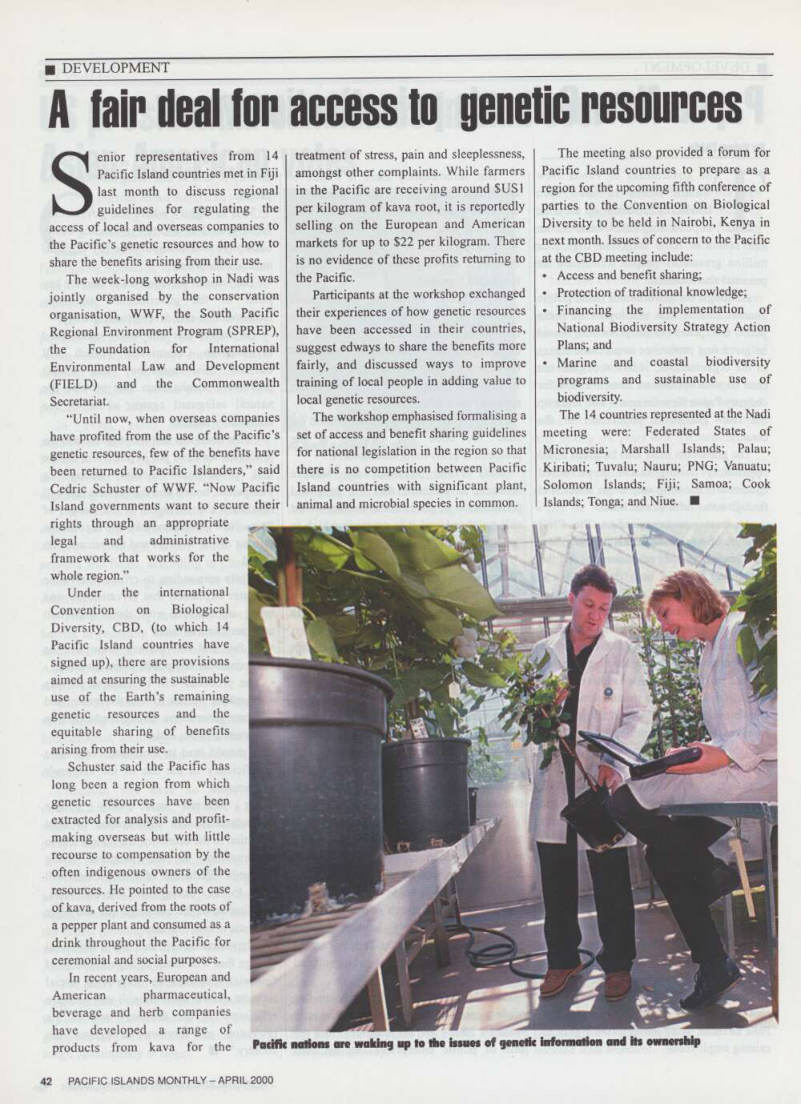
Pacific nations are waking up to the issues of genetic information and its ownership