US presidential candidates in bind over
p. 40 · Read in the full issue
Asian-American votes
Courting Asian-American votes is proving tricky business for US presidential candidates who are tripping up this year over fundraising scandals, racial slurs and the tough task of targeting the diverse community.
The Democrats’ minority-friendly policies give the party an edge among Asian-Americans, whose numbers have doubled since 1970 and are expected to reach 20 million - or six per cent of the population - by 2020.
In 1996, many Asian-Americans abandoned the Republican party to back President Bill Clinton, nearly doubling their turnout from four years earlier and organizing as never before.
The move was triggered by Republican efforts to limit immigration and bar children of illegal aliens from public schools and funds, according to Christine Chen with the Organization of Chinese Americans.
“The community saw those laws as a barrier to reuniting their families,” Chen said, noting that the growing number of Asian-American politicians have also been mostly Democrats.
But today Asian-Americans are equally split among Republicans, Democrats and Independents, according to Karen Narasaki with the National Asian Pacific Legal Center.
“Because you have so many new citizens and new voters, you have a large segment that doesn’t identify with any party,” she said.
And they are hardly a homogenous bloc.
Asian-Americans have the highest percentage of incomes of 75,000 or more slightly ahead of whites - but they are also the fastest growing group living in poverty, according to the new report “The State of Asian Pacific America.”
The study by an academic consortium, which includes the University of California in Los Angeles, also counted some 30 Asian groups in the United States, making them a tough constituency to target.
The largest concentration of Asian- Americans is in California, a gold mine for the presidential nominating delegates where all the White House hopefuls have been campaigning ahead of the state’s March 7 primary.
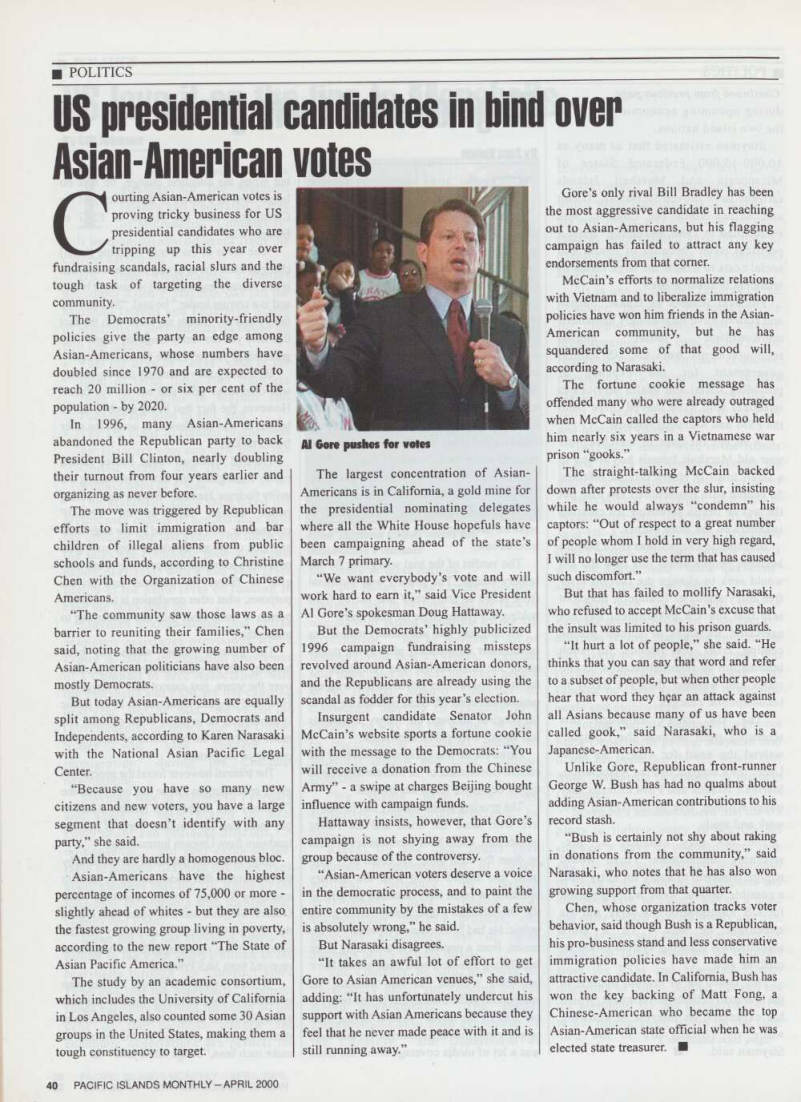
“We want everybody’s vote and will work hard to earn it,” said Vice President
A 1 Gore’s spokesman Doug Hattaway.
But the Democrats’ highly publicized 1996 campaign fundraising missteps revolved around Asian-American donors, and the Republicans are already using the scandal as fodder for this year’s election.
Insurgent candidate Senator John McCain’s website sports a fortune cookie with the message to the Democrats: “You will receive a donation from the Chinese Army” - a swipe at charges Beijing bought influence with campaign funds.
Hattaway insists, however, that Gore’s campaign is not shying away from the group because of the controversy.
“Asian-American voters deserve a voice in the democratic process, and to paint the entire community by the mistakes of a few is absolutely wrong,” he said.
But Narasaki disagrees.
“It takes an awful lot of effort to get Gore to Asian American venues,” she said, adding: “It has unfortunately undercut his support with Asian Americans because they feel that he never made peace with it and is still running away.”
Gore’s only rival Bill Bradley has been the most aggressive candidate in reaching out to Asian-Americans, but his flagging campaign has failed to attract any key endorsements from that comer.
McCain’s efforts to normalize relations with Vietnam and to liberalize immigration policies have won him friends in the Asian- American community, but he has squandered some of that good will, according to Narasaki.
The fortune cookie message has offended many who were already outraged when McCain called the captors who held him nearly six years in a Vietnamese war prison “gooks.”
The straight-talking McCain backed down after protests over the slur, insisting while he would always “condemn” his captors: “Out of respect to a great number of people whom I hold in very high regard, I will no longer use the term that has caused such discomfort.”
But that has failed to mollify Narasaki, who refused to accept McCain’s excuse that the insult was limited to his prison guards.
“It hurt a lot of people,” she said. “He thinks that you can say that word and refer to a subset of people, but when other people hear that word they h?ar an attack against all Asians because many of us have been called gook,” said Narasaki, who is a
Japanese-American.
Unlike Gore, Republican front-runner George W. Bush has had no qualms about adding Asian-American contributions to his record stash.
“Bush is certainly not shy about raking in donations from the community,” said Narasaki, who notes that he has also won growing support from that quarter.
Chen, whose organization tracks voter behavior, said though Bush is a Republican, his pro-business stand and less conservative immigration policies have made him an attractive candidate. In California, Bush has won the key backing of Matt Fong, a Chinese-American who became the top Asian-American state official when he was elected state treasurer. ■
Al Gore pushes for votes