Lessons from a tragedy in paradise
Editorial
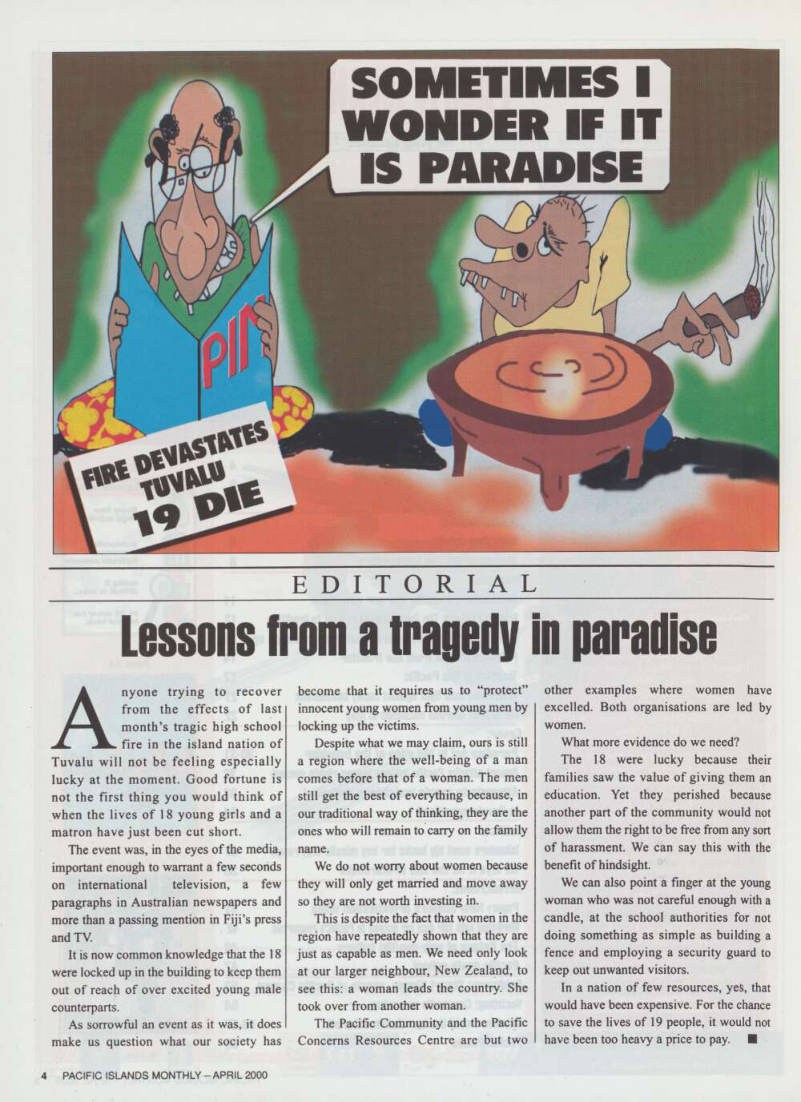
Anyone trying to recover from the effects of last month’s tragic high school fire in the island nation of Tuvalu will not be feeling especially lucky at the moment. Good fortune is not the first thing you would think of when the lives of 18 young girls and a matron have just been cut short.
The event was, in the eyes of the media, important enough to warrant a few seconds on international television, a few paragraphs in Australian newspapers and more than a passing mention in Fiji’s press and TV.
It is now common knowledge that the 18 were locked up in the building to keep them out of reach of over excited young male counterparts.
As sorrowful an event as it was, it does make us question what our society has
become that it requires us to “protect” innocent young women from young men by locking up the victims.
Despite what we may claim, ours is still a region where the well-being of a man comes before that of a woman. The men still get the best of everything because, in our traditional way of thinking, they are the ones who will remain to carry on the family name.
We do not worry about women because they will only get married and move away so they are not worth investing in.
This is despite the fact that women in the region have repeatedly shown that they are just as capable as men. We need only look at our larger neighbour, New Zealand, to see this: a woman leads the country. She took over from another woman.
The Pacific Community and the Pacific Concerns Resources Centre are but two
other examples where women have excelled. Both organisations are led by women.
What more evidence do we need?
The 18 were lucky because their families saw the value of giving them an education. Yet they perished because another part of the community would not allow them the right to be free from any sort of harassment. We can say this with the benefit of hindsight.
We can also point a finger at the young woman who was not careful enough with a candle, at the school authorities for not doing something as simple as building a fence and employing a security guard to keep out unwanted visitors.
In a nation of few resources, yes, that would have been expensive. For the chance to save the lives of 19 people, it would not have been too heavy a price to pay. ■