Kiribati faces AIDS threat
p. 45 · Read in the full issue
Kiribati - the tiny South Pacific nation that was the centre of world attention as the first place to greet the new millennium - is facing an AIDS crisis, according to a report for a UN agency.
The Institute of Justice and Applied Legal Studies, a Suva, Fiji-based agency, said in a report prepared for the UN Development Programme that the prevalence of AIDS in Kiribati was
“exceptionally” high.
The institute said that in May 1999 there were 28 cases of HIV infection in Kiribati.
HIV is the virus which causes AIDS.
Nineteen of the 28 cases were men.
The institute estimates that for every reported case of AIDS, there are up to 10 people who are infected but who either don’t know it or have not been diagnosed.
Based on that assumption, the report said the rate of AIDS in Kiribati is on par with AIDS rates in some countries in hard-hit Africa.
It appeared the virus was being spread by some of the more than 2000 Kiribati men who work as seamen aboard foreign ships, the country’s biggest sector of private
employment.
One third of the men infected were seamen, while all of the women infected are married to seamen, the report said.
Swift and decisive action, including new laws to prosecute people who knowingly spread the disease, is urgently needed to stop the infection rate increasing further, the report said.
The wives of seamen were at special risk and should be targeted with appropriate education. Seamen should be subject to mandatory AIDS testing, the report recommended.
Compounding the problem is high
density living, which makes transmission easier, the report said. About 20,000 of Kiribati’s 80,000 population live at one end of the horseshoe-shaped atoll Tarawa The rest of the Micronesian country’s population is spread over Kiribati’s 33
islands and atolls stretching across 3.3 million square km of ocean, just west of the international dateline.
A report published by the UN at the end of 1995 said the 22 countries making up the South Pacific region were lightly affected
by AIDS.
But the report warned that the region
faced a high risk that the disease would spread rapidly unless governments introduced education campaigns and other measures.
The report warned that some island nations would become seriously depopulated if AIDS broke out.
AP
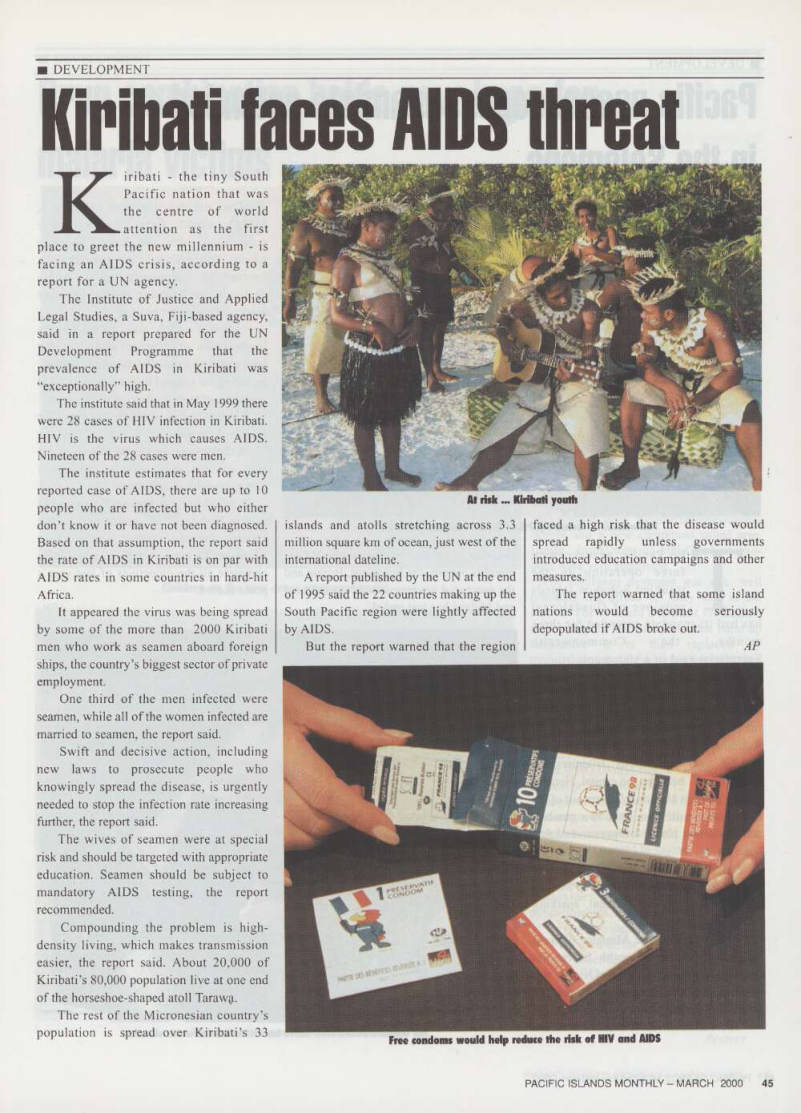
At risk ... Kiribati youth
Free condoms would help reduce the risk of HIV and AIDS