Pilot error may have caused Fiji's worst crash
p. 44 · Read in the full issue
A pilot who had taken a
powerful sedative
antihistamine drug was officially blamed for the crash of an Air Fiji plane last year which left 17 people dead. “It was established that the pilot in command had insufficient rest prior to the flight and had taken medication which may have further degraded his ability to safely pilot the aircraft,” the report by two investigators from the Australian Transport Safety Bureau said.
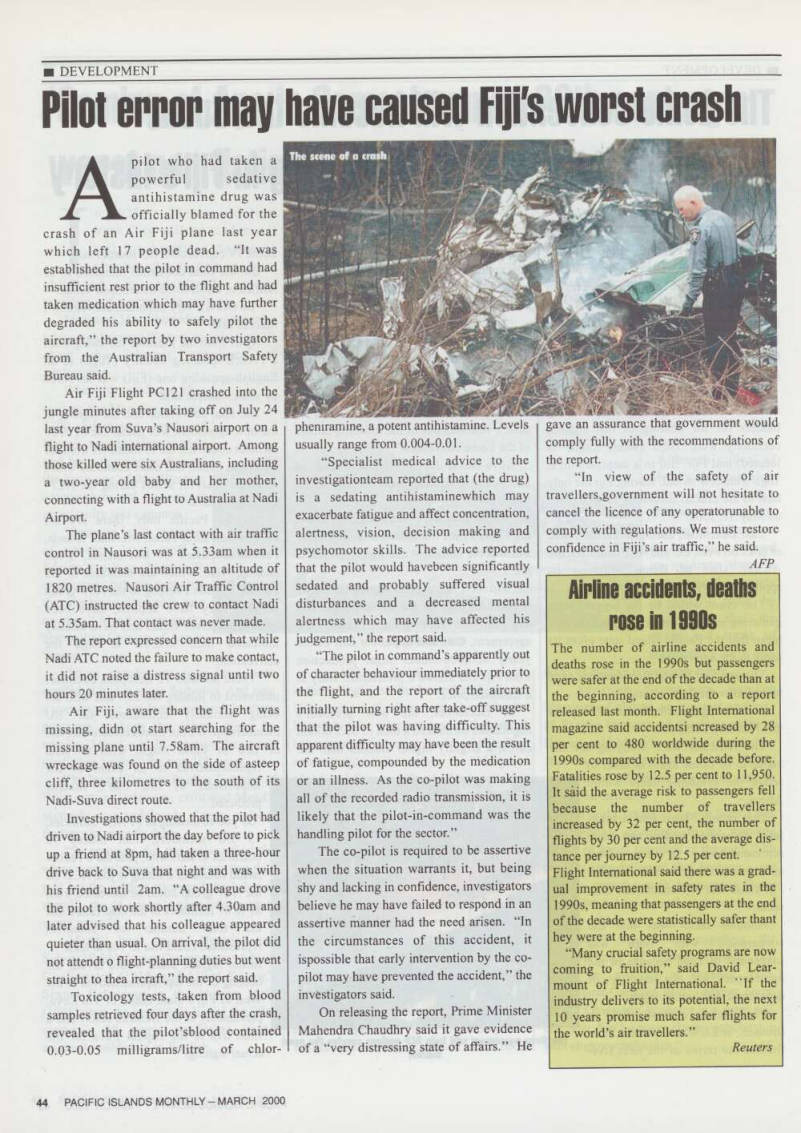
Air Fiji Flight PCI2I crashed into the jungle minutes after taking off on July 24 last year from Suva’s Nausori airport on a flight to Nadi international airport. Among those killed were six Australians, including a two-year old baby and her mother, connecting with a flight to Australia at Nadi Airport.
The plane’s last contact with air traffic control in Nausori was at 5.33 am when it reported it was maintaining an altitude of 1820 metres. Nausori Air Traffic Control (ATC) instructed the crew to contact Nadi at 5.35 am. That contact was never made.
The report expressed concern that while Nadi ATC noted the failure to make contact, it did not raise a distress signal until two hours 20 minutes later.
Air Fiji, aware that the flight was missing, didn ot start searching for the missing plane until 7.58 am. The aircraft wreckage was found on the side of asteep cliff, three kilometres to the south of its Nadi-Suva direct route.
Investigations showed that the pilot had driven to Nadi airport the day before to pick up a friend at Bpm, had taken a three-hour drive back to Suva that night and was with his friend until 2am. “A colleague drove the pilot to work shortly after 4.30 am and later advised that his colleague appeared quieter than usual. On arrival, the pilot did not attendt o flight-planning duties but went straight to thea ircraft,” the report said.
Toxicology tests, taken from blood samples retrieved four days after the crash, revealed that the pilot’sblood contained 0.03-0.05 milligrams/litre of chlor-
phemramine, a potent antihistamine. Levels usually range from 0.004-0.01.
“Specialist medical advice to the investigationteam reported that (the drug) is a sedating antihistaminewhich may exacerbate fatigue and affect concentration, alertness, vision, decision making and psychomotor skills. The advice reported that the pilot would havebeen significantly sedated and probably suffered visual disturbances and a decreased mental alertness which may have affected his judgement,” the report said.
“The pilot in command’s apparently out of character behaviour immediately prior to the flight, and the report of the aircraft initially turning right after take-off suggest that the pilot was having difficulty. This apparent difficulty may have been the result of fatigue, compounded by the medication or an illness. As the co-pilot was making all of the recorded radio transmission, it is likely that the pilot-in-command was the handling pilot for the sector.”
The co-pilot is required to be assertive when the situation warrants it, but being shy and lacking in confidence, investigators believe he may have failed to respond in an assertive manner had the need arisen. “In the circumstances of this accident, it ispossible that early intervention by the co pilot may have prevented the accident,” the
investigators said.
On releasing the report, Prime Minister Mahendra Chaudhry said it gave evidence of a “very distressing state of affairs.” He
gave an assurance that government would comply fully with the recommendations of the report.
“In view of the safety of air travellers,government will not hesitate to cancel the licence of any operatorunable to comply with regulations. We must restore confidence in Fiji’s air traffic,” he said.