Ell and former AGP colonies conclude new treaty
p. 20 · Read in the full issue
After a year of stormy negotiations, the European Union and its 71 former Africa, Caribbean and Pacific (AGP) colonies wraped up a convention projecting their trade and aid ties well into the 21 st century.
Two new developments marked the two day meeting.
Cuba asked for AGP membership, a request heartily supported by the AGP but which still needs EU approval, likely since Cuba is already receiving substantial EU aid.
And Togo, under EU fire over human rights and the rule of law, abruptly withdrew its bid to host the May 31 treaty signing ceremony, which passed to the only other candidate, Fiji.
As a result, the new convention, to replace the five-year-old Lome IV pact, will not be called Lome V as planned, but Suva I instead.
The main sticking point to an accord, said an EU source, was agreement on the readmission of AGP nationals in transit, a sub-question in the global convention article on migration.
“The EU justice and home affairs ministers in December adopted a standard clause which should be in all our conventions with third countries and that is the basis for the EU position,” he said.
“It concerns not only nationals of the third countries, but stateless people and people in transit living in third countries.”
The problem would arise, for example, when a national of Rwanda boards a plane in Tanzania for an EU country, where he is denied admission and sent back.
Where does the EU country send him?
The EU holds that in such case it would be Tanzania’s duty to take back the immigrant, national or not, because he departed from its territory.
The ACP does not accept that, claiming the system poses an undue financial burden on countries that can ill afford it. It wants such questions dealt with on a bilateral basis between the EU and the ACP countries concerned.
In other matters of migration, said the EU source, the AGP is digging in its heels because “it objects to having obligations imposed on it that the EU does not even impose on itself.”
Another point of divergence still be be sorted out was the question of trade preferences for the poorest AGP countries during the eight-year transition in which the AGP is to adopt standards of the World Trade Organization (WTO).
If the poorest nations are accorded special access to EU markets, the rest are likely to claim discrimination and demand equal treatment.
EU-ACP commerce is based on a system of unilateral trade preferences accorded by the EU in the form of total or partial
exemption of customs duties on AGP
products.
And a final sticking point was the length of the new convention itself. The AGP wants it to run for 30 years, the EU wants 15.
In the end both groups agreed on a 20year compromise.
A breakthrough on the most fundamental treaty problems came in
December when the EU gave up its insistence on changing the elusive concept of “good governance” from a “fundamental element” to an “essential element” of the treaty.
As an essential element equal in weight with human rights, democracy and the rule of law - violation can result in suspension of EU aid and cooperation.
Violation of a fundamental element essentially brings a slap on the wrist from the EU.
Good governance - the efficiency with which a country runs itself - has become diplomatic language for the elimination
of high-level corruption that plagues many developing countries.
The AGP saw this as too broad, capable of embracing anything from petty theft by a clerk to embezzlement of millions of euros by a government minister.
In December, both sides agreed on “a combined commitment to good governance,” and that suspension of EU aid would be limited to “serious cases of corruption.”
Agreement must be reached as well on EU aid to the AGP over the next five years.
The EU has proposed 13.5 billion euros in addition to nine billion in unpaid credits. The AGP, which includes 38 of the world’s poorest countries, wants 14.6 billion.
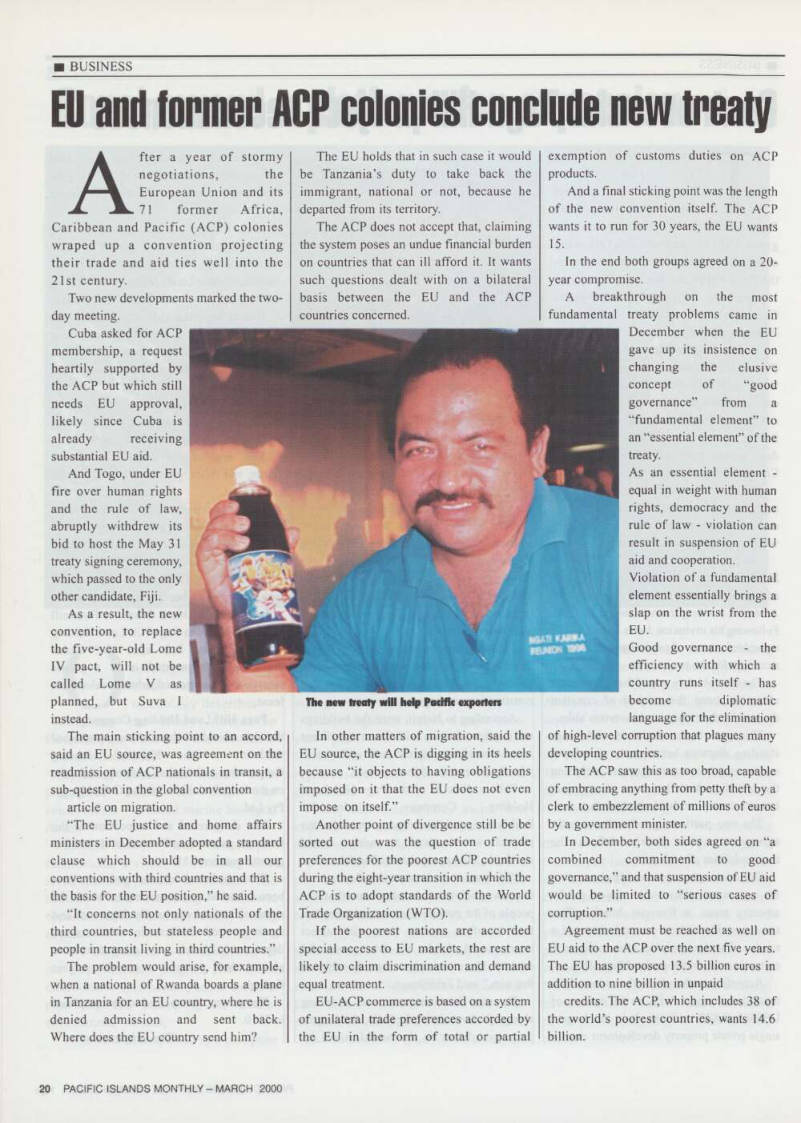
The new treaty will help Pacific exporters