Worth the weight, worth the wait
Editorial
Mankind has left eternal footprints on the moon. Supersonic aircraft have reduced travel around the world to no more than a few hours. The bravest of our species have collectively reached the top of Mount Everest more than 1000 times. But as we enter a new century, no human has visited the farthest depths of the ocean floor.
This has not stopped us from attempting to explore the ocean. The Pacific plays an important role in research and exploration of the deep sea, particularly in search of minerals. Indeed, the region is believed to be one of the most prospective for offshore mineral resources.
Early interest was directed towards offshore hydrocarbons, but that soon expanded to include manganese nodules,
cobalt-rich manganese crusts and polymetallic massive sulphides.
Since 1985, SOPAC, the South Pacific Applied Geoscience Commission, has explored selected offshore areas of the region in a project funded by Japan’s Technical Cooperation Programme. Early in February this year SOPAC, The Japan International Cooperation Agency and the Metal Mining Agency of Japan signed a new agreement as part of the Deep Sea Mineral Exploration Project.
Under the new agreement, surveys will be carried out over a three-year period in areas in the Exclusive Economic Zones of the Cook Islands, Fiji, and the Marshall Islands. Each survey will consist of five weeks of cruise-time a year in the offshore waters of the three countries. SOPAC estimates that mining could take place in the Pacific within 10 years, although it is
more likely to occur within 20.
These deposits will be mined at some point so it is important that offshore mineral development is managed in a sustainable manner. The technology to mine manganese nodules for example has been proposed and developed. It varies from suction to dredging, but at the current stage of development, it would result in low recovery rates with much of the resource lost in the process.
Undersea minerals are an attractive source of income for the not-so-rich Pacific nations.
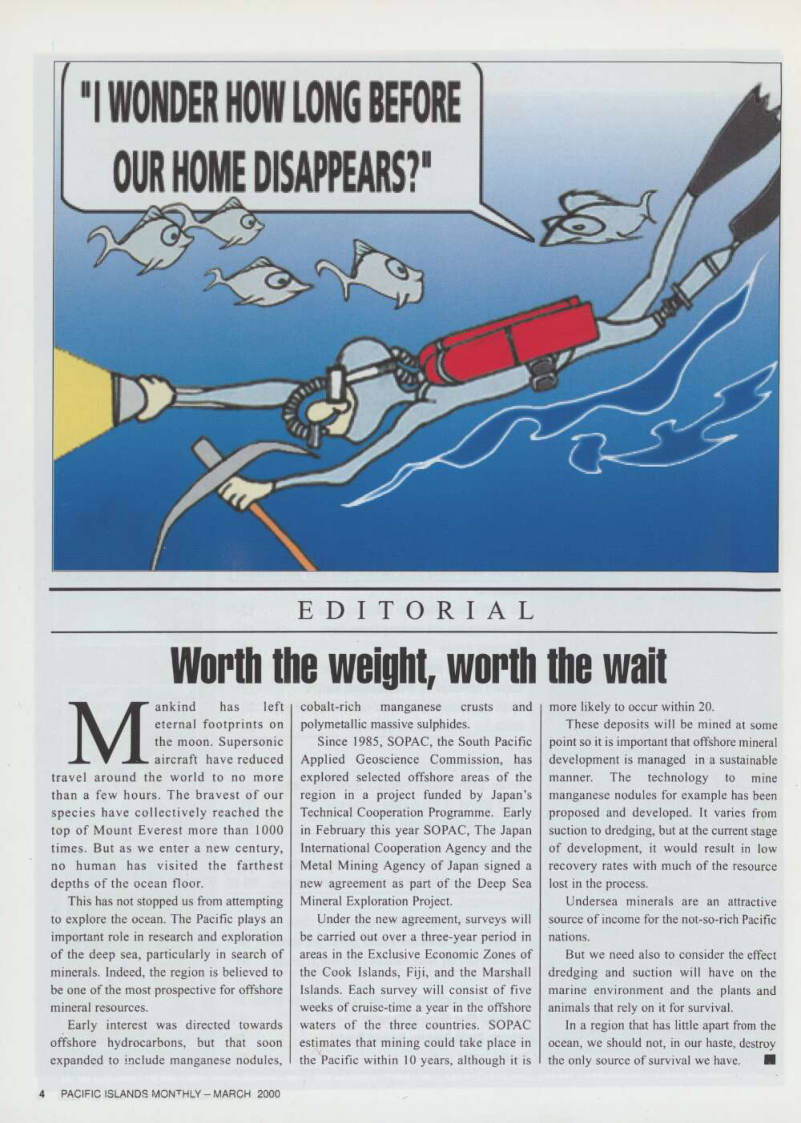
But we need also to consider the effect dredging and suction will have on the marine environment and the plants and animals that rely on it for survival.
In a region that has little apart from the ocean, we should not, in our haste, destroy the only source of survival we have. H