Propelling into the world markets
p. 44 · Read in the full issue
Leading yachtsmen have
confirmed that they can move faster through the seas and achieve considerable fuel savings by using an automatic variable pitch (AVP) propeller that delivers optimum thrust in both forward and reverse modes, without any need for manual adjustment.
Developed in the United Kingdom, the Autoprop is making a dramatic impact and has become one of the best selling all-round yacht propellers on the international market.
Its innovative design, sales success and direct benefit to users have helped win a Queen’s Award for Technological Achievement for its manufacturer, Brunton’s Propellers, of southern England.
Invented by John Coxon, an aeronautical engineer, then further developed by Brunton’s, the AVP propeller for sailing boats was first produced in 1988.
Ten years later there were more than 25000 in service. Sales is accelerating: In 1988 it increased by 30 per cent; and in the last quarter on 1999 sales increased by 40 per cent over the corresponding period for 1998. More than 70 per cent of annual sales are for export.
Two fleets of round-the-world yachts fitted Autoprop on the advice of leading yachtsmen Sir Robin Knox-Johnson and Sir Chay Blyth who discovered the advantages of the “clever propeller” on solitary yachts in the often stormy waters of the Atlantic and Pacific oceans.
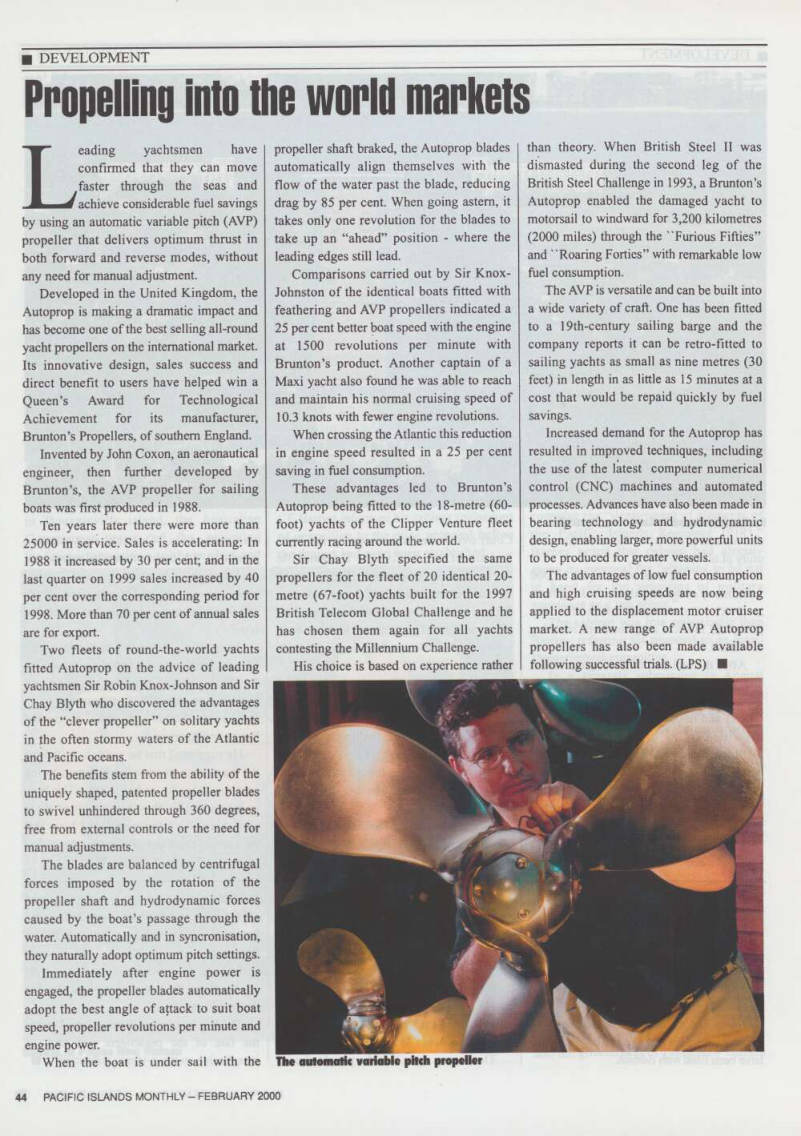
The benefits stem from the ability of the
uniquely shaped, patented propeller blades
to swivel unhindered through 360 degrees, free from external controls or the need for
manual adjustments.
The blades are balanced by centrifugal forces imposed by the rotation of the propeller shaft and hydrodynamic forces caused by the boat’s passage through the water. Automatically and in syncronisation, they naturally adopt optimum pitch settings.
Immediately after engine power is engaged, the propeller blades automatically adopt the best angle of attack to suit boat speed, propeller revolutions per minute and engine power.
When the boat is under sail with the
propeller shaft braked, the Autoprop blades automatically align themselves with the flow of the water past the blade, reducing drag by 85 per cent. When going astern, it takes only one revolution for the blades to take up an “ahead” position - where the leading edges still lead.
Comparisons carried out by Sir Knox- Johnston of the identical boats fitted with feathering and AVP propellers indicated a 25 per cent better boat speed with the engine at 1500 revolutions per minute with Brunton’s product. Another captain of a Maxi yacht also found he was able to reach and maintain his normal cruising speed of 10.3 knots with fewer engine revolutions.
When crossing the Atlantic this reduction in engine speed resulted in a 25 per cent saving in fuel consumption.
These advantages led to Brunton’s Autoprop being fitted to the 18-metre (60foot) yachts of the Clipper Venture fleet currently racing around the world.
Sir Chay Blyth specified the same propellers for the fleet of 20 identical 20metre (67-foot) yachts built for the 1997 British Telecom Global Challenge and he has chosen them again for all yachts contesting the Millennium Challenge.
His choice is based on experience rather
than theory. When British Steel II was dismasted during the second leg of the British Steel Challenge in 1993, a Brunton’s Autoprop enabled the damaged yacht to motorsail to windward for 3,200 kilometres (2000 miles) through the "Furious Fifties” and "Roaring Forties” with remarkable low fuel consumption.
The AVP is versatile and can be built into a wide variety of craft. One has been fitted to a 19th-century sailing barge and the company reports it can be retro-fitted to sailing yachts as small as nine metres (30 feet) in length in as little as 15 minutes at a cost that would be repaid quickly by fuel savings.
Increased demand for the Autoprop has resulted in improved techniques, including the use of the latest computer numerical control (CNC) machines and automated processes. Advances have also been made in bearing technology and hydrodynamic design, enabling larger, more powerful units to be produced for greater vessels.
The advantages of low fuel consumption and high cruising speeds are now being applied to the displacement motor cruiser market. A new range of AVP Autoprop propellers has also been made available following successful trials. (LPS) ■
The automatic variable pitch propeller