Racist politics not dead, Just 'mainstreamed'
pp. 39-40 · Read in the full issue
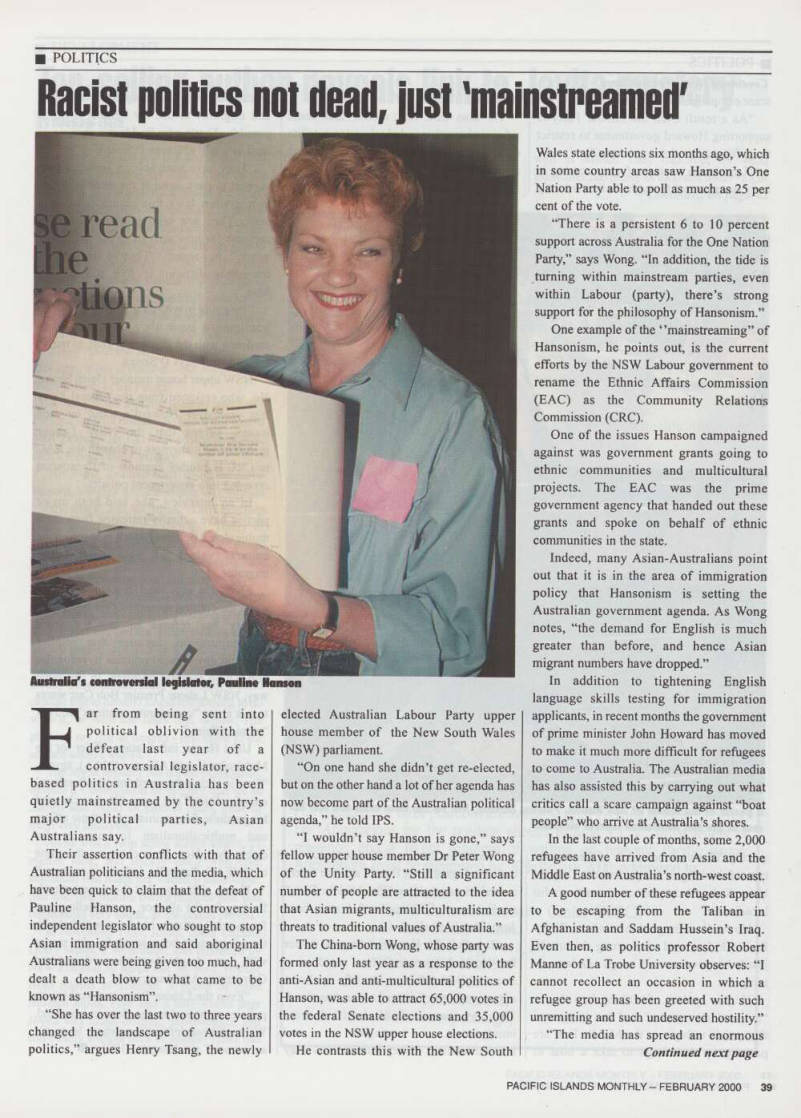
Far from being sent into political oblivion with the defeat last year of a controversial legislator, race based politics in Australia has been quietly mainstreamed by the country’s major political parties, Asian Australians say.
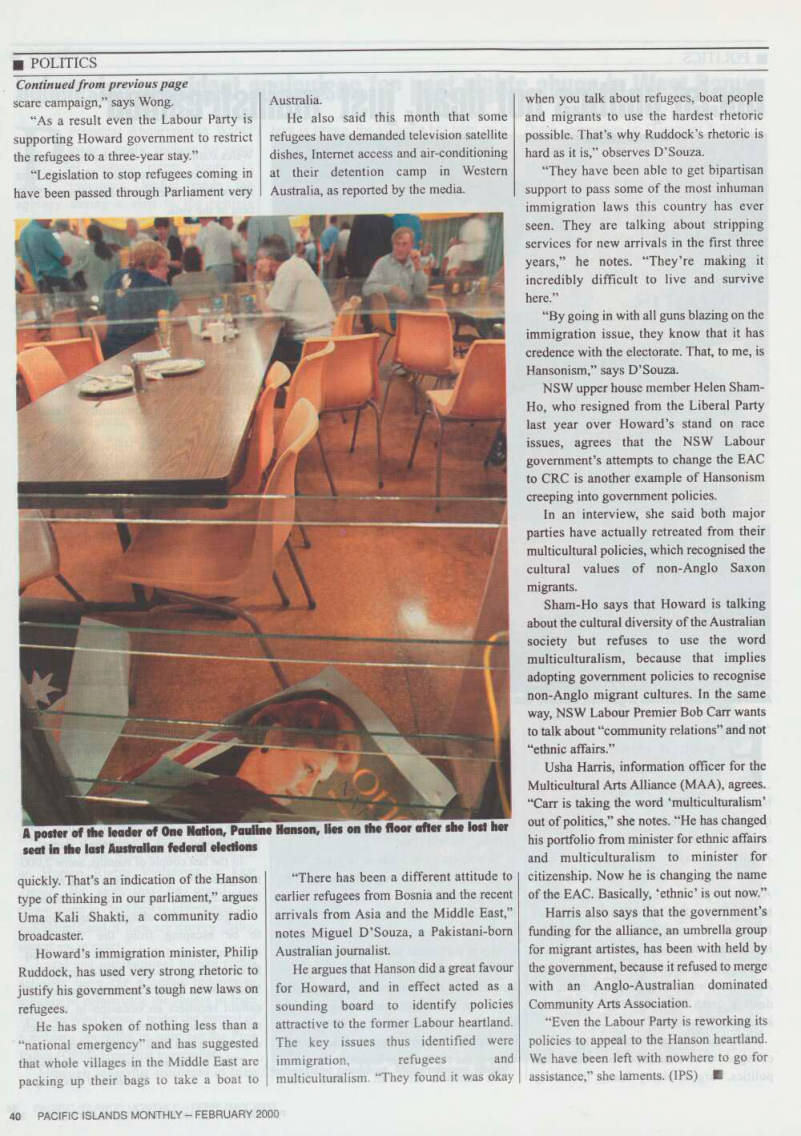
Their assertion conflicts with that of Australian politicians and the media, which have been quick to claim that the defeat of Pauline Hanson, the controversial independent legislator who sought to stop Asian immigration and said aboriginal Australians were being given too much, had dealt a death blow to what came to be known as “Hansonism”.
“She has over the last two to three years changed the landscape of Australian politics,” argues Henry Tsang, the newly
elected Australian Labour Party upper house member of the New South Wales (NSW) parliament.
“On one hand she didn’t get re-elected, but on the other hand a lot of her agenda has now become part of the Australian political agenda,” he told IPS.
“I wouldn’t say Hanson is gone,” says fellow upper house member Dr Peter Wong of the Unity Party. “Still a significant number of people are attracted to the idea that Asian migrants, multiculturalism are threats to traditional values of Australia.”
The China-bom Wong, whose party was formed only last year as a response to the anti-Asian and anti-multicultural politics of Hanson, was able to attract 65,000 votes in the federal Senate elections and 35,000 votes in the NSW upper house elections.
He contrasts this with the New South
Wales state elections six months ago, which in some country areas saw Hanson’s One Nation Party able to poll as much as 25 per cent of the vote.
“There is a persistent 6 to 10 percent support across Australia for the One Nation Party,” says Wong. “In addition, the tide is turning within mainstream parties, even within Labour (party), there’s strong support for the philosophy of Hansonism.”
One example of the ‘’mainstreaming” of Hansonism, he points out, is the current efforts by the NSW Labour government to rename the Ethnic Affairs Commission (EAC) as the Community Relations Commission (CRC).
One of the issues Hanson campaigned against was government grants going to ethnic communities and multicultural projects. The EAC was the prime government agency that handed out these grants and spoke on behalf of ethnic communities in the state.
Indeed, many Asian-Australians point out that it is in the area of immigration policy that Hansonism is setting the Australian government agenda. As Wong notes, “the demand for English is much greater than before, and hence Asian migrant numbers have dropped.”
In addition to tightening English language skills testing for immigration applicants, in recent months the government of prime minister John Howard has moved to make it much more difficult for refugees to come to Australia. The Australian media has also assisted this by carrying out what critics call a scare campaign against “boat people” who arrive at Australia’s shores.
In the last couple of months, some 2,000 refugees have arrived from Asia and the Middle East on Australia’s north-west coast.
A good number of these refugees appear to be escaping from the Taliban in Afghanistan and Saddam Hussein’s Iraq.
Even then, as politics professor Robert Manne of La Trobe University observes: “I cannot recollect an occasion in which a refugee group has been greeted with such unremitting and such undeserved hostility.”
“The media has spread an enormous
Continued next page
Continued from previous page
scare campaign,” says Wong.
“As a result even the Labour Party is supporting Howard government to restrict the refugees to a three-year stay.”
“Legislation to stop refugees coming in have been passed through Parliament very
quickly. That’s an indication of the Hanson type of thinking in our parliament,” argues Uma Kali Shakti, a community radio broadcaster.
Howard’s immigration minister, Philip Ruddock, has used very strong rhetoric to justify his government’s tough new laws on refugees.
He has spoken of nothing less than a “national emergency” and has suggested that whole villages in the Middle East are packing up their bags to take a boat to
Australia.
He also said this month that some refugees have demanded television satellite dishes, Internet access and air-conditioning at their detention camp in Western Australia, as reported by the media.
“There has been a different attitude to earlier refugees from Bosnia and the recent arrivals from Asia and the Middle East,” notes Miguel D’Souza, a Pakistani-bom Australian journalist.
He argues that Hanson did a great favour for Howard, and in effect acted as a sounding board to identify policies attractive to the former Labour heartland.
The key issues thus identified were immigration, refugees and multiculturalism. “They found it was okay
when you talk about refugees, boat people and migrants to use the hardest rhetoric possible. That’s why Ruddock’s rhetoric is hard as it is,” observes D’Souza.
“They have been able to get bipartisan support to pass some of the most inhuman immigration laws this country has ever seen. They are talking about stripping services for new arrivals in the first three years,” he notes. “They’re making it incredibly difficult to live and survive here.”
“By going in with all guns blazing on the immigration issue, they know that it has credence with the electorate. That, to me, is Hansonism,” says D’Souza.
NSW upper house member Helen Sham- Ho, who resigned from the Liberal Party last year over Howard’s stand on race issues, agrees that the NSW Labour government’s attempts to change the EAC to CRC is another example of Hansonism creeping into government policies.
In an interview, she said both major parties have actually retreated from their multicultural policies, which recognised the cultural values of non-Anglo Saxon migrants.
Sham-Ho says that Howard is talking about the cultural diversity of the Australian society but refuses to use the word multiculturalism, because that implies adopting government policies to recognise non-Anglo migrant cultures. In the same way, NSW Labour Premier Bob Carr wants to talk about “community relations” and not “ethnic affairs.”
Usha Harris, information officer for the Multicultural Arts Alliance (MAA), agrees.
“Carr is taking the word ‘multiculturalism’ out of politics,” she notes. “He has changed his portfolio from minister for ethnic affairs and multiculturalism to minister for citizenship. Now he is changing the name of the EAC. Basically, ‘ethnic’ is out now.”
Harris also says that the government’s funding for the alliance, an umbrella group for migrant artistes, has been with held by the government, because it refused to merge with an Anglo-Australian dominated Community Arts Association.
“Even the Labour Party is reworking its policies to appeal to the Hanson heartland.
We have been left with nowhere to go for assistance,” she laments. (IPS) ■
A poster of the leader of One Nation, Pauline Hanson, lies on the floor after she lost her seat in the last Australian federal elections