West Papua mobilising for freedom from Indonesia
pp. 36-37 · Read in the full issue
Politics
By Andrew Kllvert
The indigenous Melanesians of Irian Jaya or West Papua, are calling for independence from Indonesian rule in the year 2000.
On the December 1 last year (1999) on the anniversary of the Dutch handover of Irian Jaya to the Papuan people in 1961, the biggest wave of independence demonstrations in the history of the province took place.
Around this vast and mountainous country an estimated 20 000 people took to the streets to raise the outlawed ‘Morning Star’ independence flag and to declare themselves separate from Indonesia.
In Sentani on the outskirts of the capitol Jayapura, the leader of the newly formed Papuan Council, Theys Eluay presided over the formation of a group calling themselves the Papuan Army. They drilled with
bamboo sticks instead of rifles and wore uniforms of black fatigues with the ‘Morning Star’ independence flag painted on the front.
The December protests went smoothly in Jayapura with the flag only flying for one day following an agreement between Theys Eluay and the Police Chief for the
province.
On the south coast in the mining town of Timika, near the vast US owned Freeport Gold and Copper mine where protesters have been campaigning for independence since early November last year, the protests did not go so well.
The Indonesian TNI Mobile Brigade from Jayapura shot 55 of the protesters killing at least three of them.
At dawn on December 2, the soldiers sealed off the exits to the protest which was
being held in the Catholic Church grounds near the centre of town. They then entered the grounds and began pulling down the Independence flag which had been flying for the past month.
Some of the Papuans tried to defend the flag using only their hands and were kicked and rifle butted by the soldiers. As the people fled this scene the soldiers opened fire.
According to one witness, “The soldiers began firing wildly into the crowd as the people ran away. There was no provocation from the protesters they were not armed with sticks or bows and arrows.”
Despite this shooting the protesters, angry and embittered, re gathered the next day at the site and continued with their demonstration although without flying the independence flag. This demonstration is continuing.
Tensions remain high in other parts of the province with reports of ongoing independence rallies and planned Indonesian military operations coming from Nabire on the north coast.
In Nabire in the Cenderawsih bay there is only a small military presence and protesters took advantage of this to take to the streets carrying bows and arrows and spears. There are accounts filtering out of demonstrators banging metal spikes into the airstrip to stop planes from landing extra troops.
In other parts of the contested province like the town of Sorong on the western tip of the island there are also ongoing protests against Indonesian military rule which human rights workers in the province believe could lead to more bloodshed at the hands of the military.
There are a number of factors driving these protests. 36 years of Indonesian military rule whose tactics mass killings, torture, dispossession of the people from their lands, mass migration from Java and Bali, lack of jobs and loss of resources are the key cause of this resentment of the military rule.
Recent events in East Timor have also buoyed the aspirations of the West Papuans
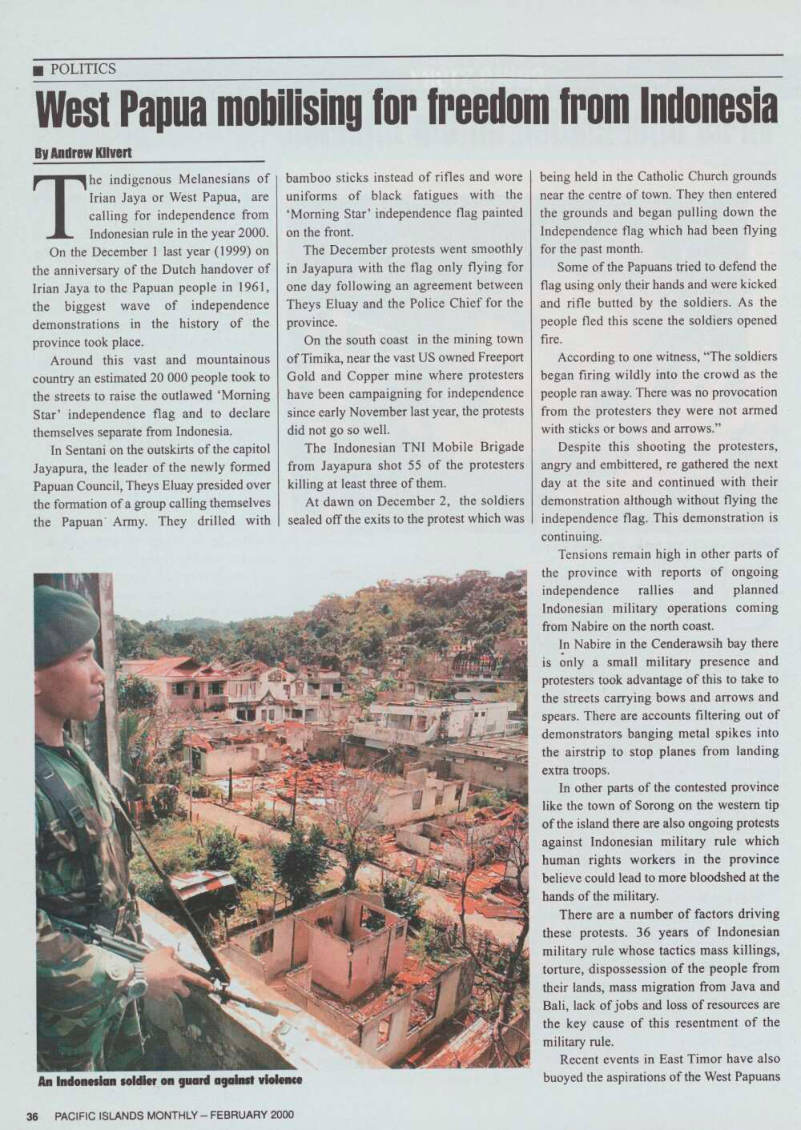
An Indonesian soldier on guard against violence
for independence who believe that their case for secession is as strong as that of East Timor.
With the departure of Suharto in 1998 the independence movement saw an opportunity to again take to the streets to push their desire for freedom.
Two years later and despite the deaths of several hundred Papuans in Biak, Manokwari and the mountains villages still under military operations, this movement is growing in strength and commitment.
The is the common belief that there will be a divine intervention during the year 2000.
Some people believe that a character from Biak mythology named Manzerin will return to liberate the Melanesian people of the province, others believe that Jesus will return and deliver their lands back to the traditional people.
This belief also exists in the nearby Maluku islands who are also seeking liberation from Indonesian military and Indonesian settlers. There have been sightings of Jesus in Ambon and many believe that the time for their freedom is near. The people of this country arc pragmatic about their religion and any sign of an end to the ongoing human rights abuses in the province will be interpreted as the work of God.
Recent events in Europe suggest that God may be on their side, last month (December 1999) the European parliament voted to maintain an arms embargo against Indonesia citing human rights abuses in Aceh and Irian Jaya.
Around (he same time the Dutch parliament ordered an inquiry into the conduct of the infamous 1969 ‘Act of Free Choice' that saw 1025 West Papuan men forced to vote to join Indonesia in a United Nations ballot that was never ratified in the UN.
The Dutch have already announced that the findings of this inquiry will be taken to the UN. Things arc even on the move in Jakarta with the new parliament agreeing to allow the name change of the province from Irian Jaya to West Papua and to change the name of the capitol from Jayapura back to Port Numbay, the name given to it by the West Papuans when their country was handed back by the Dutch in
1961. Jayapura which translates literally as ‘victory city’ was named by the Indonesians as part of the celebration of their successful invasion in 1963.
What is obvious is the growth in the public outcry for freedom from Indonesian rule. In the towns people brazenly wear the West Papua flag that would have had them arrested two years ago. People openly talk about joining Papua New Guinea or forming an alliance with them as an independent West Papua.
The chief obstacle for the West Papuans
is the remarkable wealth of their country.
With approximately 15 per cent of the worlds natural gas reserves, nickel, gold, copper and the most intact stands of tropical rainforest left on the planet, Indonesia is not going to give up on this one without a fight.
Whereas East Timor was a case of injured pride for the Indonesian colonialists, West Papua is 22 per cent of their land mass and the Freeport Copper mine is the single greatest contributor to Indonesia’s GDP. ■
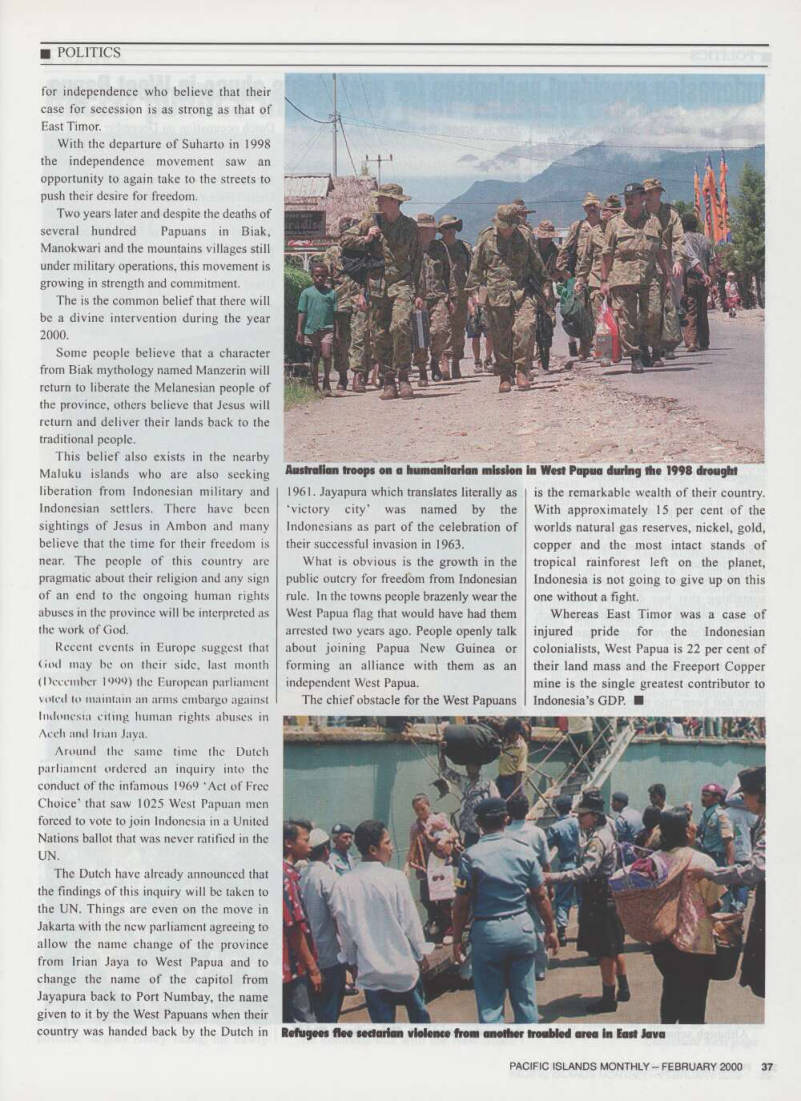
Australian troops on a humanitarian mission in West Papua during the 1998 drought
Refugees flee sectarian violence from another troubled area in East Java