Prospectors strike gold in Website names
pp. 33-35 · Read in the full issue
WHEN he was 13, Mark Zonarich ran his own
curb-painting business.
Now he is a 19-year old architecture student building castles in cyberspace by dreaming up Internet addresses and selling them to the highest bidder.
Like the California gold rush of the 1840 s, entrepreneurs big and small are digging deep - this time into the dictionary or thesaurus for dot-com nuggets as the Internet domain names business becomes a fast way to a fortune.
“It’s a bit like buying a painting at a garage sale and finding out it is a Picasso and it is too valuable to hang in your home,” said Tim Pluma, sales director of Greatdomains.com, a leading California based domain names broker.
In December, a California company paid a record US$7.5 million (A$ 11.48 million) for an Internet address when it bought the rights to use the domain name business.com from a Houston entrepreneur.
America.com is currently up for sale at an asking price of NZ$lO million (A 57.91 million). Celebrities.com could be yours for US$2 million (A 53.06 million), and tens of thousands of other names, ranging from the quirky to the blindingly obvious, are changing hands for a fistful of dollars in the cyber equivalent of real estate.
All you need is an eye for invention and US$7O(A$lO7) to register an Internet domain name not already in use. Players in the market range from college kids like Zonarich with talent and time on their hands to small businessmen who spotted the potential two or three years ago and registered dozens of addresses.
Texas businessman Jeremy Baldwin jumped in a couple of years ago when he wanted a Website address for his computer consulting company. “I found it was already taken and every iteration I could think of.
So I said to myself, there’s gold in them thar hills,” he said.
Baldwin started registering every generic name he could think of related to computers and put prices.com after it. Then
he put an e in front of all the products he thought people might want to buy on the Internet, like ecigars.com and ewine.com.
He is now owner or joint owner of some 370 Internet domain names and gets offers
ranging from US$5,OOO (A 57,654) to
Us$4O,Ooo (A 561,236).
Thanks to him and others like him, some 97 per cent of the words in Webster’s dictionary have been registered and the number of domain names in the United States has swollen from one million to six million in three years - all of which makes it harder for newcomers, who are turning to quirkier combinations to get a piece of the action.
“Very rarely do I find one that I think has a lot of potential that is still available. Most people don’t realise how hard it is,” said Zonarich, who has registered 17 names in the past month.
Heyuk.com and its British equivalent heyuk.co.ukare the proudest inventions to date of the University of Maryland student whose earlier moneymaking ventures included running his own curb-painting and lawn service businesses.
“I’ve always been very interested in business and looking for any opportunity to start my own. I am basically a young entrepreneur. I truly believe that it is completely possible to make a living out of this,” he said.
With about 50 domain names brokers in the United States alone, prices for a great online business address are expected to soar, especially for catchall generic names that are easy to remember and type.
“Prices will probably continue to go up until the bubble bursts or common sense prevails,” said David Redhill, an executive
Continued next page
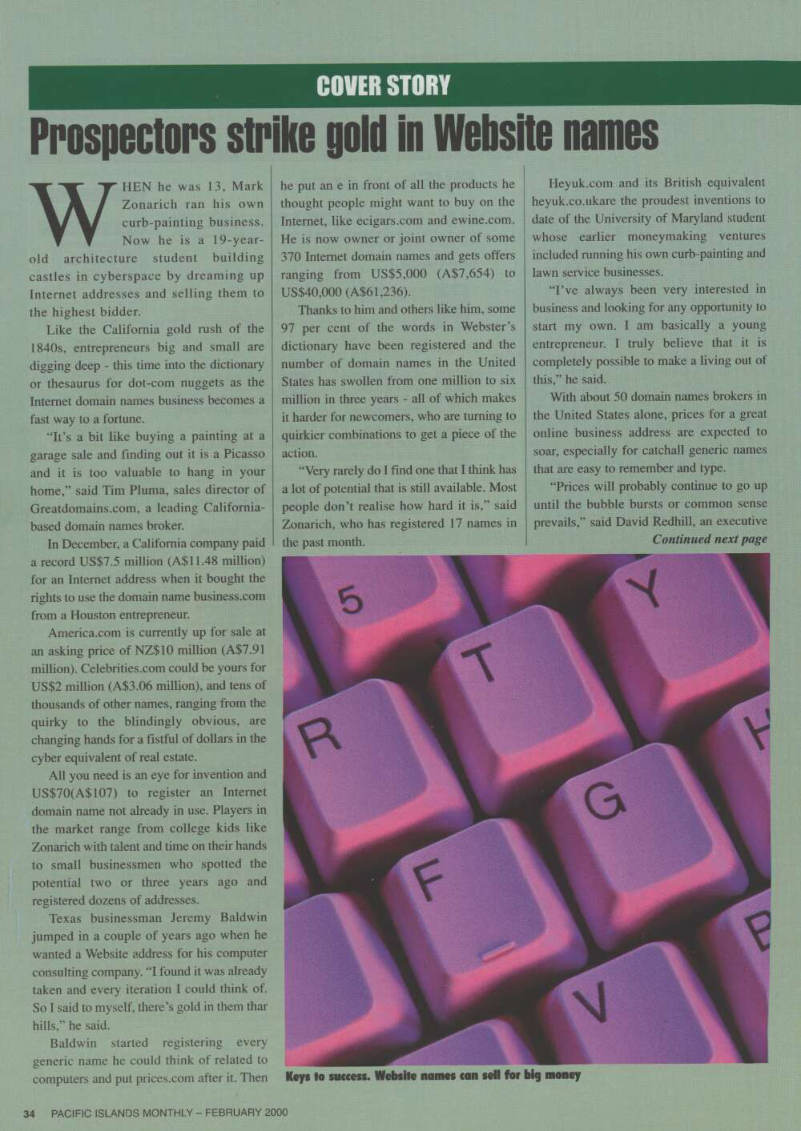
Keys to success. Website names can sell for big money
Pig, Fijian music from South Pacific Recordings, spices from spice farmer Ron Gatty, handicraft and artifacts, coffee and kava.
“We don’t have that many products on line but that is the way we would prefer to have it. There is no point putting 1000 products there just for the sake of it and no one is interested.
“We want items that are Fijian. I know there are some companies which are interested, but who are waiting to see how well we do.”
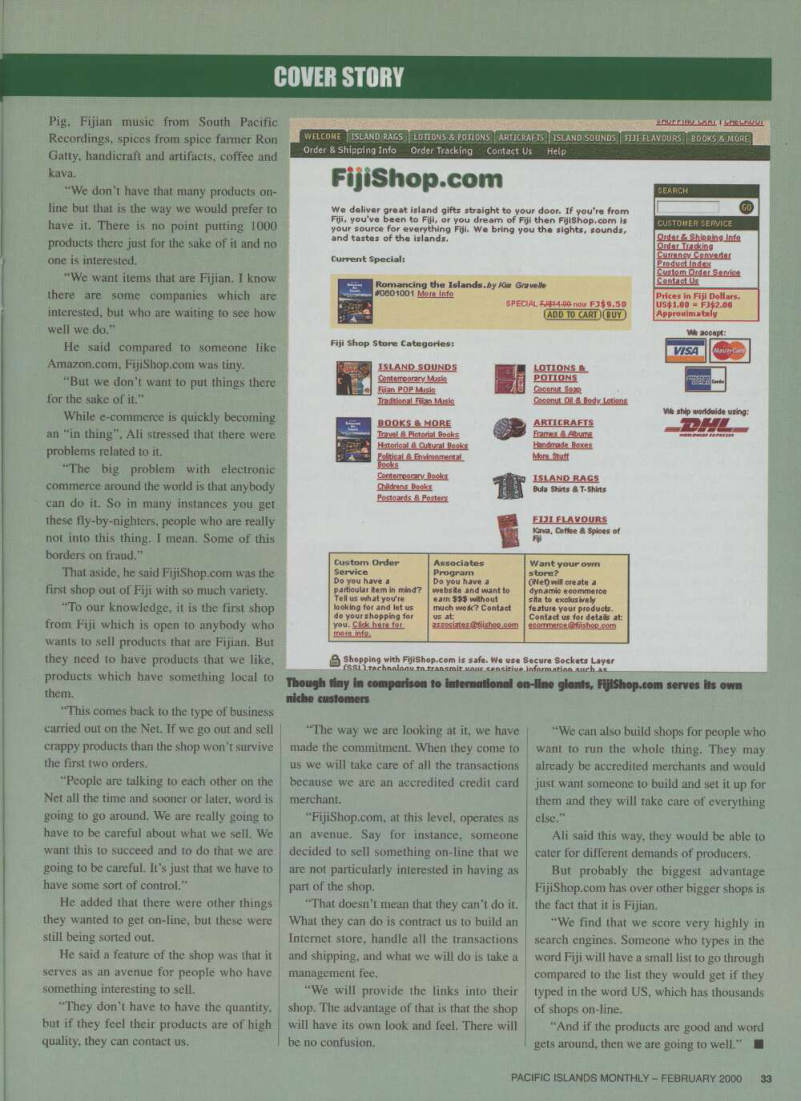
He said compared to someone like Amazon.com, FijiShop.com was tiny.
“But we don’t want to put things there for the sake of it.”
While e-commerce is quickly becoming an “in thing”, Ali stressed that there were problems related to it.
“The big problem with electronic commerce around the world is that anybody can do it. So in many instances you get
these fly-by-nighters, people who are really
not into this thing. I mean. Some of this borders on fraud.”
That aside, he said FijiShop.com was the first shop out of Fiji with so much variety.
“To our knowledge, it is the first shop from Fiji which is open to anybody who wants to sell products that are Fijian. But they need to have products that we like, products which have something local to them.
“This comes back to the type of business carried out on the Net. If we go out and sell crappy products than the shop won’t survive the first two orders.
“People are talking to each other on the Net all the time and sooner or later, word is going to go around. We are really going to have to be careful about what we sell. We want this to succeed and to do that we are going to be careful. It’s just that we have to have some sort of control.”
He added that there were other things they wanted to get on-line, but these were still being sorted out.
He said a feature of the shop was that it serves as an avenue for people who have
something interesting to sell.
“They don’t have to have the quantity, but if they feel their products are of high quality, they can contact us.
“The way we are looking at it, we have made the commitment. When they come to us we will take care of all the transactions because we are an accredited credit card merchant.
“FijiShop.com, at this level, operates as an avenue. Say for instance, someone decided to sell something on-line that we are not particularly interested in having as part of the shop.
“That doesn’t mean that they can’t do it.
What they can do is contract us to build an Internet store, handle all the transactions and shipping, and what we will do is take a management fee.
“We will provide the links into their shop. The advantage of that is that the shop will have its own look and feel. There will be no confusion.
“We can also build shops for people who want to run the whole thing. They may already be accredited merchants and would just want someone to build and set it up for them and they will take care of everything else.”
Ali said this way, they would be able to cater for different demands of producers.
But probably the biggest advantage
FijiShop.com has over other bigger shops is the fact that it is Fijian.
“We find that we score very highly in search engines. Someone who types in the word Fiji will have a small list to go through compared to the list they would get if they typed in the word US, which has thousands of shops on-line.
“And if the products are good and word gets around, then we are going to well.” ■
Though tiny in comparison to intemotionnl on-line giants, FiyiShop.com serves its own niche customers
Continued from previous page
director at San Francisco-based Landor
Associates, a leading global branding
consultant.
Redhill was wary of predicting how the Internet would develop in its second generation. The dot-com milch cow could dry up if suffixes like dot biz or other variations are introduced, and as more organisations around the world go online style and a user-friendly Website even with an obscure address may count for more than an obvious name.
“The generic names have got the high ground at the moment but it is difficult to
say what will happen in a few years time,”
Redhill said. “If people want to continue to refer to one site they are going to bookmark it. If the site is worth revisiting then people are not going to have to keep typing a quirky or unusual name in. The name is only one part of it. The site architecture is important too,” he said.
Baldwin said the days of the domain names gold rush are numbered. “I think in the next two years people can make some ridiculously big numbers with this, but then it’s got to start to slow down because you are going to get to where the names are taken,” he said.
“I don’t know if my mind is weird but I just keep coming up with them. There’s probably got to be about another 100 in my head, especially after a good glass of red wine.”
Baldwin figures he has about half a dozen names that are worth about US$5OO,OOO (A 5765,462) a piece and he is planning to use the windfall to finance his own Website aimed at instructing professional salesmen in sales and
marketing techniques.
Needless to say, he will not be handing over millions to someone else for a Website address. (REUTERS) ■