UN book offers kids' view of environmental damage
p. 28 · Read in the full issue
Children beware. The “good ship Planet Earth” will crash and burn in the near future if you behave as recklessly with the environment as your parents did, or so says a new book by kids and for kids.
Pachamama: Our Earth - Our Future, sponsored by the United Nations Environment Program (UNEP), paints a troubling picture of the Earth’s deteriorating health from the perspective of eco-conscious children.
“All the rubbish that people throw on the ground. After a few years will become a big mound. A mound that gives out the most terrible smell. Which is what makes this planet a living hell,” wrote British children in their contribution.
The book for 11 to 14-year-old readers gives children’s opinions and sometimes frightening experiences with global warming, land degradation, urban sprawl and sea pollution.
“I think kids are more aware than any other group in society on the environmental problems we all face,” said Cecilia
Weckstrom, co-director of .the UNEP project. “Obviously they see and feel much of the suffering due to our negligence.”
In a section on floods and drought, Hajara Kider, a child from Niger, described her family’s daunting routine walking great distances to the nearest well, which regularly dries up.
“Each day, I had to walk 20 kilometres to find a well to fill my bucket. The walk back was the worst - the bucket was so heavy on my head that I swear my neck had shrunk by the time I got home,” Kider said.
“But it’s OK. It’s what you have to do if you live in a dry, hot country.”
Some environmental groups are concerned about materials such as the United Nations book, saying many kids have a bleak outlook on the environment as a result.
“Surveys of kids show they have dark visions for our future,” said Kathleen deßettencourt, executive director of Washington-based Environmental Literacy Council. The non-profit group tries to help improve environmental studies in schools.
“I think it’s a little scary. If childreni are hopeless, they are less likely to be a parrt of the solution,” she said. But the book ccould be helpful by informing children of environmental problems throughout the world, she added.
The 96-page book contains case studlies, games and topics for classroom discussion of pollution, waste disposal and other environmental issues.
It comes with two companion publications, a teacher’s guide and a ‘how to’ guide for kids to take action and reach political leaders.
UNEP executive director Klaus Topfer said he hopes the book will challenge children to organise and find solutions and educate their generation how to change harmful habits.
“Some things (youth) have to say are disturbing. Adults have acted irresponsibly in caring for the environment,” Topfer said.
“But young people are also enthusiastically dedicated to their future, a future where Mother Earth is healthy and where people work together to solve our current and
future problems.”
The book, which took two and half years to complete, involved editors rummaging through essays, poems and drawings from more than 10,000 children from over 100 countries.
“The hardest part was choosing from thousands of contributions,”
Weckstrom said. “We could have made 10 books.”
The UNEP plans to hold its third environmental conference for children in May. Some 1,000 kids between 10 and 12 years old are expected to attend the meeting in England to share their ideas for reducing air and water pollution and other types of environmental damage.
(Reuters) ■
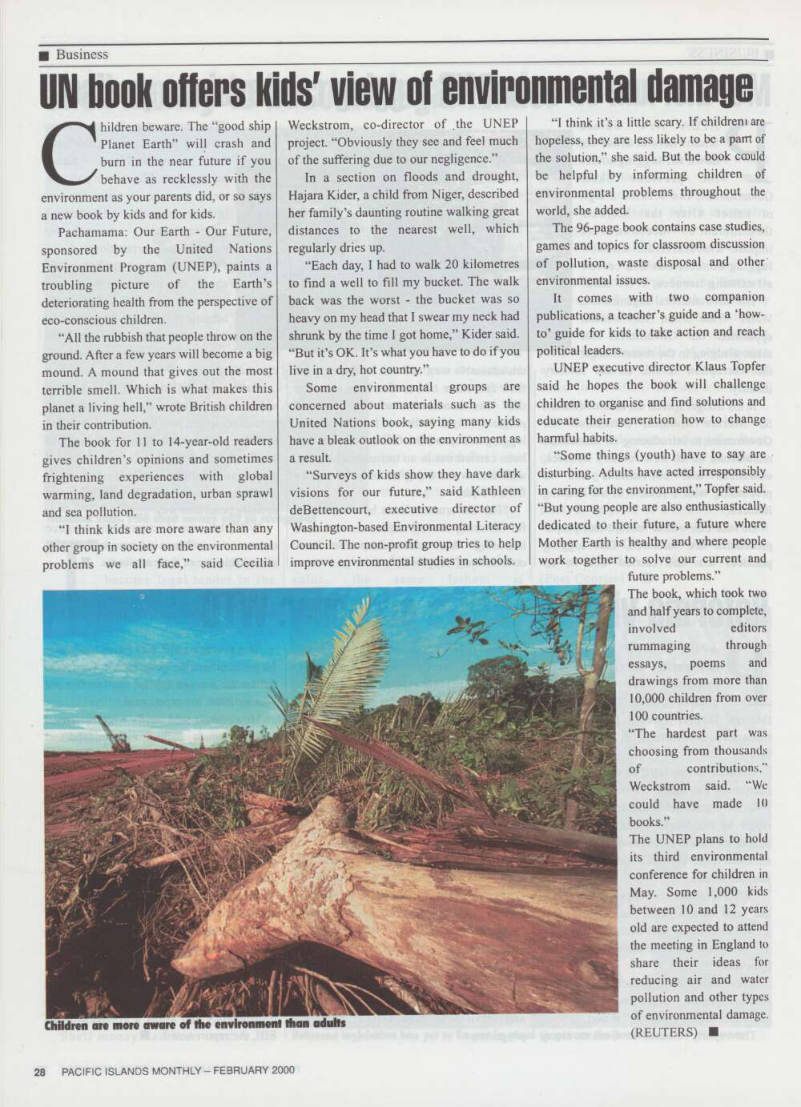
Children arc more aware of Hie environment than adults