A netful! of opportunities
Editorial
The internet has changed business forever. Its advent has provided people with the infrastructure to extend the reach of their oiganisation while reducing the cost of serving customers.
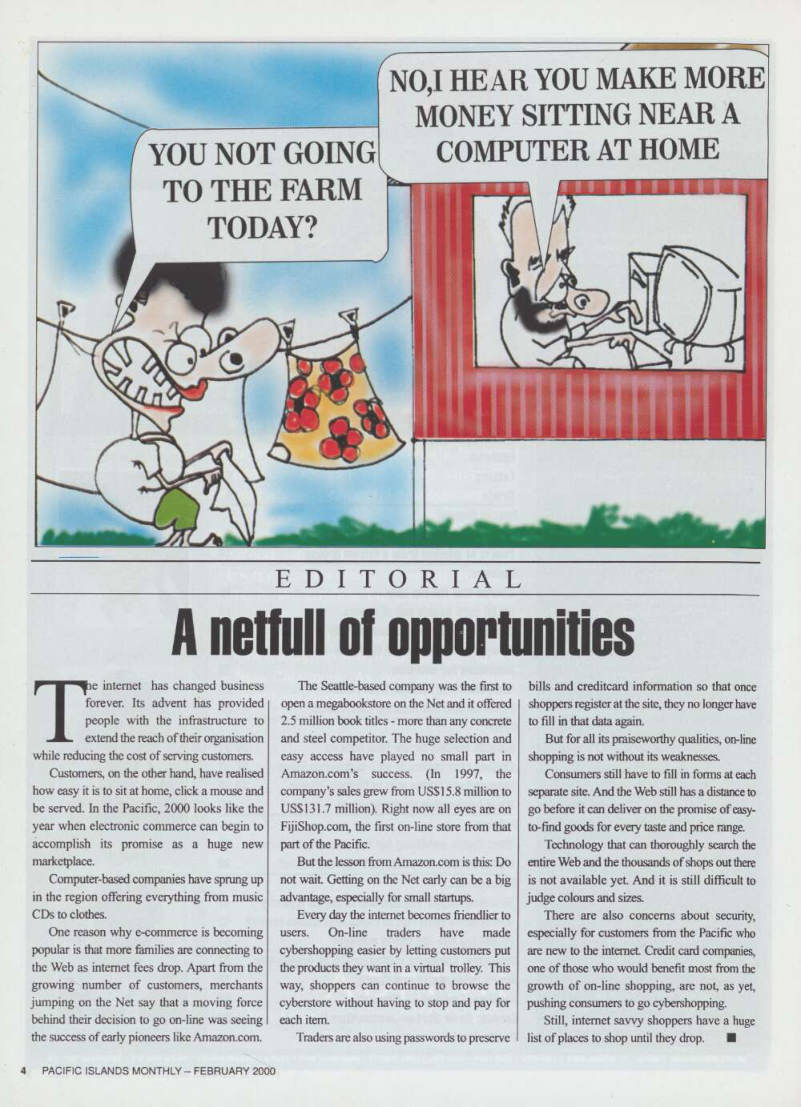
Customers, on the other hand, have realised how easy it is to sit at home, click a mouse and be served. In the Pacific, 2000 looks like the year when electronic commerce can begin to accomplish its promise as a huge new marketplace.
Computer-based companies have sprung up in the region offering everything from music CDs to clothes.
One reason why e-commerce is becoming popular is that more families are connecting to the Web as internet fees drop. Apart from the growing number of customers, merchants jumping on the Net say that a moving force behind their decision to go on-line was seeing the success of early pioneers like Amazon.com.
The Seattle-based company was the first to open a megabookstore on the Net and it offered 2.5 million book titles - more than any concrete and steel competitor. The huge selection and easy access have played no small part in Amazon.com’s success. (In 1997, the company’s sales grew from US$l5.B million to U 55131.7 million). Right now all eyes are on FijiShop.com, the first on-line store from that part of the Pacific.
But the lesson from Amazon.com is this: Do not wait. Getting on the Net early can be a big advantage, especially for small startups.
Every day the internet becomes friendlier to users. On-line traders have made
cybershopping easier by letting customers put
the products they want in a virtual trolley. This way, shoppers can continue to browse the cyberstore without having to stop and pay for each item.
Traders are also using passwords to preserve
bills and creditcard information so that once shoppers register at the site, they no longer have to fill in that data again.
But for all its praiseworthy qualities, on-line shopping is not without its weaknesses.
Consumers still have to fill in forms at each separate site. And the Web still has a distance to go before it can deliver on the promise of easy to-find goods for every taste and price range.
Technology that can thoroughly search the entire Web and the thousands of shops out there is not available yet. And it is still difficult to judge colours and sizes.
There are also concerns about security, especially for customers from the Pacific who are new to the internet Credit card companies, one of those who would benefit most from the growth of on-line shopping, are not, as yet, pushing consumers to go cybershopping.
Still, internet savvy shoppers have a huge list of places to shop until they drop. ■