Fears US military legacy en Pacific island producing cancer
p. 37 · Read in the full issue
By Mlchael Field
Residents of an island once the scene of one of World War ll’s more horrific battles are fearful their key role in the Cold War has left them with a legacy of stomach, liver and kidney cancers. The US deployed Nike Ajax nuclear tipped missiles to Saipan during the late 1950 s to counter what was believed to be a serious threat posed by Soviet strategic bombers.
When they walked away in 1961 they dumped electrical capacitors containing polychlorinated biphenyl (PCB) around Tanapag in north-west Saipan, home to around 1700 people. Capacitors were also shipped in from elsewhere and dumped.
Tanapag is near Morubi Cliff's where hundreds of Japanese civilians threw themselves into the sea after the American occupation in 1944. Over 50,000 people died in the battle and the US sustained its heaviest casualties there.
Commonwealth of Northern Mariana
Islands (CNMI) Washington Representative Juan Babauta said if the chemical dumping had occurred in the United States the Defense Department would have been made to take action. Babauta said “disturbing signs of ill health” had been found in Tanapag.
“Fetal death is the leading cause of mortality and local medical professionals have alerted me to abnormal numbers of chromosomal defects and high rates of congenital heart disease,” Babauta said.
“All of these seem to correlate with current research findings that reproductive dysftinction may be the most serious effect of prolonged PCB exposure,” said Babauta. He added there have been “unusual cancers” among Tanapag villagers.”
He said 55 gallon-drums in the area are leaking unidentified fluids that then drain down the ravine into the larger water system.
The US Army Corps of Engineers had found a foot (a third of a metre) of oil above the groundwater in the southern section of
Saipan.
The daily Saipan Tribune reported the area was used by the US Navy and the Central Intelligence Agency. After they left, they dumped PCBs that have now been found west of the Tanapag Elementary School (old cemetery and social hall). PCBs have also been found in the cemetery located south of the village. The Corps of Engineers, which has the responsibility for the mess, was being “lackadaisical in its responsibility” about cleaning up the mess.
“There’s also the dire need to conduct an independent study to determine the contents of 50-gallon drum cans found in the old military dump in upper Tanapag, specifically, whether the materials there are in fact carcinogenic and more importantly, whether it finally percolated down to the water lenses that feeds such a basic need (water) to the people in Tanapag Village,” the newspaper asked in an editorial.
“Over the last 20 years, there’s been a marked increase in cancer cases in these isles.
We are not talking about lung cancer as a direct result of smoking, but stomach, liver, kidney and other forms of internal cancer.”
An unknown quantity of ceramic capacitors containing PCBs was shipped to Saipan in the 1960 s by the Department of Defense. These contained Arochlor 1254 and PCB oil and were manufactured by Comell-Dublier Electronics.
Many of the discarded electrical capacitors have been used in the village as barricades, boundary markers, roadblocks for driveways, windbreaks for barbecue sites and headstones.
The Northern Marianas Department of Public Health (DPH) has asked the Agency for Toxic Disease Registry to carry out an extensive medical testing in Tanapag.
Based on the preliminary review of the people’s medical records in Tanapag, the Commonwealth Health Center has seen an increase in the incidence of cancer cases and chromosomal abnormalities among the residents, said DPH Secretary Joseph Kevin Villagomez. He has requested tests on blood, body fats and breast milk to determine whether residents have been exposed to high levels of PCBs. ■
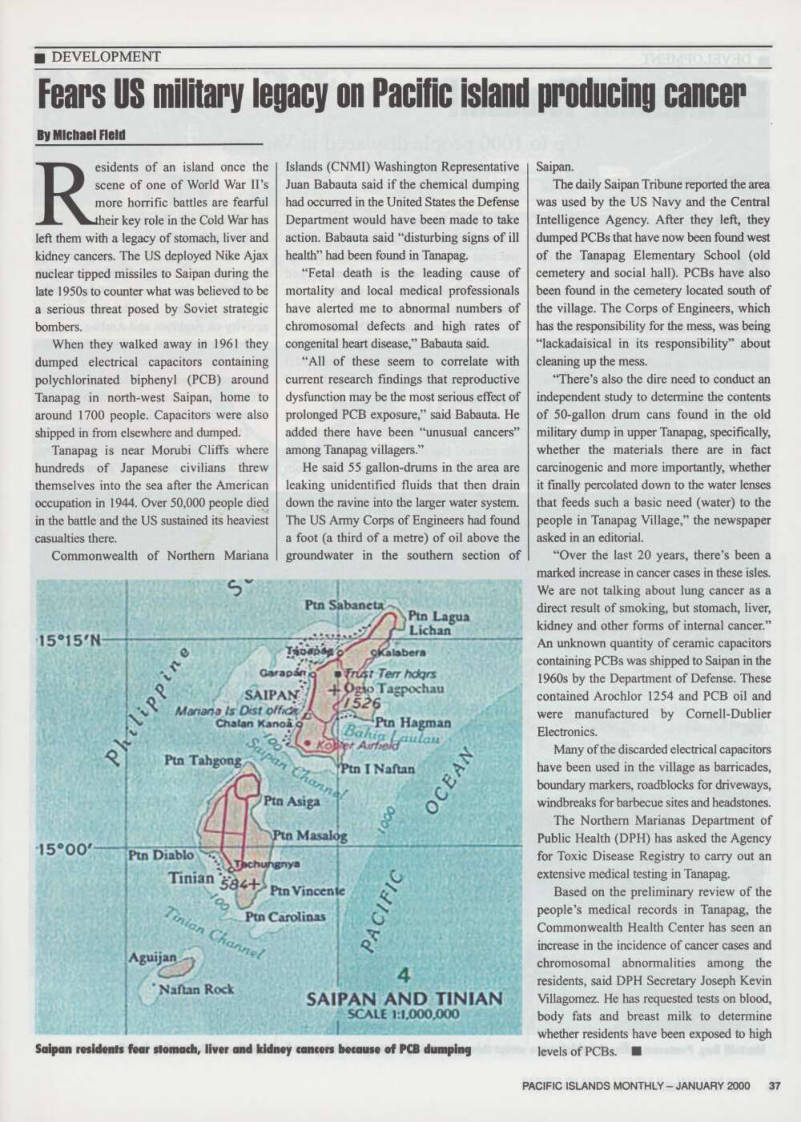
Saipan residents fear stomach, liver and kidney cancers because of PCB dumping