Dirty money
pp. 30-31 · Read in the full issue
Cover Story
Island countries accused of aiding money “launderers”
Powerful forces
are moving in on Pacific states playing in the dangerous world of money
laundering.
Nauru, which has
allegedly become the Russian Mafia’s banker, is the primary target.
Niue, allegedly sheltering South American drug cartel wealth, is next. Then Vanuatu and the Solomons, the Cook Islands and Samoa.
Despite an avowed devotion to God these countries are suspected of supping with the Devil himself, thanks to the Internet and the shadowy world of tax havens and shell companies.
Not only are they allegedly guilty of hypocrisy in that they have allied themselves with prostitution, drug running, murder and counterfeiting, they are also violating the wordy declaration that Pacific countries made to stay clean.
Dangerously Nauru has been involved in an operation that threatened the integrity of America’s mainline banking system and so is incurring the wrath of Washington now.
Nauru, a country of just 10,605 people who live amidst the ruins of their strip mined island, is believed to have seen US$7O billion pass through its banks.
The figure is scarcely believable but it came from Victor Melnikov, deputy chair of the Russian central bank, who said it was the proceeds of Russian Mafia operations just short of Russia’s annual legitimate exports worth US$74 billion dollars.
The Group of Seven (G 7) - the United States, Japan, Germany, France, Britain, Italy and Canada - and the 25-nation Paris based Organisation of Economic Cooperation and Development (OECD) are putting the final draft together of an operation which, if carried out, will be as devastating to the Pacific economies as any cyclone can be.
The powerful Financial Action Task Force (FATF) - a kind of international banking police force based within the OECD - has a mandate to hit at countries who are “serious obstacles to the fight against money laundering.”
By Michael Field
So far FATF has not publicised what will be a list, but significantly key media outlets in the last two months have all received background briefings from senior
intelligence, diplomatic and law
enforcement outlets.
The Washington Post, the London Sunday Times and Agence France-Presse have all got similar messages; Nauru is the number one bad guy, the key banker to the criminal world.
The Sunday Times said everyday tens of millions of pounds were going through at least 200 banks and shell companies registered, mostly over the Internet, at the Nauru Agency Corporation (NAC).
“Dozens of companies run by the Russian Mafia prosper in the electronic ether behind two dated computers run from the ramshackle office in Yaren, the island’s principal town,” the newspaper said.
“Others are suspected of being linked to scams that have caused chaos in the world’s financial markets.”
The reason the G 7 has FATF taking action is that the Russian-Nauru banks have allegedly been trying to break into the City of London by offering investment packages and banking facilities.
John Merrit, the director of the commercial crime unit of the British-based International Chamber of Commerce (ICC),said Nauru has always been a problem area.
“The shell banks try to open accounts with an established bank and use it as a tool to add to their credibility.”
Investigators are looking carefully into
one Semion Mogillevich, “the Red Don”, vwho is believed to be the main figure behind the laumdering of between US$7-lUSSIO billion through the B;ank of New York.
Mogilevich has denied all[ the allegations against him, saying; “Thie case has been fabricated by dishonesit FBI officials.”
Police are also investigating wlhether Mogilevich has laundered money through Nauru.
Nagendi Goswami, general manager of the Bank of Nauru, said: “It has come to our notice that some of the banks have been involved in money laundering. The Nauru Agency Corporation has cancelled their agencies with those banks.”
The Washington Post quoted Melnikov on the US$7O billion figure but added it was only the middle of a wide range of estimates of what was going through Nauru.
Melnikov said he believes more than 90 percent of the money transferred to Nauruan accounts was returned to Russia.
“That is to say, simply, our economic entities use this method to transfer their assets, hiding them ... And later, when they need these funds for their work here, they bring them in as credits,” Melnikov said.
“They effectively evade taxes this way,” causing “great damage to the country,” he added.
A senior US official told the Washington Post: “The central bank of Russia has come to us and confirmed that large amounts of Russian capital are flowing into and out of Nauru, and that has raised concerns on their part and on ours and certainly raised
suspicions.”
Nauru has quickly risen on Washington’s radar. In 1996 it was not mentioned at all in official documents but last year the US State Department said: “Nauru’s current offshore banking regime ... is an open invitation to financial crime and money laundering.”
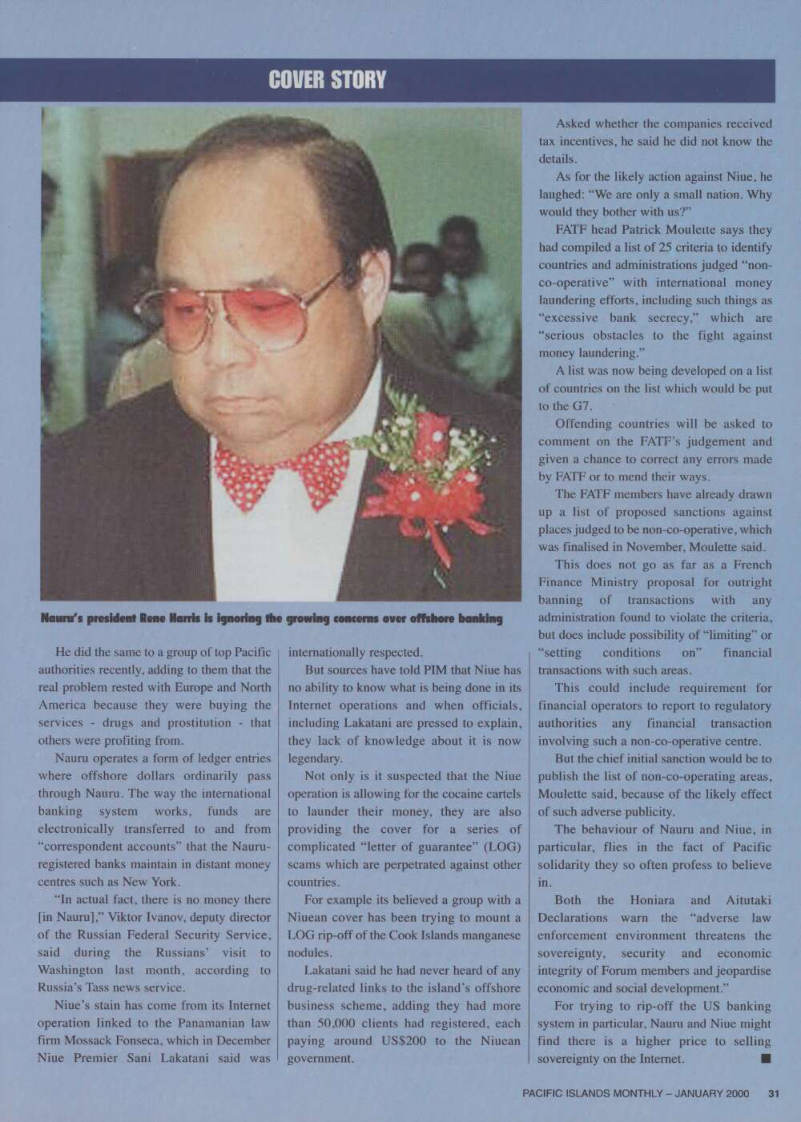
Nauru’s president Rene Harris is
ignoring the growing concerns.
“What’s it got to do with you?” he told the Washington Post angrily before hanging up.
He did the same to a group of top Pacific authorities recently, adding to them that the real problem rested with Europe and North America because they were buying the services - drugs and prostitution - that others were profiting from.
Nauru operates a form of ledger entries where offshore dollars ordinarily pass through Nauru. The way the international banking system works, funds are electronically transferred to and from “correspondent accounts” that the Nauru registered banks maintain in distant money centres such as New York.
“In actual fact, there is no money there [in Nauru],” Viktor Ivanov, deputy director of the Russian Federal Security Service, said during the Russians’ visit to Washington last month, according to Russia’s Tass news service.
Niue’s stain has come from its Internet operation linked to the Panamanian law firm Mossack Fonseca, which in December Niue Premier Sani Lakatani said was
internationally respected.
But sources have told PIM that Niue has no ability to know what is being done in its Internet operations and when officials, including Lakatani are pressed to explain, they lack of knowledge about it is now legendary.
Not only is it suspected that the Niue operation is allowing for the cocaine cartels to launder their money, they are also providing the cover for a series of complicated “letter of guarantee” (LOG) scams which are perpetrated against other countries.
For example its believed a group with a Niuean cover has been trying to mount a LOG rip-off of the Cook Islands manganese nodules.
Lakatani said he had never heard of any drug-related links to the island’s offshore business scheme, adding they had more than 50,000 clients had registered, each paying around US$2OO to the Niuean government.
Asked whether the companies received tax incentives, he said he did not know the details.
As for the likely action against Niue, he laughed: “We are only a small nation. Why would they bother with us?”
FATF head Patrick Mouleite says they had compiled a list of 25 criteria to identify countries and administrations judged “non co-operative” with international money laundering efforts, including such things as “excessive bank secrecy,” which are “serious obstacles to the fight against money laundering.”
A list was now being developed on a list of countries on the list which would be put totheG7.
Offending countries will be asked to comment on the FATF’s judgement and given a chance to correct any errors made by FATF or to mend their ways.
The FATF members have already drawn up a list of proposed sanctions against places judged to be non-co-operative, which was finalised in November, Moulette said.
This does not go as far as a French Finance Ministry proposal for outright banning of transactions with any administration found to violate the criteria, but does include possibility of “limiting” or “setting conditions on” financial transactions with such areas.
This could include requirement for financial operators to report to regulatory authorities any financial transaction involving such a non-co-operative centre.
But the chief initial sanction would be to publish the list of non-co-operating areas, Moulette said, because of the likely effect of such adverse publicity.
The behaviour of Nauru and Niue, in particular, flies in the fact of Pacific solidarity they so often profess to believe in.
Both the Honiara and Aitutaki Declarations warn the “adverse law enforcement environment threatens the
sovereignty, security and economic
integrity of Forum members and jeopardise economic and social development.”
For trying to rip-off the US banking system in particular, Nauru and Niue might find there is a higher price to selling sovereignty on the Internet. ■
Nauru's president Rene Harris is ignoring the growing concerns over offshore banking