Big changes after Marshalls national election
pp. 10-11 · Read in the full issue
Special Report
By Gift Johnson
Marshall Islands’ voters knocked out two-thirds (four of six) of the cabinet ministers seeking re election and dropped other incumbents giving the United Democratic Party the first ever majority for an opposition group in this north Pacific nation.
The two most powerful cabinet ministers, finance minister Tony deßrum and foreign minister Phillip Muller, were unseated by a UDP landslide in the capital.
Majuro went from being a three-to-two government party stronghold to a four-to one UDP base as a result of the vote.
While the fates of a couple of ministers were decided by just one or two votes, Muller and deßrum didn’t even come close to returning. Both are 16 year veterans of the Nitijela.
The political changes evident since the death of first President Amata Kabua continue to escalate. Kabua, who died in December 1996, dominated Marshall Islands politics for three decades through his power as a paramount chief.
But the November national election is just the latest in a string of unprecedented
political developments as Marshall
islanders are increasingly shrugging off the yoke of traditional control.
The force of this year’s campaigning has its roots in a watershed event that occurred 18 months ago, in March 1998.
In that month, citizens of the Marshall Islands did something that had never done
before: the community led a campaign that resulted in the Nitijela (parliament) shutting off gambling in the country.
It demonstrated that ordinary people had the power to effect change in government policy - a previously unheard of concept in a country where traditional leaders have dominated the western political system.
The impact of that Nitijela vote continues to reverberate. President Imata Kabua, Muller and deßrum were barred from voting by Speaker Kessai Note because they owned gambling machines.
The High Court and Supreme Court supported the Speaker’s action. As well, Kabua brought in deßrum, formerly a leading opposition member, as finance minister, dropping five Amata-era cabinet ministers.
The country’s first vote of no confidence lost by a single vote, the United Democratic Party was formed, and now the voters have endorsed change.
The first national election in the post- Amata Kabua era was preceeded by aggressive campaigning by UDP candidates who campaigned on an anti-
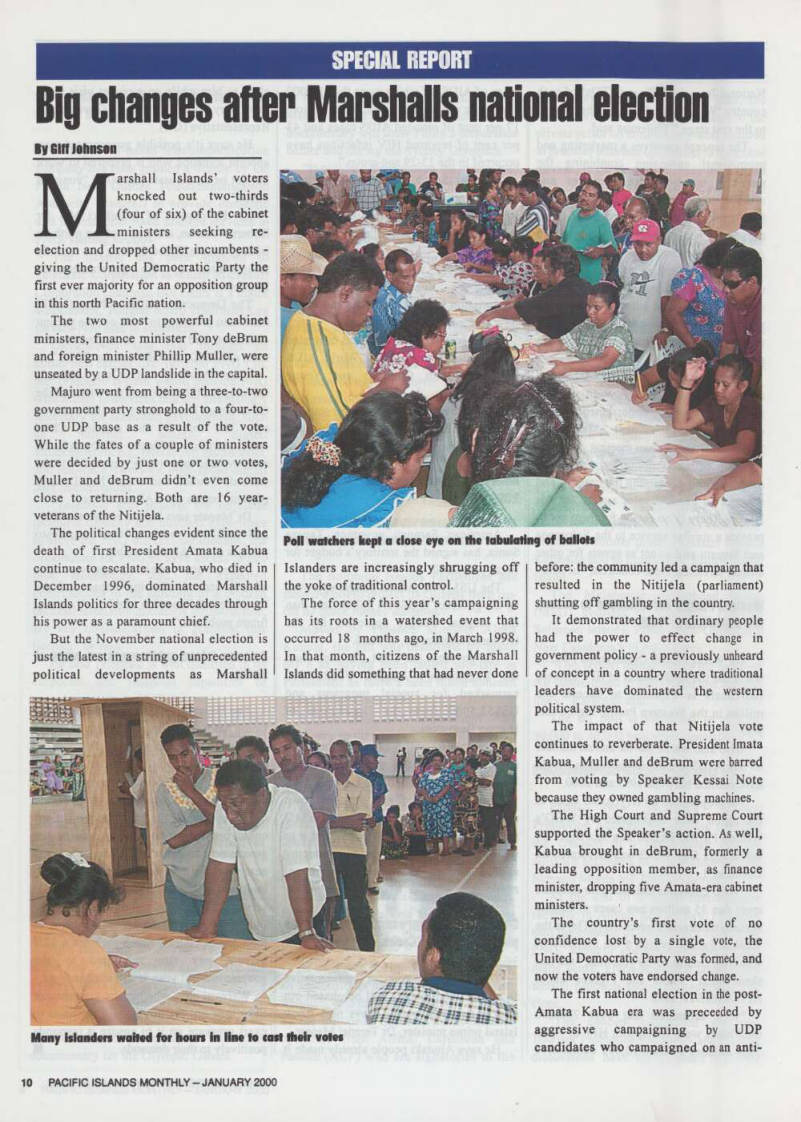
Many islanders waited for hours in line to cast their votes
Poll watchers kept a close eye on the tabulating of ballots
corruption platform. UDP candidates led a grassroots effort that went village by village in Majuro, and to a number of the outer atolls.
Feeling the heat of the opposition’s criticism, Muller and deßrum about six weeks before the election mounted a high profile campaign as part of a three-way team with Iroij (chief) and vice speaker Jurelang Zedkaia. Zedkaia is the ranking chief for Majuro since Amata Kabua’s death.
But while he managed a third place finish in the five-seat contest, UDP incumbents Wilfred Kendall, the former long time ambassador to Washington, and Witten Philippo, the former chief justice of the high court, ran away with the top two slots.
UDP candidates Brenson Wase and Alik Alik rounded out the Majuro field.
Imata Kabua was easily reelected to office representing Kwajalein, where he is the leading chief. But unless he can engineer
substantial defections from the UDP, he will return to the Nitijela as a minority party leader. Other signs of change were evident in local government races. The Majuro Atoll local council will see at least seven new members on the 13-seat council, several of whom will significantly lower the average age of the membership.
Eight years ago, the Ralik Ratak Democratic Party launched the first high profile campaign based heavily on an anti corruption and issue-oriented platform.
In 1991, it rocked the boat but gained only a handful of seats in a country then dominated by Amata K^bua.
Though tabulating was continuing into December because of the large number of absentee votes throughout this watery nation, it appeared that the UDP would have at least 18 votes in the 33 seat parliament. This is a switch from the previous alignment when President Imata Kabua controlled by the same margin.
The biggest challenge for the UDP is arriving at agreement on its presidential candidate. There were at least four possible candidates, but popular Jaluit Senator Alvin Jacklick pulled back in order, he said, to keep the “U” in UDP intact.
Thus the battle was shaping up among Speaker Kessai Note, top Majuro vote getter Kendall and Ailinglaplap Senator Christopher Loeak. Loeak is a chief, and former cabinet minister under Amata Kabua, who lost his post last year in the cabinet shakeup.
Nitijela convenes on January 3, and the UDP was holding meetings in mid- December to arrive at a concensus for the opening of Nitijela.
Assuming the UDP can maintain its present unity and pull together around a single presidential candidate, Kabua’s group, long known as the “caucus” or simply the government party, will need to get a name change. ■
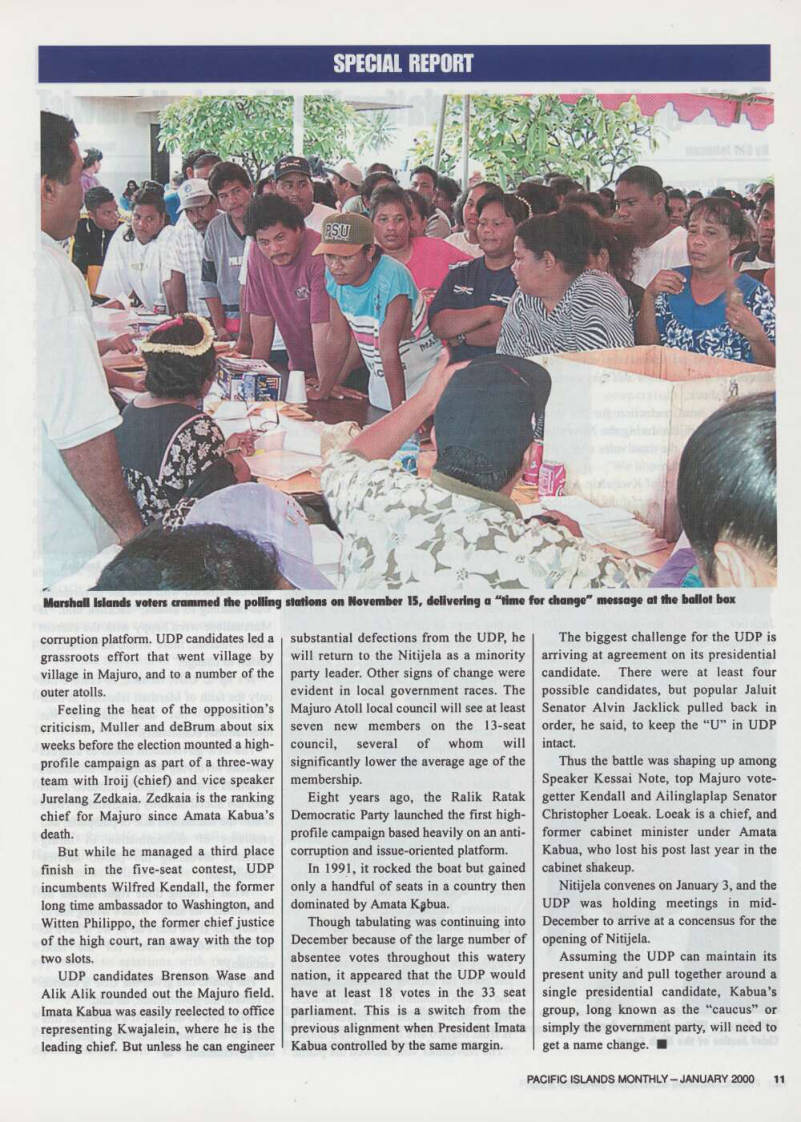
Marshall Islands voters crammed the polling stations on November 15, delivering a "time for change" message at the ballot box