What lies ahead in the Pacific region?
pp. 5-7 · Read in the full issue
Opinion
BY Noel Levi, CBE, Secretary
General, South Pacific Forum
Secretariat
South Pacific Forum Leaders at their Palau meeting responded to WTO and globalisation by making the historic decision to establish a free trade area among Forum members.
What will the free trade area look like, and what are its implications for private sector development and business associations? Before attempting to answer these questions I would like to first explain the rationale behind Leaders’ decision to pursue this strategy.
All of us are aware that there has been a fundamental shift in global aid and trade regimes. On the one hand there has been, and continues to be, a decline in real aid flowing to developing countries.
This has given rise to the need to develop an alternative and more sustainable basis for our development agenda. This is where trade enters the picture. It is not a new idea. This is what founding members of the Forum envisaged when they talked about the need for “Trade not Aid.”
But we are also faced with the challenges to and loss of trade preferences that currently sustain some of our key industries. We see this in the WTO, and we see it in the way the benefits under the Lome Convention are being challenged and eroded. We also see how trade liberalisation and the debate in the WTO continues to chip away at aid, which has been critical to our survival as small and underdeveloped nations in this world of the “uneven playing field.”
All Forum members have begun to
respond to these challenges by undertaking
reforms to enhance economic management and liberalise their economies. In addition, we have also begun, to varying degrees, some measure of trade integration.
Many of our members have entered into bilateral trade agreements with each other.
In Melanesia, the Melanesian Spearhead
Group Trade Agreement has become in effect the ‘spearhead’ of trade liberalisation for all Forum Island countries. What the MSG countries have forged together is a good
practical example
of integration at the sub-regional level.
The aim of the Forum free trade area is to expand and deepen the MSG model to the region as a whole.
So exactly what benefits can we expect from doing this? Or in other words, how will the formation of a
regional trading
bloc strengthen our
position in the world of the ‘uneven playing field’?
It does so by addressing two fundamental characteristics of our individual economies that constrain economic growth - smallness and isolation.
One of the greatest problems confronting the region is that the market in most Forum Island countries is too small to adequately develop the private sector. A small domestic consumer base prevents enterprises from realising economies of scale in their production and reducing their unit costs.
The benefits of the potential economies of scale generated by the creation of a single market of six million people rather than 14 fragmented ones will be obvious to anyone in the business community.
Free trade will also encourage regional cooperation in areas of trade facilitation such as customs, quarantine, standards and statistics that will permit economies of
Continued next page
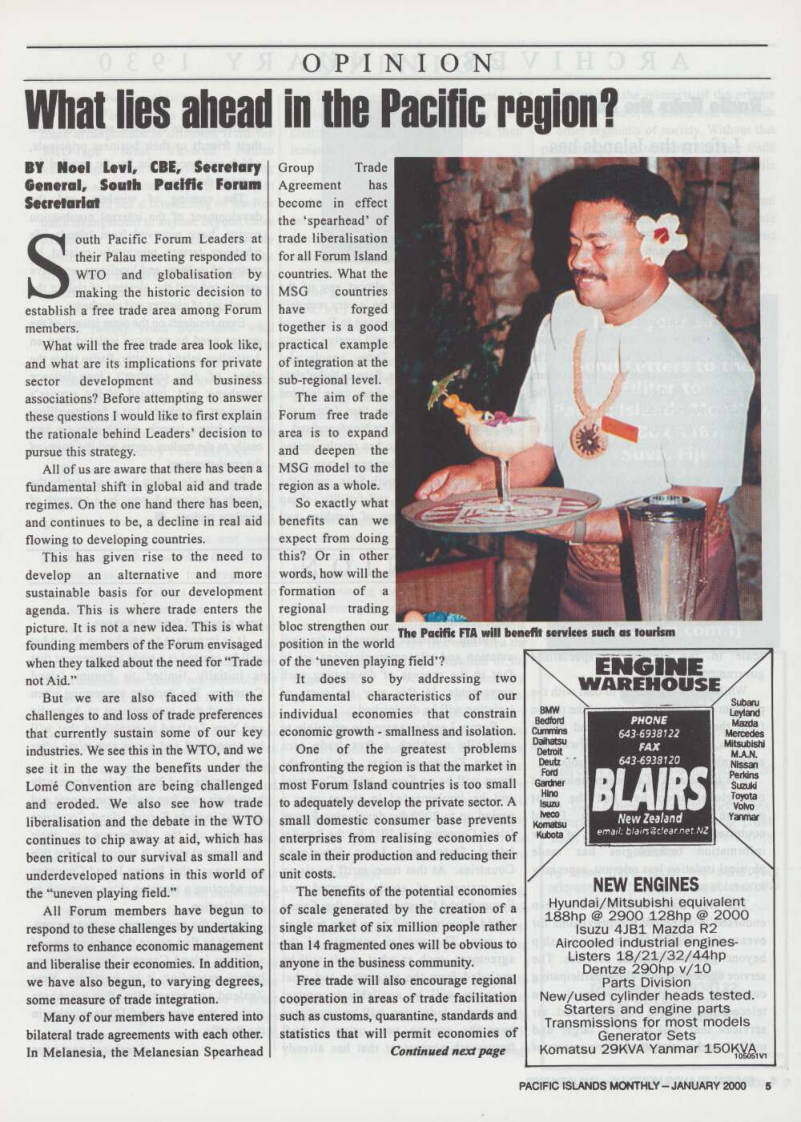
The Pacific FTA will benefit services such as tourism
Continued from previous page
scale in the supply of specialised government services.
While it is not possible to deal with the problem of physical isolation of the region from the rest of the world and global markets, it is possible to deal with the economic consequences of that isolation.
It is in the area of telecommunications that globalisation has had the most positive benefit for Forum Island countries. The development of new information technologies has made physical isolation less relevant, especially to service providers.
The free trade area that has been endorsed in principle has provisions for
eventually deepening the relationship
beyond goods to include services. The service agreement will allow participating countries to append protocols on telecommunications, shipping and air services that will create a larger and unified market, thereby lowering costs of
these services.
Forum Ministers responsible for civil aviation and telecommunications are in fact in the process of developing such agreements. In this way the costs of isolation will be diminished ...
Forum Leaders agreed in principle to gradually establish a free trade area among Forum members. Initially the focus will be on Forum Island Countries and be implemented in stages over a period up to 2009 for developing Forum Island Countries and 2011 for the Smaller Island States and Least Developed Countries. At that time, tariff levels on the majority of goods imported into Forum Island Countries from other Forum Island Countries will have been reduced to zero. The precise contents of the agreement, such as what goods will be excluded from the agreement and what measures will be available to protect developing industries, will be negotiated over the coming year using a draft framework agreement that has already
been prepared for this purpose.
It is important to emphasise that what will be created is a trade arrangement that is initially limited to Forum Island Countries. The decision concerning when to extend the arrangement to Australia and New Zealand is something that will be negotiated and occur sometime after 2011.
Australia and New Zealand currently have their own free trade arrangement and did not include Forum Island Countries because of the difference in their development status. It is precisely for this same reason that Forum Island Countries are adopting a stepping stone approach to liberalization.
Being the prudent region that we are, we wish to first gauge the implications of a Forum Island Country free trade area before extending it to Australia, New Zealand and potentially other neighbors such as the French and US territories in the Pacific.
Continued next page
Continued from previous page
It is also important to note that the free trade arrangement is different from the WTO-type Most Favored Nation liberalisation that is based on lowering tariffs to all countries. There is nothing in it that would see a broadening of the free trade arrangement to anyone beyond those countries and territories already mentioned. There is also nothing in the arrangement that prevents members from pursuing broader liberalisation at an MFN level, or with any country they wish.
Ten, twenty years from now, what impact can we expect the free trade area to have had on Forum Island Countries?
Some of you may be aware of the analysis we had prepared to estimate the welfare and economic benefits that might be expected to follow the creation of a Forum Island Country free trade area.
The analysis showed the benefits for almost all members to be small in magnitude. This in fact was not a surprise, given that the analysis was based on current economic structures and trade patterns. In other words, the results reflected an inability to imagine or envisage new possibilities that a free trade area will create for businesses.
As the Australia-New Zealand Closer Economic Relations Trade Agreement so clearly illustrates, free trade areas create opportunities that could not possibly be imagined at the time of their inception.
In the case of Australia and New Zealand - two countries with limited trade prior to their trade agreement - their free trade agreement created an enabling environment where businesses identified and capitalised on new opportunities. The Forum Island Country free trade area offers the private sector in our member countries similar potential.
We should not, however, underestimate the challenge associated with establishing a healthy investment climate. It includes a
long list of requirements including quality
infrastructure services at competitive prices, secure access to land and an educated and productive workforce. These issues will need to be addressed in order for businesses to grow and take advantage of the opportunities that free trade will create for our members.
I like to view the free trade area as a catalyst that will assist our members in the continuing challenge to improve their business environments.
I have already spoken about how the free trade approach will bring economy of scale to both producers in the private sector and suppliers of specialised government services. I have also highlighted how it will diminish the costs of isolation. In addition, and perhaps one of the greatest benefits of the free trade area, will be the discipline it forces on member countries to maintain economic policies that make it a competitive place to invest and do business.
Clearly, enterprises operating within efficiently administered, low cost, stable business environments will have a competitive edge over those that do not.
Those countries that do not maintain a competitive environment for their private sector will lose out to their neighbours that do. I expect the free trade area therefore to play an important role in maintaining government focus and resolve in continuing the economic reforms they have embarked upon.
Negotiating and implementing the free trade area agreement is not something that can be done by government in isolation.
In order to embrace the free trade area the private sector must be consulted in the negotiation process. Similarly, government officials and representatives of the private sector will need to work together to analyze existing trade patterns in the region, identify where the potential opportunities lie and determine what actions they should each be taking in order to take advantage of these them. This
requires close and on-going dialogue
between government and the private sector. This is where business associations come into play.
Government needs strong, representative business associations with which to interact. A fragmented business
community, with enterprises pursuing
their own narrow interests is a cumbersome and unproductive partner to work with. The private sector on the other hand needs a government that understands the realities of the business world and is
Continued next page
committed to the interests of the private sector as a whole, balanced with the needs of other segments of society. Without this partnership, it is unlikely the free trade area will generate the benefits it is capable of providing. * This text is part of an address to Maui Pacific Center Conference on “The Role of Business Associations in Pacific Island Economic Growth.” ■