US annexation of Wake Island illegal
pp. 36-37 · Read in the full issue
By Giff Johnson
American claims to sovereignty
over Wake Atoll in north Pacific are based on an annexation that violated international law, according to an article published in a recent edition of the Journal of Pacific History.
The detailed discussion of Wake’s history since the late 1800’s, by researcher Dirk H R Spennemann, the former chief archeologist in the Marshall Islands who is now the cultural heritage manager of the Johnstone Center at Charles Sturt University in Australia, casts a shadow over American claims to Wake.
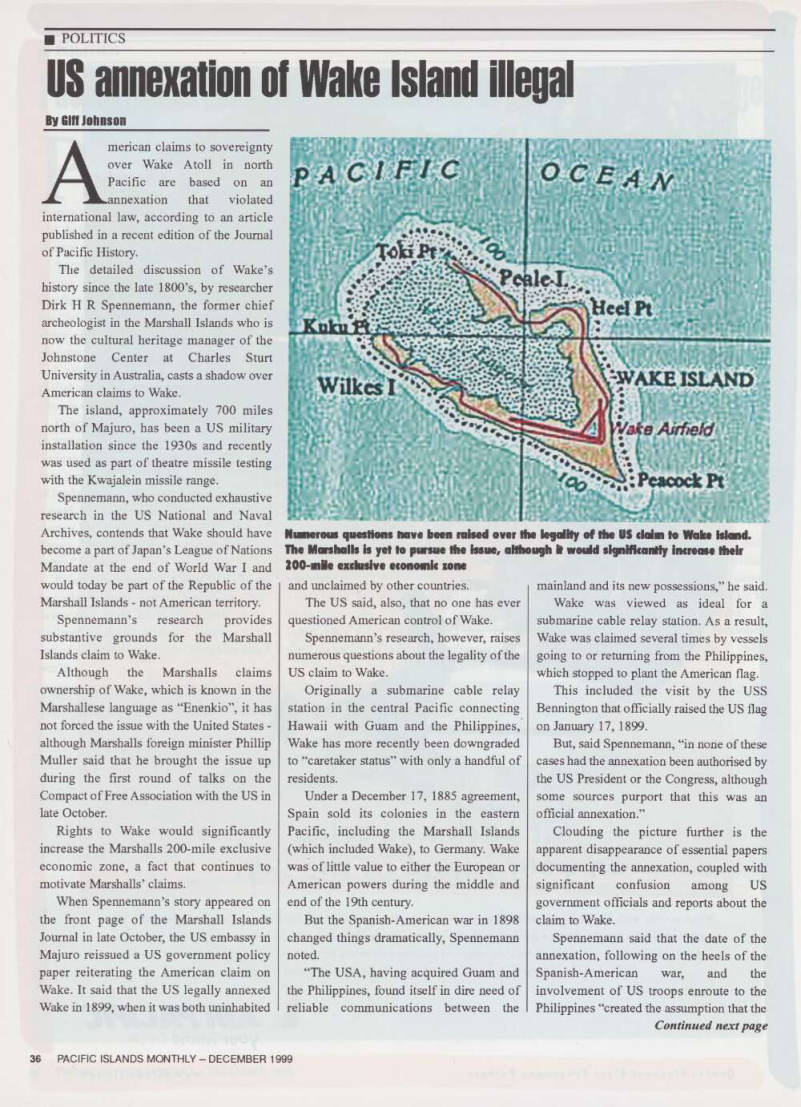
The island, approximately 700 miles north of Majuro, has been a US military installation since the 1930 s and recently was used as part of theatre missile testing with the Kwajalein missile range.
Spennemann, who conducted exhaustive research in the US National and Naval Archives, contends that Wake should have become a part of Japan’s League of Nations Mandate at the end of World War I and would today be part of the Republic of the Marshall Islands - not American territory.
Spennemann’s research provides substantive grounds for the Marshall Islands claim to Wake.
Although the Marshalls claims ownership of Wake, which is known in the Marshallese language as “Enenkio”, it has not forced the issue with the United States although Marshalls foreign minister Phillip Muller said that he brought the issue up during the first round of talks on the Compact of Free Association with the US in late October.
Rights to Wake would significantly increase the Marshalls 200-mile exclusive economic zone, a fact that continues to motivate Marshalls’ claims.
When Spennemann’s story appeared on the front page of the Marshall Islands Journal in late October, the US embassy in Majuro reissued a US government policy paper reiterating the American claim on Wake. It said that the US legally annexed Wake in 1899, when it was both uninhabited
and unclaimed by other countries.
The US said, also, that no one has ever questioned American control of Wake.
Spennemann’s research, however, raises numerous questions about the legality of the US claim to Wake.
Originally a submarine cable relay station in the central Pacific connecting Hawaii with Guam and the Philippines, Wake has more recently been downgraded to “caretaker status” with only a handful of residents.
Under a December 17, 1885 agreement, Spain sold its colonies in the eastern Pacific, including the Marshall Islands (which included Wake), to Germany. Wake was of little value to either the European or American powers during the middle and end of the 19th century.
But the Spanish-American war in 1898
changed things dramatically, Spennemann
noted.
“The USA, having acquired Guam and the Philippines, found itself in dire need of reliable communications between the
mainland and its new possessions,” he said.
Wake was viewed as ideal for a submarine cable relay station. As a result, Wake was claimed several times by vessels going to or returning from the Philippines, which stopped to plant the American flag.
This included the visit by the USS Bennington that officially raised the US flag on January 17, 1899.
But, said Spennemann, “in none of these cases had the annexation been authorised by the US President or the Congress, although some sources purport that this was an official annexation.”
Clouding the picture further is the apparent disappearance of essential papers documenting the annexation, coupled with significant confusion among US government officials and reports about the claim to Wake.
Spennemann said that the date of the annexation, following on the heels of the Spanish-American war, and the involvement of US troops enroute to the Philippines “created the assumption that the
Continued next page
Numerous questions nave been raised over the legality of the US claim to Wake Island.
The Marshalls is yet to pursue the issue, although it would significantly increase their 200-mile exclusive economic zone
Continued from previous page US annexed Wake from Spain.”
But if Spain had considered Wake still a part of its Micronesian holdings, the island would have been included in the negotiations of the Paris Treaty of Peace at the end of the Spanish-American war. “This was not the case,” Spennemann said. “In the eyes of Germany, Wake had been obtained from Spain as part of the Marshalls” when the two nations signed the treaty in 1885.
Why, then, didn’t Germany object to this infringement on its territory? The aftermath of the Spanish-American war saw major realignment of colonial control over possessions in the region: the US took control of the Philippines and Guam, Hawaii became a US territory and the Carolines, Palau and the rest of the Marianas became German.
Control of Samoa and the economic interests that resulted “had been the focus of a long-running dispute among Germany, the US and England. The German government, which saw Samoa as a prize possession, did not wish to endanger any emerging agreement,” he said. “In this game, Wake was a pawn.” With Germany’s defeat in World War I, the ownership issue was conveniently forgotten, Spennemann said.
But the fact that Germany - not Spain claimed ownership of Wake is indisputable, Spennemann said.
In addition to the sale agreement of 1885, following the Spanish-American war,
Spain and Germany signed another
agreement on September 10, 1898 guaranteeing that Germany would
eventually gain control of all Spanish
possessions in the South Pacific that were not ceded to or otherwise disposed of by treaty with the United States.
“Even if the US were in doubt as to the German ownership of Wake based on the 1885 agreement, the terms of the 1898 agreement and the non-inclusion of Wake in the Treaty of Paris (between Spain and the
US) unequivocally reconfirmed Germany’s
claim (to Wake),” Spennemann said.
Indeed, while in 1906 the Navy said rather ambiguously that it “was of the opinion” that Wake was under its jurisdiction, in 1913 the General Board of the Navy was more blunt.
“The records in the Department (of the Navy) afford little definite information in regard of Wake Island aside from the fact that it belongs to the US. It does not appear that this island has ever been placed under the control of any of the executive
departments.”
Interestingly, noted Spennemann, the US did not take aggressive action to enforce its sovereignty at Wake when the uninhabited island was being lived on and used by
Japanese fishermen intermittently between
1902 and 1908. In contrast, he said, when the same situation occurred on German controlled Taongi and US-controlled Laysan/Lisianski, both countries acted to enforce sovereignty. “The US did nothing to develop Wake or to enforce its sovereignty,” he said.
Spennemann said the record demonstrates that “the annexation of Wake is far from straightforward.”
Because Germany controlled Wake by the time of the Spanish-American war of
1898, “the US annexation contravened international law, especially as Germany had been neutral"’ during the war, he said.
“That the US felt uneasy over the ownership issue becomes clear in light of the internal confusion on its own authority on the island and the government’s reluctance to spell out details of the annexation.
“The disappearance of crucial documents relating to the US annexation and the lack of material on a German- American agreement on Wake leaves a bad aftertaste especially in view of its
implications.
“If the atoll had been annexed illegally, then under international law it would have remained German until the end of the First World War, and in 1919 have become part of Japan’s Mandate over the former German possessions and, via the post-Second World War US Trust Territory period, would today be an integral part of the Republic of the Marshall Islands.” ■