Back to basics as Y2K approaches
p. 25 · Read in the full issue
Year 2000
By Brian Tobla
Many workers at the University of Papua New Guinea and their families are making haste to escape from imminent ordeal that may arise when computers crash in January 31, 1999.
They are among many city residents trying to flee to their remote villages where there is food and water in abundance.
This follows full twelve page advertisement taken up by the PNG government’s Y2K Planning Committee in local newspapers on October 29, 1999, in which it warned the people to be ready.
“Computer problems: Get Ready Before Year 2000” - was the headline of the advertisement and it advised people to, among other things, have extra cash on hand in case computers in banks fail to work, stock up food (mainly rice, tinned food, biscuits and others that can last and do not need refrigeration), store water for cooking and washing, store kerosene, candles and lamps, soap and all other necessary requirements in case something happens.
Local airline operators reported increasing number of people flocking to the airport terminals to make bookings while many others make bookings by telephone.
Many workers at UPNG with their families and relatives are contemplating spending Christmas and New Year holidays in their villages. They want to leave Port Moresby before December 31, 1999 or as early as November - and UPNG is expected to be a “Ghost Suburb” for the Christmas and New Year periods respectively.
Some of them said “back home is the only best possible place to be and receive the new millennium and anything that comes with it”. Others said security for their houses and property would be a problem on campus as only few people would be left behind but that is not paramount - they would leave that task to UniForce (UPNG Security).
It is not by choice they are going away but rather a must for safety and security - it would be safer back home where there is a lot of food in case the computers do not work as per the government advice.
“Yu save taim kuputa i no wok and kaikai na wara i sot, bai i gat planti problem ... ol man bai bagarapim narapela man long kaikai tasol na ino bilong mani,” said an employer in Pidgin English. (You know when there is food and water shortage due to computer crash, people would attack others not necessarily for money but for these material
things).
He added that there would be a lot of law and order problems in the cities and even the police may not be able to contain them because they too would be affected. So it is much safer at home. While there is some level of panic among the general populous on what may happen when computers stop working on January 1,2000, the government and experts have their opinions.
UPNG Computer Services director, Marco Guevera recommended to UPNG staff not to be afraid but not be surprised either. If people believe rumors, they can expect bigger problems during the new year.
Guevera said that if people were going to
their villages, they may take their money with them, putting banks in negative cash flow positions. “Crime will increase here and in their own villages as well because of high circulation of the bills,” he added.
There is a danger that some people can manipulate others like in those sects were a considerable number of people were persuaded to commit suicide - and that is a collective response to an improper news circulating in the air. “So whatever you are going to do, please think about it two or three times before doing it ... but please put your foot on the ground because the earth does not know about Y2K,” he said.
He believes the government is aiming for all systems to be Y2K compliant, or as much as possible with the technology it has, while at the same time, advising people to be aware in case some problems appear after January 1, 2000. There are no guarantees.
Guevera says UPNG staff and Papua New Guineans should be conscious of the existence of this problem like being conscious of all the virus, war, natural disasters and others and be prepared anyway.
“As I mentioned before, we have to do all that is in our hands to be sure nothing can happen ... but Y2K is a problem actually present in all the digital devices (which contains a small or big computer inside) and due to the wide range of use of this devices at present, we can not be 100 per cent sure about this problem unless we face it and experience it,” he added.
Like the rest of the world, computers have proliferated in PNG. Governments and the private sector around the world have spent big amounts of money to fix the bug.
Generally, big companies in sectors
including communications, electricity, banks
and water (because of the impact of their services on the community) should have updated systems by the end of the year.
Jf anyone is going to be affected, it will most likely be those smaller companies whose budgets could not be extended for Y2K updates. These small companies may have smaller problems but their number would be probably considerable. ■
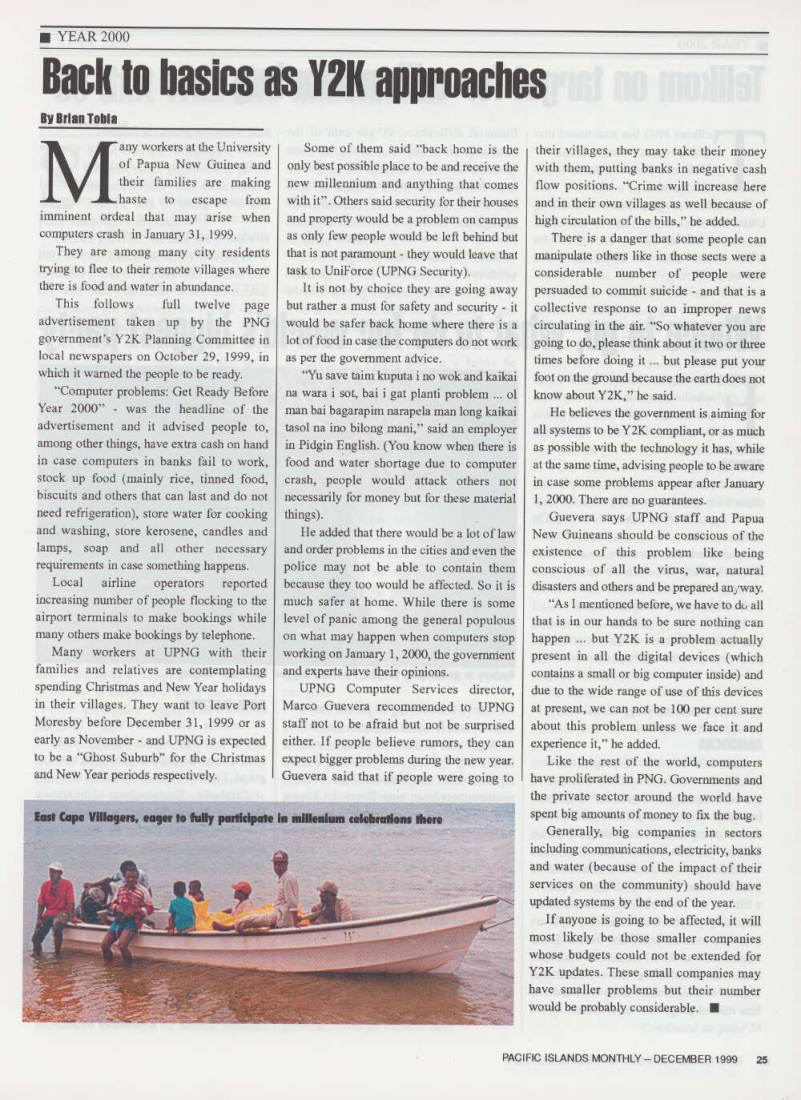
East Cape Villagers, eager to fully participate in millenium celebrations there