Pilot error suspected in Guam crash
p. 23 · Read in the full issue
Pilot error and cockpit confusion were cited by United States federal investigators as the main causes of the 1997 crash of a Korean Air jumbo jet in Guam that killed 228 people. But investigators said training problems and inadequate US oversight of foreign airliner safety were also factors.
The US National Transportation Safety Board said the captain of Korean Air Flight 801 failed to brief the flight crew of the potential complications in the landing and then became preoccupied with a partially
inoperative instrument landing system,
causing the plane to slam into a hillside five miles from the runway.
“The probable cause of this accident was the captain's failure ... to execute the nonprecision approach and the first officer’s and flight engineer’s failure to effectively monitor and cross-check the captain’s execution of the approach,” the 300-page report concluded.
But the NTSB said there were underlying factors that played a significant role in the accident, including: • The fatigue of the captain, who did not follow procedures for landing when the instrument landing system is not operating properly, a condition the flight crew had been made aware off at least three times. • The Federal Aviation Administration’s deliberate decision to inhibit and not
properly manage a ground-based
altitude warning system that - had it been coded as designed - would have warned controllers that the jetliner was too close to the ground more than a minute before it crashed. The FAA issued a statement acknowledging that the devices, which are at 193 airports, were having problems in 1997, but that they since then had been reprogrammed and the problems corrected. • Korean Air’s “inadequate flight crew training” and inadequate attention to cockpit management. At the time of the accident, there were “systemic problems” in the airline’s training of flight crews. In addition, the NTSB said
it found the FAA’s international aviation safety assessment program “not adequate to determine whether foreign air carriers operating into the United States are maintaining an adequate level
of safety.”
Korean Air, the world’s 13th-largest airline, has had one of the worst safety records of any major air carrier. Yet, before the Guam accident and a string of more recent runway mishaps, it was given good marks by Korea’s aviation agency and its operation did not raise warning signs within the FAA in Washington.
Since the Guam crash, the airline has invested $ll4 million in new training programs, required increased use of flight simulators to help pilots deal with unusual circumstances, and hired more experienced Western pilots.
“We’re not the same airline. From our standpoint we saw Guam as a starting point for rebuilding our operations,” said William Hardy, a veteran pilot hired by Korean Air to make safety improvements and overhaul its training programs.
Gregory Feith, who led the Guam investigation, told the board members there was confusion in the cockpit during Flight 801’s approach to the island airport on
August 6, 1997, as the pilots appeared to be overly concerned that part of the airport’s instrument landing system was not working even though they had been told of the problem on three occasions.
Still, they failed to use a separate “step down” procedure of controlled descent that was required under those conditions, Feith said.
Investigators also said the captain’s fatigue likely added to the problem and kept him from responding quickly to break off the approach as the Boeing 747 roared toward a hillside nearly five miles from the airport runway in a steady nighttime rain.
“There is evidence the captain was impaired by fatigue,” said Malcome Brenner, one of the investigators.
Just as the NTSB concluded the 27month investigation into the Guam crash, in which 26 passengers survived, its investigators were heavily involved in the Egypt Air crash in the Atlantic off New England.
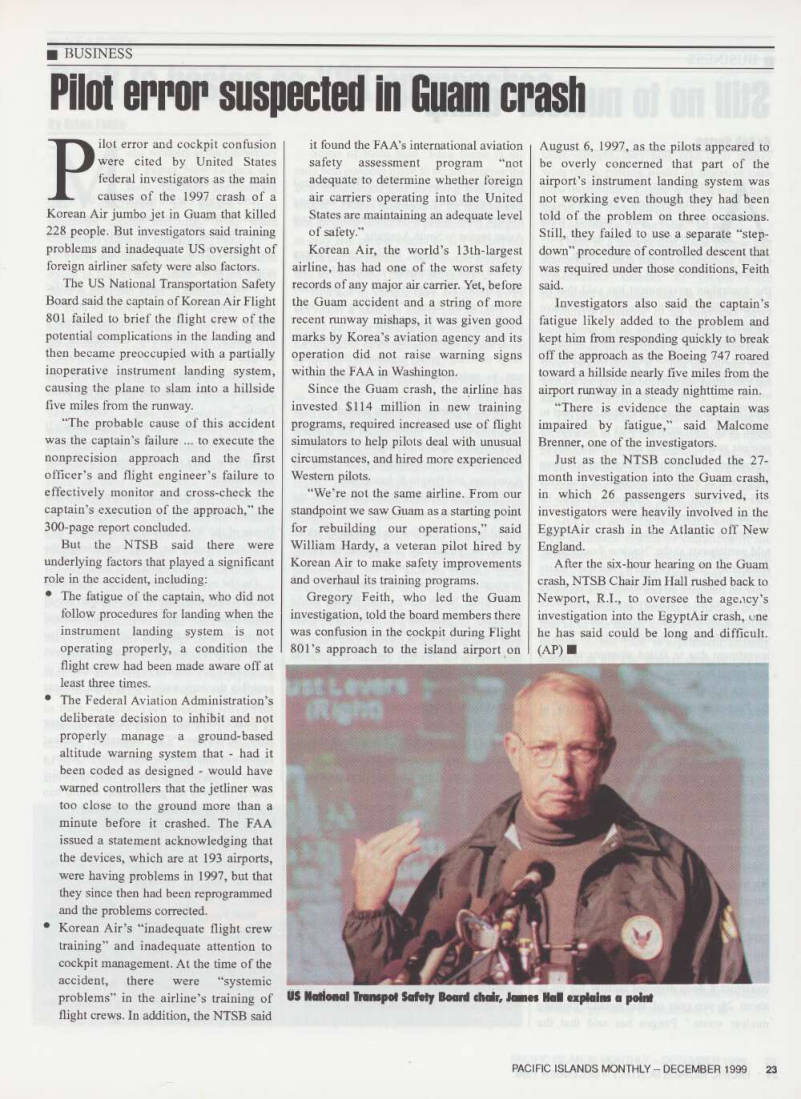
After the six-hour hearing on the Guam crash, NTSB Chair Jim Hall rushed back to Newport, R. 1., to oversee the agency’s investigation into the Egypt Air crash, one he has said could be long and difficult. (AP) ■
US Notional Transpot Safety Board chair, James Hal explains a point