Falealupo aerial walkway spawns retirement fund
p. 19 · Read in the full issue
Samoan cabinet minister Sofia Papu Va’ai recently announced that
Falealupo village (the village that
saved their rain forest as recounted in the book, Nafanua: Saving the Samoan Rain Forest) has decided to use revenues from the aerial canopy walkway to fund a modest retirement fond for elderly villagers.
Sofia reports that Falealupo village council decided as a millennium project to give, beginning on January 1, 2000, each villager over the age of 65 a monthly stipend based on tourist revenues from the aerial walkway.
“This is the first time to our knowledge in the South Pacific that a village has developed its own retirement plan for the elderly,” minister Sofia said. “Many thanks to Seacology for building the rain forest canopy walkway which provides the necessary revenue stream.”
Prominently featured in National Geographic Traveler and other travel
magazines, the Falealupo walkway,
suspended high in the rain forest canopy, is becoming a “must see” for visitors to the island nation of Samoa.
Suspended from stainless steel cables,
the 1,000-metre long, 30 metre high walkway was engineered by Arbornaut Access of Vancouver and funded jointly by Seacology and Nu Skin’s Force for Good.
“The walkway is generating nearly $1,500 per month for the village which retains all proceeds,” reports Seacology chair Paul Cox.
“The village is, in effect, earning far more from the walkway than they were ever offered by the loggers, and many other villages have, as a result, banned all logging activities.
I am deeply touched that the village chiefs would decide to use these funds to help elderly men and women within the village live a better quality of life. What a wonderful millennium project!”
In traditional Polynesian mythology, Falealupo is the last place in the world for each day to end, and will be the last place in the Southern Hemisphere to usher in the new millennium. ■
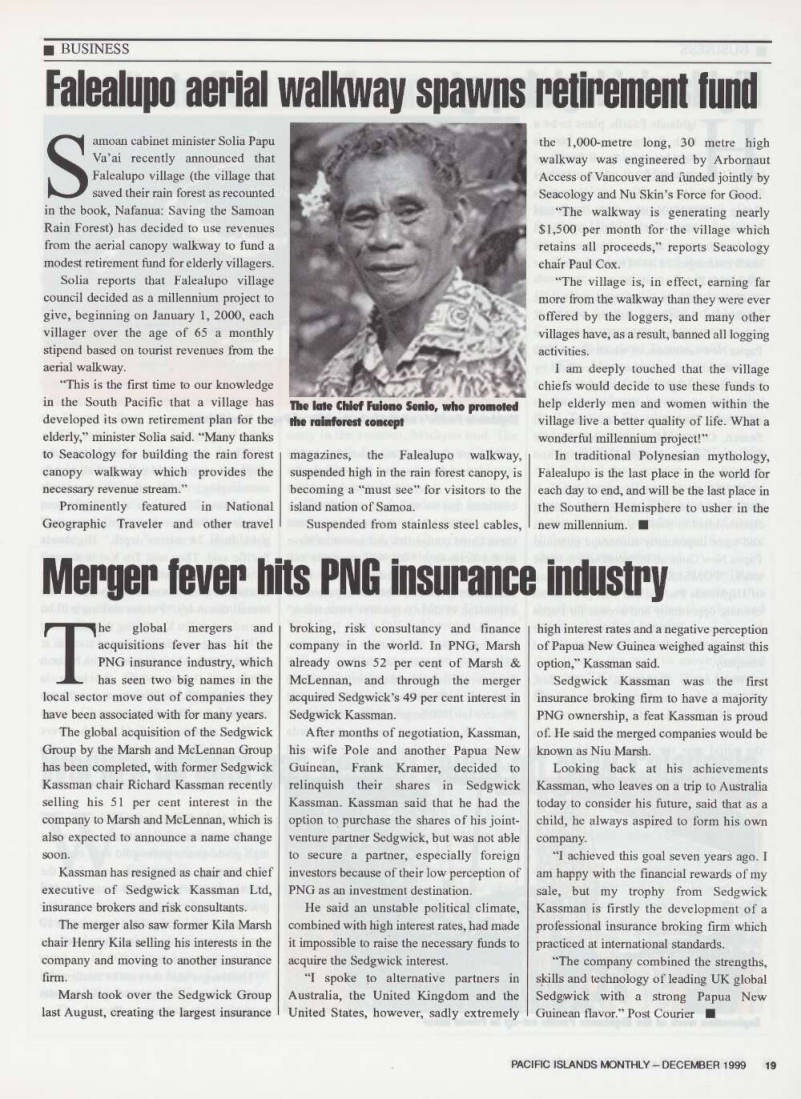
The late Chief Fuiono Senio, who promoted the rainforest concept