Small Islands gain support at special UN session
pp. 44-45 · Read in the full issue
special UN session
SMALL islands are facing a “serious risk of marginalisation,” and current trends in globalisation “will have a crippling effect on our economies,”
Samoan prime minister Tuila’epa Sailele Malielegaoi, who is also Chair of the Alliance of Small Island States (AOSIS), has warned.
He made the comments at the two day Special Session of the United Nations General Assembly on small islands in late September.
Some 120 countries that particpated in the talks agreed that more should be done to assist small island nations con front increasing threats of rising sea levels and natural disasters, as well as the forces
of globalisation.
In a declaration and text agreed by a negotiating group, the Special Session called for increased financing, technology and assistance to the small islands.
Countries renewed their support for a Programme of Action forged five years ago at the Barbados Conference on small islands, which provided the founda tion for a global partnership to tackle
island challenges.
Small island leaders welcomed the UN Special Session as an opportunity to draw attention to their concerns. These include the generally bleak economic prospects for the islands as a result of globalisation and the elimination of trade preferences that have helped sustain their economies in the past.
Nevertheless, many small island representatives voiced concerns that the international community had not been forthcoming with the support that had been promised at the Barbados Confer ence. While applauding the role of the UN in convening the Special Session, St.
Lucia minister of foreign affairs and inter-
national trade, George W. Odium, said, “The failure of developed countries to enter into the spirit of international coop eration has withered the dream. Our hopes have withered, like a raisin in the sun.”
He pointed out that as a result of the recent World Trade Organisation (WTO) ruling against preferential treatment for small island bananas, St. Lucia’s exports had declined by half between 1992 and 1997, and the country’s ranking in the UNDP Human Development Index, which ranks countries according to their eco nomic and social progress, fell from 58th place last year to 81st place this year.
Acknowledging the islands’ fragile
position in the world economy, the Special Session asked the WTO and the UN Con ference on Trade and Development (UNCTAD) to take into consideration the effects on the islands of the erosion of trade preferences and their difficulties with diversification and market access.
In a sympathetic spirit, developed
countries stressed that they would contin ue to work in partnership with the islands.
Speaking for the European Union, Satu Hassi, Finland’s Minister for the Environ
ment and Development Co-operation,
noted that the EU is “by far, the largest development partner for small island developing states,” and pledged to make the poorest, and women, its highest prior
ity.
The EU also hoped that a new trade agreement would serve as “a flexible instrument of cooperation and partnership for the coming decade and beyond.”
Japan said it remained committed to providing assistance despite its recent
economic problems.
United States Under Secretary of State Frank E. Loy, while acknowledging that globalisation “strikes fear in the hearts of many,” said small islands still had much to gain from the process.
While noting that the small islands had already taken many steps on their own to deal with their problems and had made “perceptible progress” in the past five years, the Special Session found that
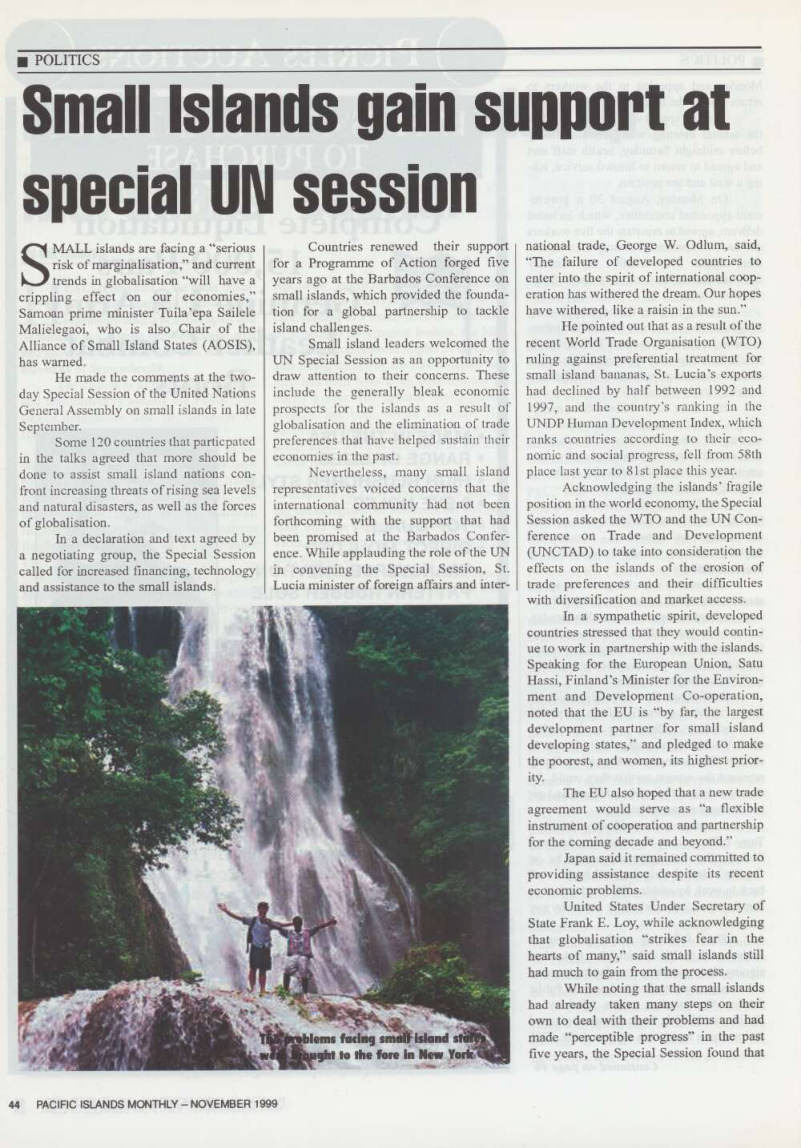
The problems facing small island stares we[?] brought to the fore in New Yor[?]
these efforts had been limited by financial constraints and by global economic and environmental factors.
Countries called on the internation al community to provide the necessary resources to the small islands to fully implement the Barbados Programme of Action. The Special Session did not put a price tag on the small islands action plan, and donor countries generally did not pledge specific amounts of assistance at the Special Session.
The small islands have particularly sought international assistance to deal with issues that are often well beyond their control, yet which seem to affect the islands first, and hardest - such as natural disasters and climate change.
The Special Session agreed that these problems required urgent action, and recommended that greater assistance be provided to help small islands weather disasters and adapt to rising sea levels and other climate impacts.
One of the more contentious issues at the Special Session was the shipping of hazardous and radioactive wastes in sea lanes that pass near the islands.
Barbados deputy prime minister Billie Miller said it was difficult to accept assurances that the movement of radioac tive waste through the Panama Canal en route to Europe for processing was safe.
At a press briefing she said, “You can’t create a mess without any idea of how we’re going to clean it up.”
In the negotiations, the small islands pressed for stronger limits and controls over such shipments, but many developed countries maintained that the question was already covered by existing treaties.
Ultimately, an agreement was reached that called on countries and international organisations to address questions of safety, disclosure, liability and compensation in the event of an accident, recognising the island position that these issues are not adequately dealt with under the Law of the Sea Conven tion or the Basel Convention on haz ardous waste.
The small island developing States, while often small in size and in population, nevertheless represent an important global constituency.
Representatives of AOSIS point ed out that their group consists of 43 countries, 36 of which are UN members, accounting for 19 per cent of the total UN membership and 26 per cent of all developing countries.
Yet, they maintain, small islands are poorly represented in many impor tant global organisations and have had little access to important WTO negotia tions.
Assessing the outcome of the Special Session on behalf of AOSIS, Ambas sador Tuiloma Neroni Slade of Samoa said, “We’ve waited a long time since Barbados for our voices of concern to be heard. People assume that small islands have small problems, but I think we’ve shown this isn’t so.
This Special Session has again raised interna tional awareness of the serious challenges that threaten the very survival of small islands.
The agreement reached outlines some pragmatic steps to be taken, and we look forward to working with our part ners in the international community to put these words into action.”
The Barbados Confer ence was mandated by the
1992 Rio Earth Summit, where over 100 Heads of State agreed on a plan for glob al sustainable development, balancing economic growth and environmental pro tection.
The small islands action plan was seen as the first test of the Rio agreements. ■
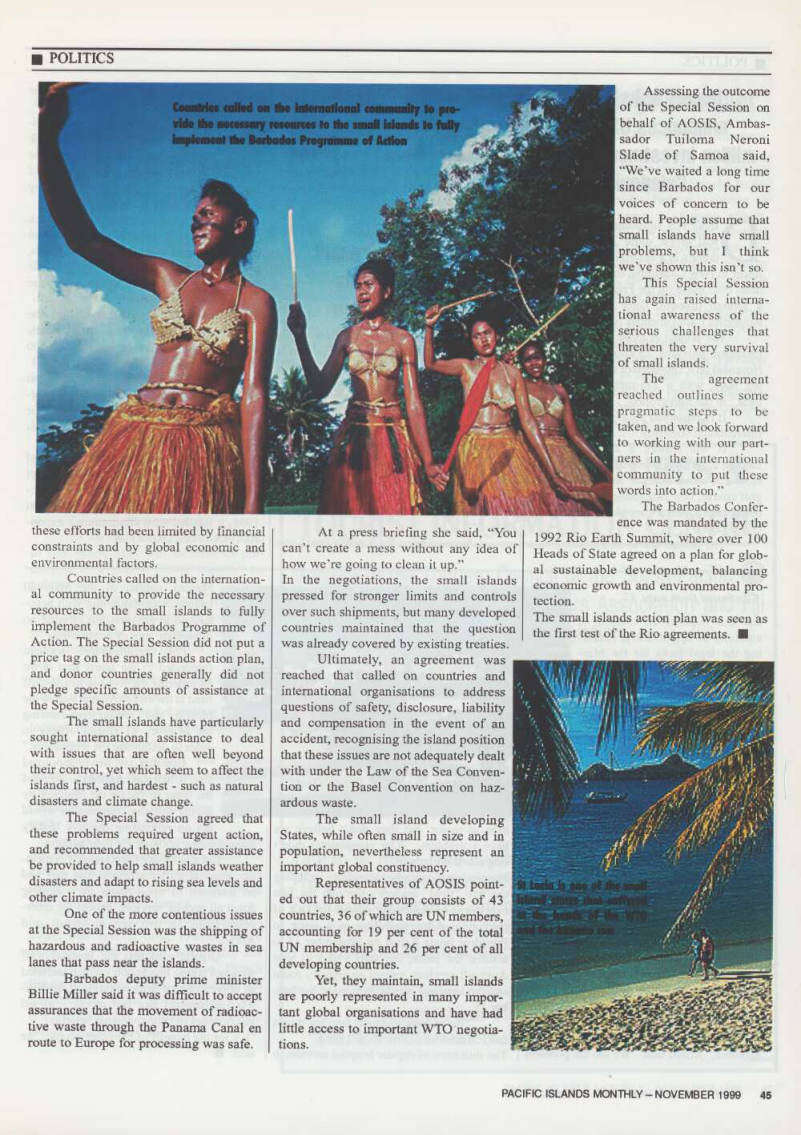
Countries called on the international community to pro vide the necessary resources to the small islands to fully implement the Barbados Programme of Action
St Lusla is one of the [?] Island stares [?] on the [?] and the [?]