Marshalls' capital
pp. 42-46 · Read in the full issue

Politics
Health protests shake up Marshalls' capital
By Gift Johnson
HEALTH services at the main hospi tal in the Marshall Islands were repeatedly shut down in August and September in a dispute between health staff and government leaders that was still unre solved as of September 18.
The dispute is pitting doctors, nurses and administrators against the Public Ser vice Commission and the Minister of Health.
Although the issue at the core of the dispute is the Ministry’s demand to have
personnel management authority trans
ferred from PSC to the Ministry, the unprecedented protest in the Marshall Islands may have significant ramifications for the national election set for November 15.
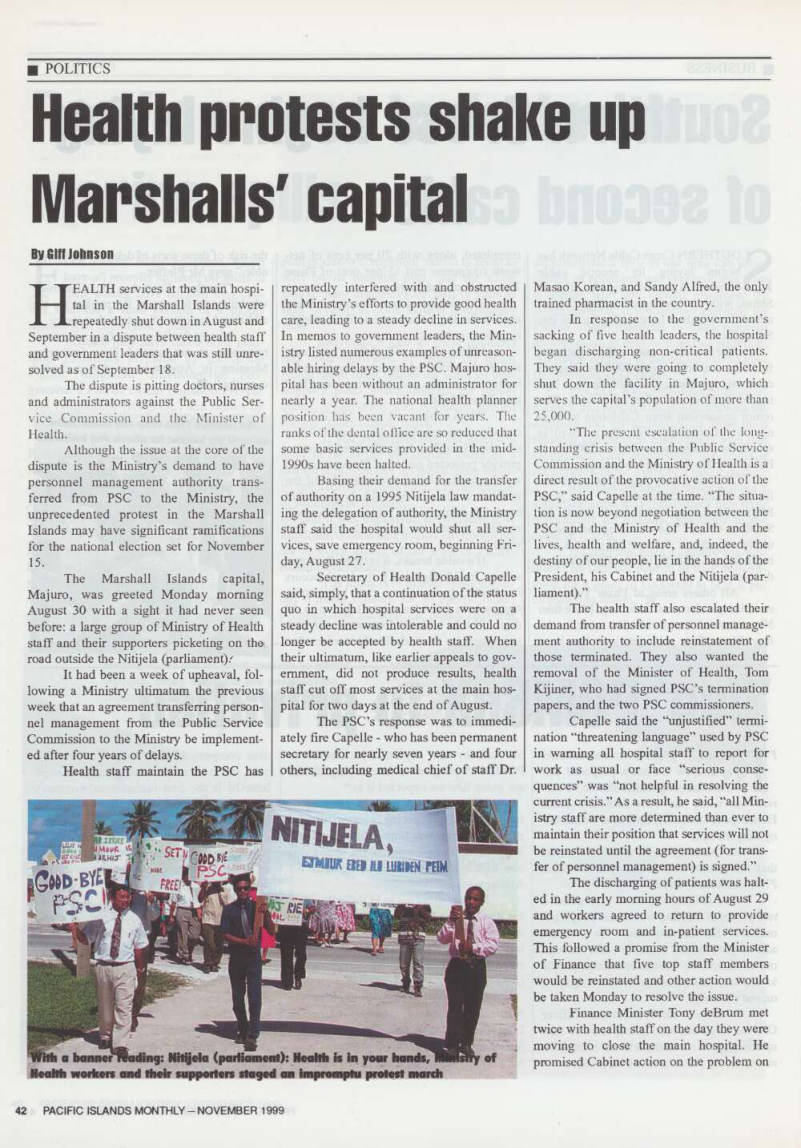
The Marshall Islands capital, Majuro, was greeted Monday morning August 30 with a sight it had never seen before: a large group of Ministry of Health staff and their supporters picketing on the road outside the Nitijela (parliament)/ It had been a week of upheaval, fol
lowing a Ministry ultimatum the previous
week that an agreement transferring person nel management from the Public Service Commission to the Ministry be implement ed after four years of delays.
Health staff maintain the PSC has
repeatedly interfered with and obstructed the Ministry’s efforts to provide good health care, leading to a steady decline in services.
In memos to government leaders, the Min istry listed numerous examples of unreason able hiring delays by the PSC. Majuro hos pital has been without an administrator for nearly a year. The national health planner position has been vacant for years. The ranks of the dental office are so reduced that some basic services provided in the mid -1990s have been halted.
Basing their demand for the transfer of authority on a 1995 Nitijela law mandat ing the delegation of authority, the Ministry staff said the hospital would shut all ser vices, save emergency room, beginning Fri day, August 27.
Secretary of Health Donald Capelle said, simply, that a continuation of the status quo in which hospital services were on a steady decline was intolerable and could no longer be accepted by health staff. When their ultimatum, like earlier appeals to gov ernment, did not produce results, health staff cut off most services at the main hos pital for two days at the end of August.
The PSC’s response was to immedi ately fire Capelle - who has been permanent secretary for nearly seven years - and four others, including medical chief of staff Dr.
Masao Korean, and Sandy Alfred, the only trained pharmacist in the country.
In response to the government’s sacking of five health leaders, the hospital
began discharging non-critical patients.
They said they were going to completely shut down the facility in Majuro, which serves the capital’s population of more than 25,000.
“The present escalation of the long standing crisis between the Public Service Commission and the Ministry of Health is a direct result of the provocative action of the PSC,” said Capelle at the time. “The situa tion is now beyond negotiation between the PSC and the Ministry of Health and the lives, health and welfare, and, indeed, the destiny of our people, lie in the hands of the President, his Cabinet and the Nitijela (par liament).”
The health staff also escalated their demand from transfer of personnel manage ment authority to include reinstatement of those terminated. They also wanted the removal of the Minister of Health, Tom Kijiner, who had signed PSC’s termination papers, and the two PSC commissioners.
Capelle said the “unjustified” termi nation “threatening language” used by PSC in warning all hospital staff to report for work as usual or face “serious conse quences” was “not helpful in resolving the current crisis.” Asa result, he said, “all Min istry staff are more determined than ever to maintain their position that services will not be reinstated until the agreement (for trans fer of personnel management) is signed.”
The discharging of patients was halt ed in the early morning hours of August 29 and workers agreed to return to provide emergency room and in-patient services.
This followed a promise from the Minister of Finance that five top staff members would be reinstated and other action would be taken Monday to resolve the issue.
Finance Minister Tony deßrum met twice with health staff on the day they were moving to close the main hospital. He promised Cabinet action on the problem on
With a banner readingF Nitijela (parliament): Health is in your hands, Rinis try of Health workers and their supporters staged an impromptu protest march
Monday and appealed to the workers to return to staff the hospital.
His first appeal was rejected but after the second meeting with deßmm shortly before midnight Saturday, health staff met and agreed to return to limited service, tak ing a wait and see position.
On Monday, August 30 a govern ment-appointed committee, which included deßrum, agreed to reinstate the five workers and have the personnel management agree ment signed. This satisfied the Ministry staff sufficiently for them to re-open all ser vices on Tuesday.
Part of the plan included appointing Kjnja Andrike, a former Marshalls ambas sador to Japan, to be the new PSC chair. He would then help with approval of the agree ment transferring personnel management authority to the Ministry.
But fewer than 48 hours later, every thing - except emergency room services was again closed briefly on Wednesday.
This was in protest of what they said was an attempt by the minister of health to change the deal reached earlier in the week.
Capelle said that the Minister of Health was proposing to change the person nel management agreement -a move that Capelle said was totally unacceptable to health workers.
Angered by this change in the agree ment, the hospital again shut down all ser vices, except emergency room. Wednesday.
But an hour and a half later, the hospital was back to normal, with the Cabinet’s commit tee intervening to get the agreement back on track, according to Capelle.
Staff from the hospital, which is located across a sports field from the parlia ment building, walked over to the parlia ment Wednesday morning while it was in session. Government leaders immediately recessed the session so that they could, for the second time that week, intervene and get health services turned back on.
Assurances from Finance Minister
Tony deßrum and Vice Speaker Jurelang
Zedkaia that the agreement would be on Capelle’s desk for signing had health staff
back to work by midday Wednesday.
But that wasn’t the end of the matter by any means.
The following week, government leaders told health officials that instead of signing the agreement transferring person nel management authority from the Public Service Commission to the Ministry of Health, the Nitijela leaders instead planned to introduce legislation to repeal the 1995
Continued on page 46
Continued from page 37
law that requires the transfer of authority to the Ministry, remov ing the legal basis for the Min istry’s demand that this authority be transferred, he indicated.
“It’s frustrating and disap
pointing,” Capelle said. “The bot tom line is we’re asking to be
given the opportunity to provide
better services to the peopled’
But, he said, “we were probably naive to think that these were rea sonable people who were con cerned with the well-being of the
people.”
This process has shown that the lead ers involved are “only concerned with retaining their power.”
Health officials said that after new PSC chair Kinja Andrike signed the agree ment after his appointment, they expected it would move forward. But the two other commissioners - Francis Horiuchi and Don ald Matthew - who had fired the five health staff refused to sign.
“People here who know their jobs appealed to the proper authorities about a problem,” Alfred said. “We see the problem
here as major, but they don’t believe we have a problem. (Our complaints) didn’t ring a bell with them.”
Hospital staff continued working - including the five “fired” leaders - through the first two weeks of September despite the lack of resolution. After appealing in a letter to President Imata Kabua on September 13 to resolve the issue, the staff voted to shut down all services, except emergency room and the inpatient wards, beginning Septem ber 15.
“We’re back to square one but minus one,” Alfred said. “We’re still fired.”
The shutdown of regular hospital services in
Majuro, capital of the Marshall Islands, was continuing with nego tiations in progress but offering no immediate sign of a resolution.
PSC Commissioner Horiuchi responded to the latest shut down by ordering the five top health staff fired at the end of August vacate the Ministry and “refrain from entering the Ministry of Health offices in order to destabilise the work force.”
Late that day, newly appointed PSC Chairman Andrike softened the order to vacate the Ministry by saying that the commission would act on reinstating the five if they
make a public apology for their actions.
But at a Friday (September 17) meet ing, hospital staff reaffirmed that they had no intention of apologising for shutting down all regular services, except for emer gency room, for two days in August, said Alfred.
Capelle said that the hospital staff were not taking this action - which included an unprecedented demonstration at the Niti jela (parliament) late last month - to get salary raises or other personal benefits.
“It’s for the benefit of the other people,” he said. ■
Flanked by police officers, Marshall Islands health staff march into the grounds of the Nitijela (parliament) to press their demands for action.