A financial ruck and maul
pp. 30-33 · Read in the full issue
Cover Story
A financial ruck and maul Smaller nations penalised by rugby’s commercialisation
By Sophie Foster Hildebrand
WHEN William Webb Ellis first disregarded the rules of football and ran with the ball under his arm about 176 years ago, he was not to know how far his flight of fancy would be taken.
Today, rugby is a multi-mil lion dollar industry, with players bundled between countries and jeal ously guarded by clubs. Everything is for sale - players, coaches, sponsorship, clothing contracts, footwear deals - in most cases, to the highest bidder.
But, although sport is touted as transcending all sorts of boundaries, rugby too has its losers - those on the flip side of the marketing coin.
With two notable exceptions - Australia and New Zealand - those on the flip side belong to the “poor south”.
These are the “boys” from the develop ing countries in the southern hemi sphere who do not attract the big spon sorship deals, nor the jet-setting lifestyle of some of today’s big players.
It is these teams that are being “penalised” by rugby’s commercial
takeover.
Fiji, for example, had to virtually break the bank in order participate in the 1999 Rugby World Cup.
The Fiji Rugby Football Union (FRFU) was in such dire straits that the government gave them a grant of about F 5300,000 to help make it to the Rugby
World Cup.
Before that, the IRB gave special grants to the eight teams competing in RWC that were not represented on its Council.
IRB Chief Executive Officer Stephen Baines said, “Each country was asked to provide details of their requirements and a total of £210,000 has been made available from the IRB Trust. Grants of £30,000 each have been allocated to USA, Samoa, Spain, Tonga, Fiji and Romania with £15,000 each for Namibia and Uruguay as they had already received previous financial assistance from the Board with their RWC preparations.”
That funding was used to meet the cost of pre-tournament training camps, kitting-out and allowances for players, many of whom were taking
unpaid leaves of absence from work to compete.
Baines said, “We certainly appre ciate the problems that have been over come and the sacrifices that have been made by the smaller unions and their players and we hope this support will go some of the way towards meeting
their concerns.”
But that amount did little to help meet the cost of taking teams to the
1999 Rwc.
The Fiji team had to raise about A 5640,400 to cover its RWC expenses - the government grant covered half of this while
the other half was raised through an appeal to the public for donations. The team also had the comparatively minuscule sponsorship dollars of the country’s mobile phone operator (about A 595,429).
The amount of funds that the Fiji team has gone through for the RWC would be more than one million dollars in local currency. Considered a large sum of money in the islands, even that may not be enough to cover all the expenses that are incurred by teams participating in the RWC, and the FRFU will still be dealing with the cost for years to come. The same is true for the rugby-playing nations of Tonga and Samoa.
While there has always been a gap between the developed and devel oping countries in the rugby world, this
widened after August 1995 - when the game progressed from an amateur sport to one that intermingles professionals and amateurs.
It was then that the Executive Council of the International Rugby Board, “recognising rugby’s growing pressures as in other high profile sports, its popularity and its ever-increasing commercial value,” declared the Game “open”.
This meant that, for the first time, players could be remunerated and had the opportunity, if good enough, to become full-time professionals.
However, because some develop ing countries did not have the finances to compete with the deals being offered by bigger nations, a rugby “brain drain” began to occur.
Those who were good enough to play professionally in developing coun tries found that money lay elsewhere in the rugby world, and greener pastures were almost always overseas.
For the South Pacific triangle of Fiji, Samoa and Tonga, a new export product arose - that of young rugby players with huge potential.
Needless to say, the effect this was having on national team selectors was chaotic.
Argentina’s Carlos Tozzi brought the issue to a head in 1997 when he called for a new ruling to ensure that once a player has accepted an invitation to play for their national team, or the next level of senior team, they will never be able to represent another country.
Outlining his position Carlos Tozzi told the Council: “For rugby to continue to develop, a country must be able to retain its best players.”
But the gap isn’t just about hav ing the financial gumshoe to retain players. Another more worrying aspect of “nouveau” rugby is causing greater division - that of developed countries refusing to let their teams play smaller, poorer nations.
Even when a country manages to retain its best players, a snobbish atti
tude seems to pervade the bigger rugby playing nations, and it is hard for poor er rugby nations to secure games against them.
Fiji’s coach Brad Johnstone summed the feeling when he labelled England one of “the greedies” who liked to keep the money and play only each other leaving the poorer nations to fend for themselves.
He described Fiji’s RWC quarter final play-off against England as “a wonderful occasion because England doesn’t usually want to know us.”
“Last year we toured England and were not even given a game with the A team, or we were but then the organisers cancelled that fixture and gave us Leicester instead.
“That exemplifies the way the big five, ‘the greedies’ as I like to call them, behave towards the ‘poorer’ nations and it is not good for the game,” he said.
Ironical ly, in 1997, the same year that advertising was allowed on the playing field and equipment, IRB chair Ver non Pugh said, “As a world governing body we have an obligation to ensure that
developing
countries are brought up to a standard where they can compete consistently with the top eight coun tries. That way we can devel op a frame work of at least 16 corn
petitive nations.”
Yet towards the end of the RWC campaign, developing countries are crying foul over the sub-standard treat ment they receive.
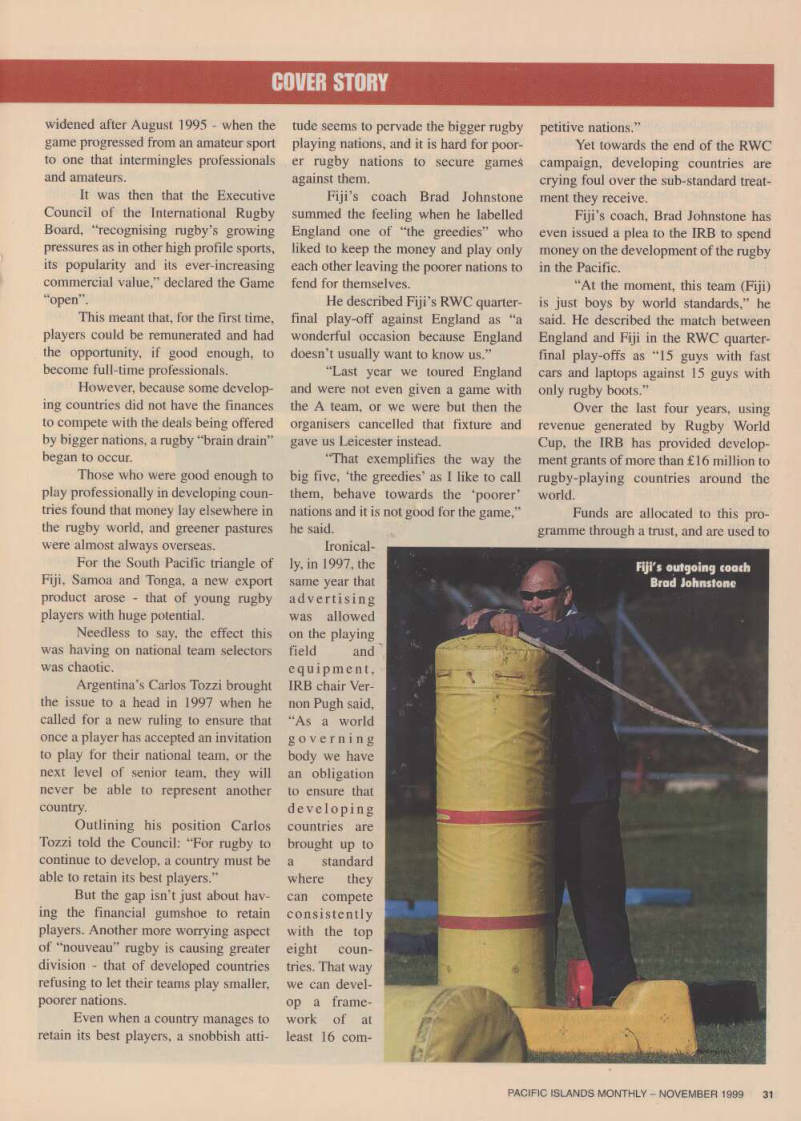
Fiji’s coach, Brad Johnstone has even issued a plea to the IRB to spend money on the development of the rugby in the Pacific.
“At the moment, this team (Fiji) is just boys by world standards,” he said. He described the match between England and Fiji in the RWC quarter final play-offs as “15 guys with fast cars and laptops against 15 guys with only rugby boots.”
Over the last four years, using revenue generated by Rugby World Cup, the IRB has provided develop ment grants of more than £l6 million to rugby-playing countries around the world.
Funds are allocated to this pro gramme through a trust, and are used to
Fiji's outgoing coach Brad Johnstone
support coaching competitions, devel
opment programmes and other activi ties that will lead on to greater partici
pation and improved playing standards.
But one of the biggest controver sies of the current RWC is that profits from ticket sales will go to the five nations hosting the tournament and not split amongst the participating coun tries nor placed in a development trust.
In a climate where the profits from ticket sales are estimated to have increased almost seven-fold (A 575.34 million - up from A 511.3 million in 1995), the developing countries that play rugby are beginning to get agitat ed.
The other source of funds from
the RWC is profit from
broadcasting, sponsor
ship and other commer cial deals, which should run into Asll3 million (up from A 544.2 million in 1995 and just A 52.51 million at the inaugural 1987
World Cup).
This money will go into a pool which the IRB will then dis tribute to both rich and poor rugby playing nations.
Two years ago, Pugh (IRB chair) said that “we need to make sure that in the pursuit of commercial gain, we do not sacrifice the
very thing that has helped to make the game so attractive to participants, pub lic broadcasters and the commercial world - namely, that ‘special ethos’.”
Pugh regards it as “a distinct camaraderie, and of having respect for others involved in rugby, be it at play ing level or in any other capacity. There is a special feeling of being involved in something quite different, largely based on that respect for the game and a belief that the whole is more important than the interests or profile of any indi vidual who plays it.”
It was this love of the game that was cited in an IRB statement after questions about the distribution of prof its.
While the IRB declined to com ment specifically, it said, in a state ment, that countries “enter the World Cup for the honour and enjoyment of taking part, rather than financial suc cour from their triumph.”
But when players see some coun tries raking in the profits, while others are struggling, it is bound to ruffle some feathers.
Canadian captain Gareth Rees said, “Most of our players aren’t paid and it is increasingly difficult to com pete at the highest level. We are not
bitching or asking for more money. But it is important for the World Cup for countries like Canada and Namibia to able to compete.”
The Rugby World Cup generates nearly all the finance the IRB has at its disposal.
“That income is distributed to the development of rugby worldwide rather than going to feed those who are already strong,” Pugh claims.
“Thankfully, there is an accep tance among the eight major unions who generate most of that money, that
this will continue to be the right course if Rugby Union is to continue to pros per.”
But this acceptance seems to be valid no more, with five of the top eight now taking a slice of the RWC profits.
There is also the criticism that the IRB has bowed to commercial interests tampering with union laws for the sake of ‘quick-fix’ entertainment. This criti cism is levelled at the introduction of the substitute and extended half-time laws.
While saying that those laws did not represent any fundamental change to the game, Pugh did not deny they were primarily introduced to accom modate television interests.
“That cynical view is probably right in that the com mercial benefits have speeded up the decision. A case for extending the half time break came from commercial interests, but it brings more money into the game which ensures its develop ment and vitality. I don’t think there’s any thing wrong with that, just as long as it doesn’t damage the game and I don’t think it does.”
But when Fiji’s
substitutes were ordered to stop warm ing up during a RWC match because they were obscuring advertising hoard ings, rugby donned its full gear as bean-counter.
Fiji’s Johnstone said, “I would have thought that the health and wel fare of our substitutes was more impor tant than advertising hoardings not being seen. But the game is now run for commercial benefit.”
Ironically, the same weapon that the IRB has been wielding to change the game is now being wielded against
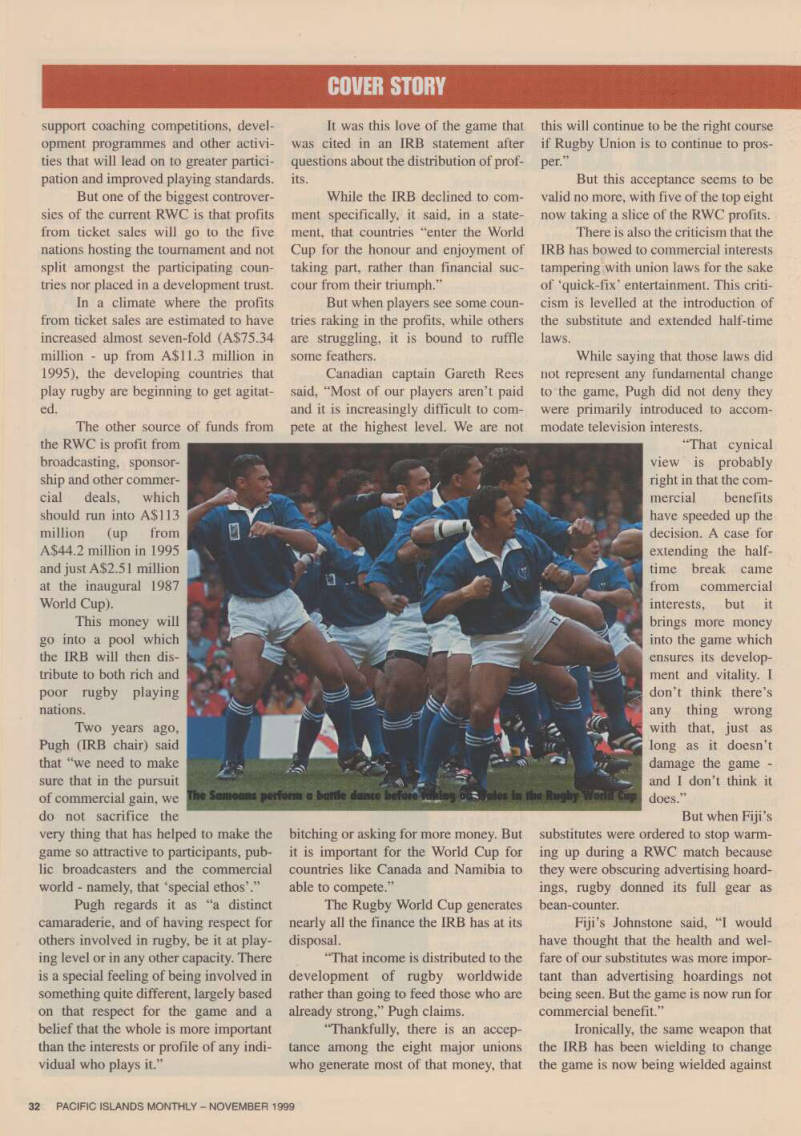
The Samoans perform a battle dance before llking on Wales in the Rugby World Cup
them.
IRB was seriously con cerned about the “consis tent central attack, viz, to effectively reduce or even eliminate the present con trol exercised by the gov erning bodies.”
“This, itself, has had one dominant objec tive, and that is the con trol of and access to the huge revenues produced from that most captivat ing and powerful of media, television and also the increasing influence
In the last Chairman’s Report, the
of these broadcasters,” the Chairman’s Report said.
Event and competition organisers challenge the entitlement of Unions to own and market sponsorship and
broadcasting rights.
The regulations are being chal lenged in different areas including the control of players, of stadia and facili ties, the organisation of events and
competitions.
Agents are now a part of the
game, something the IRB thinks it needs to licence in order to ensure the quality of people involved.
Media giants and sports/clothes manufacturers now play an “aggressive and acquisitive role”, the Chairman’s report says, “as they seek to first own and then control players, clubs and competitions.”
It said there is large concern
about global companies acquiring the right to require the playing of interna
tional matches - even out side the IRB’s Schedule.
“The danger to the traditions of our sport have never been so strong ly signalled nor, indeed, the consequences. It comes in the clothing of Santa Claus and bearing priceless gifts, but unless we recognise it for what it is and afford it the rightful place which it can and should enjoy in our sport, then it will very soon own much more than we
should rightfully and responsibly give away,” the IRB says.
Fiji’s coach, Johnstone says “the rich countries run the game to suit themselves”.
“It is ludicrous that we nearly had to bankrupt our union just to get here (RWC) when the organisers are talking of making profits of Asll3 million.”
Johnstone has become quite a vocal critic of the way that rugby has become structured and the disadvantages that this places many rugby-loving nations in.
After years of hammering away “smaller” nations have won one battle.
For the first time, Fiji, Japan, Romania, Tonga, and Samoa will final ly feature in the Internationals fixture list.
The Six Nations have agreed to make arrangements for Autumn games involving Japan, Samoa, Fiji, Tonga, USA and Romania - teams that until now have been unable to count on reg ular fixtures against rugby’s top teams.
For their part, South Africa, New Zealand and Australia have committed to annual games against Argentina and, will also undertake fixtures on an equi table basis against Canada, Japan, Fiji, Samoa, Tonga and the USA.
Although this is a major win for the smaller nations for international exposure, the financial war is far from over. ■
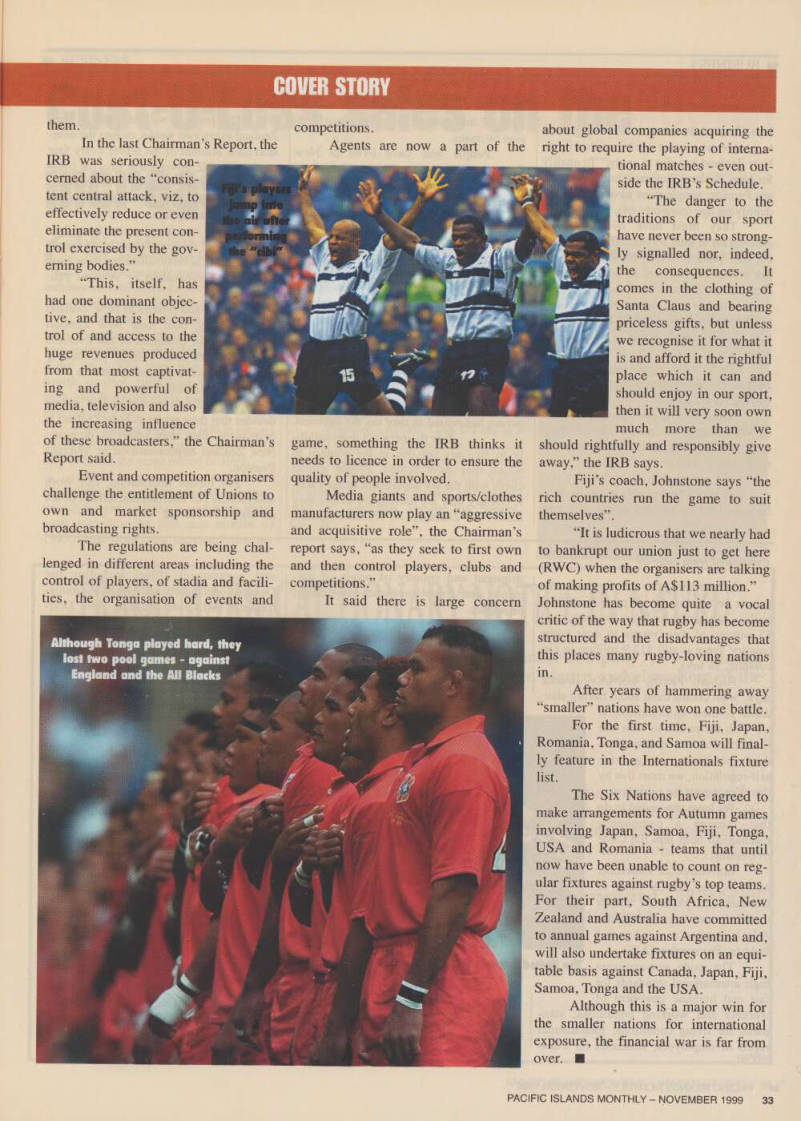
Fiji's players jump into the air after performing the "cibi"
Although Tonga played hard, they lost two pool games-against England and the All Backs