monitor Saipan garment factories
pp. 29-34 · Read in the full issue
Pricewaterhouse Coopers to monitor Saipan garment factories
By Sophie Foster Hildebrand
THIRTY-ONE of Saipan’s 34 gar ment factories will face compre hensive independent monitoring of their operations under a new programme set to begin at the end of this month.
This follows adverse publicity in the United States and elsewhere about “sweatshop” tactics allegedly used there.
Under a contract, signed September 27, between the Saipan Garment Manufactur ers Association (SGMA) and Pricewater houseCoopers (PWC), PWC will provide
monitoring compliance for the
SGMA members with the “Stan dards for the Treatment of Workers and Working Conditions and Standards for Living” set in the SGMA Code of Con duct.
“Determined to beat a ‘sweatshop’ image perpetuated by notoriously protec tionist garment unions and activists on the US mainland, 31 of the 34 factories on Saipan have joined SGMA to learn from international experts in labour law enforcement,” a SGMA statement said.
All the SGMA member factories will accept on-site monitoring inspection visits by PWC beginning November 29.
PWC will perform a baseline assessment with follow-up visits when required Price waterhouseCoopers is one of the world’s
leading professional
services organiza tions. Drawing on the knowledge and skills of 150,000 people in 150 countries, they are known for helping their clients to solve complex business problems and improve their perfor mance.
PWC was cho sen from 12 proposals received after SGMA advertised in the US for qualified monitor ing companies.
The scope of their engagement includes collecting and analysing facts and providing assessments of manufacturer compliance with the SGMA Code of Con duct.
The Factory Monitoring Program includes: Prohibition against Forced Labour, Prohibition against Child Labour, Prohibition against Harassment or Abuse, Nondiscrimination, Health and Safety, Freedom of Association and Collective Bargaining, Wages and Benefits, Overtime Pay/Hours of Work, Worker Dormito ries/Freedom of Movement, Compliance Principles.
PWC will provide its analysis and findings to the individual member compa nies and to the SGMA. A report will be prepared for public disclosure after the baseline study is complete.
This is expected to be submitted in early January 2000. All reports will list non-compliance with recommended cor rective action.
According to economist William Stewart, in a paper titled ‘The Garment Industry’s Multiplier Effect Of Money Within The CNMI Economy’, the total direct contribution of the garment industry to the CNMI economy, both in generating revenues for the government and income
for the private sector is estimated to be from $163.3 million (low) to $208.7 mil lion (high), omitting the $79 million in remitted employee salaries.
He estimates annual payments by the garment industry for a myriad of goods and services to total from $96.5 million (low estimate) to a high estimate of $119.1
million annually.
Considering that a five percent busi ness gross revenue tax, (BGRT), is paid on most of this private sector income, from $4.8 million to $6 million is further gener ated for the government in BGRT.
Major payments by the industry direct the government include: $27.2 mil lion in User’s Fees (a form of export tax); $2.6 million in labour and immigration fees; $500,000 in land lease payments; $4.4 million to CUC; $10.6 million in pay roll taxes and $4.3 million in other expens es for a total of $49.6 million.
Continued on page 34
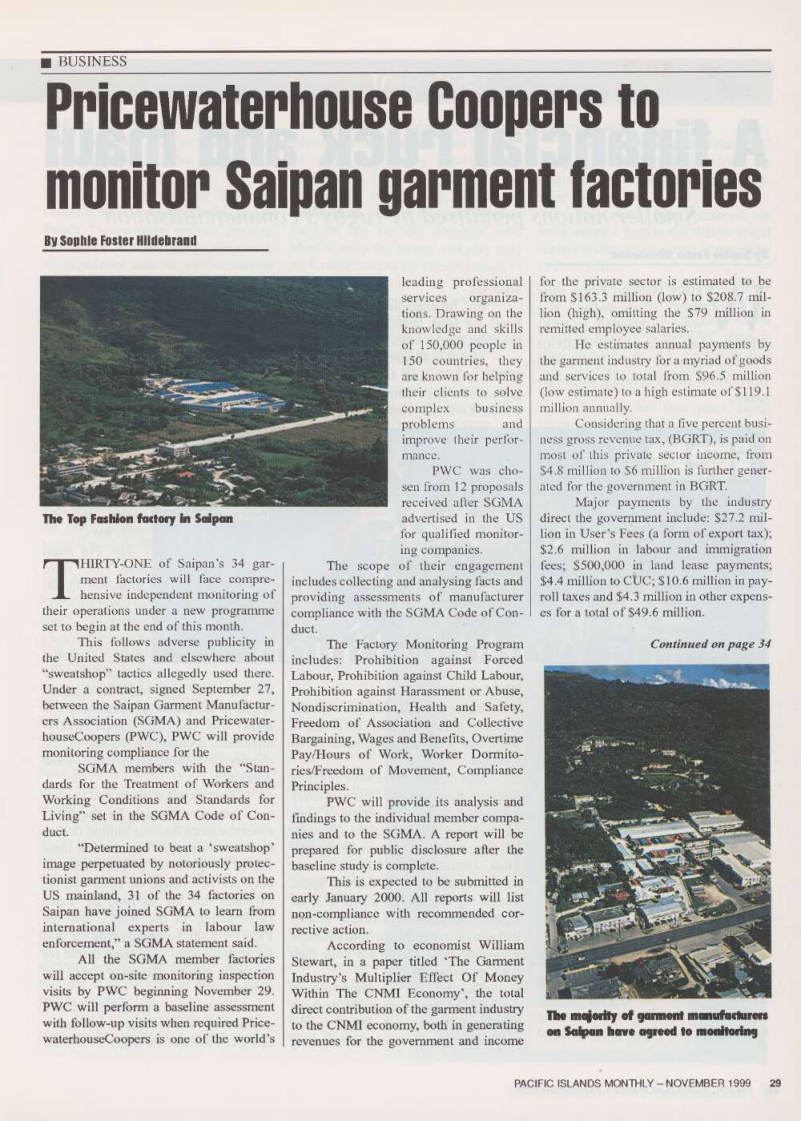
The Top Fashion factory in Saipan
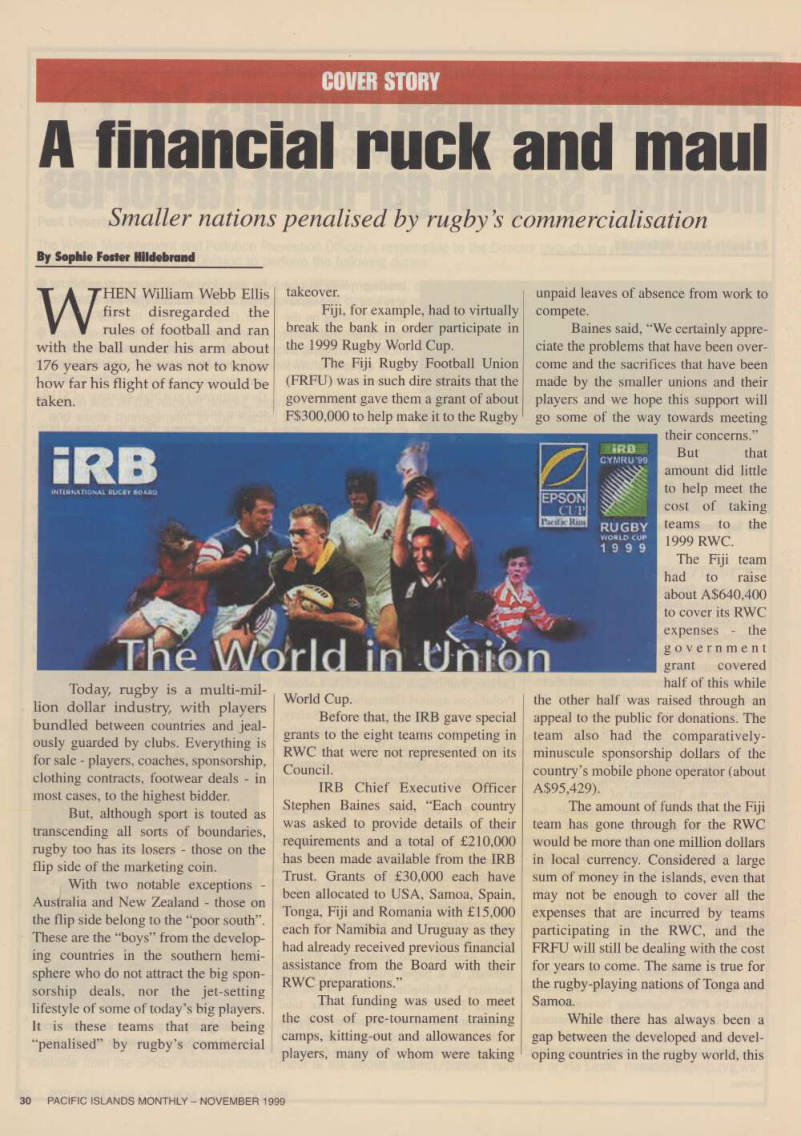
The majority of garment manufacturers on Saipan have agreed to monitoring
Continued from page 29
In examining the contribution to the private sector, the annual payroll is $92.9 million. Assuming industry workers send 85 percent of their wages to their home country, there is still $13.9 million in cir culation, he says.
Richard Pierce, SGMA’s director says “what counts most about having stan
dards is their enforcement. If we wish the public to view our Code of Conduct and indepen
dent monitoring as genuine
self-regulation, we must live by the rules we set for ourselves.
We have proceeded to do
that through a compliance
mechanism built into the Code of Conduct.”
Introduced in December of 1998, the SGMA Code of Conduct was patterned after a model derived from the Clinton
Administration’s Apparel
Industry Partnership (AIP).
The code encompasses
high international standards for fair and humane treatment of workers and working conditions; stan dards for living conditions; fundamental rights of employees; standards for trans
shipment and country of origin of gar ments; and compliance and enforcement principles.
Training required for the full imple mentation of the Code of Conduct was presented at three separate training confer ences held in January, February and August 1999. Sessions were presented by
Business for Social Responsibility, a San Francisco-based human rights and educa tional non-profit organisation, and US fed
eral government offices including the Occupational Safety and Health Adminis tration (OSHA) and Wage & Hour Divi sion of the Department of Labour.
Employing nearly 15,000 people, garment manufacturing is a driving eco nomic force in the US Commonwealth of the Northern Mariana Islands - the only
other major industry being
tourism.
The most recent OSHA sta tistics show that m fiscal year
1998, Saipan’s apparel factories
had a 70 per cent better compli ance rate than apparel factories elsewhere in the United States, despite the fact that they were among the most frequently inspected.
Saipan, the capital of the US Commonwealth of the Northern Mariana Islands is part of a chain of 14 islands located in the western Pacific some 150 miles north of Guam and 1,300 miles
from Tokyo.
Although more closely tied to
the economy of Asia, the Northern Mari anas is a US territory with a democratical ly elected local government. ■
The United International Corporation factory in Saipan