Whales bring good fortune
pp. 18-20 · Read in the full issue
to Jonah's native land
By Sophie Foster Hildebrand
JONAH Lomu may be a famous All- Black, but he is also Tongan and named for the biblical character who was saved by a whale.
History, it seems, has a habit repeating itself, but instead of saving Jonah, the whale is saving his native land from financial downturn. For whales have spawned a prof itable industry for the people of Jonah’s native land - Tonga.
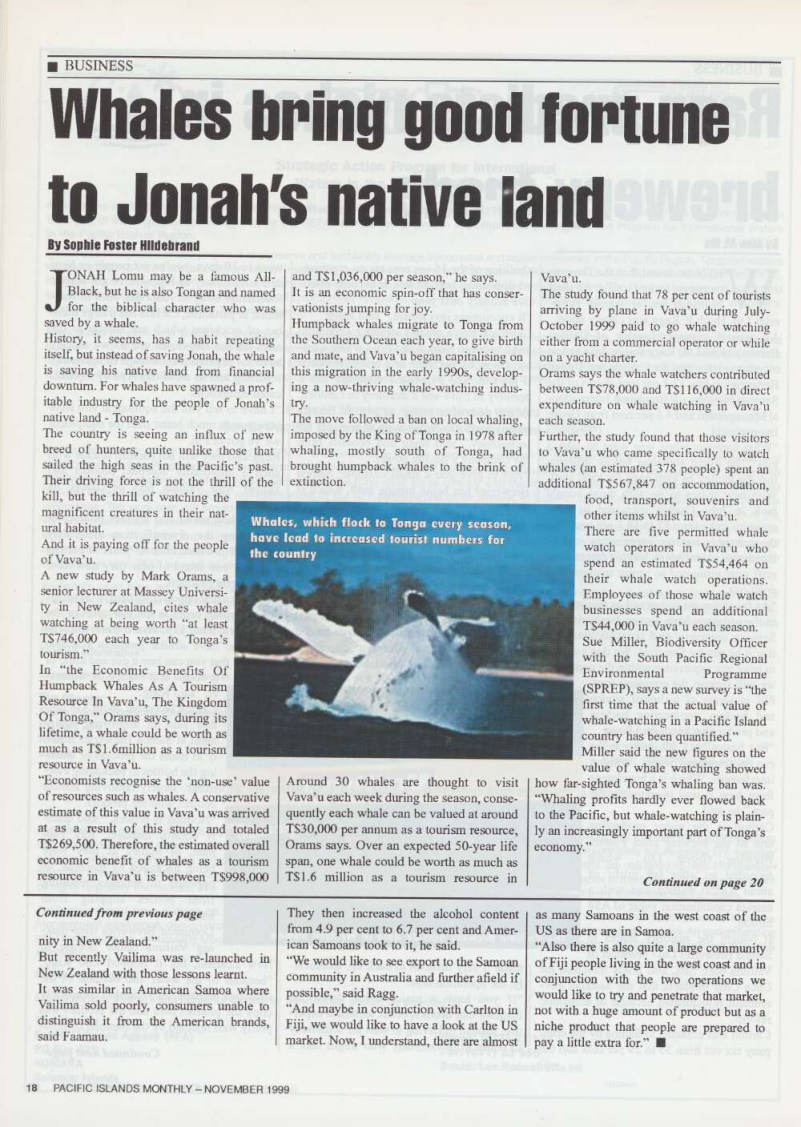
The country is seeing an influx of new breed of hunters, quite unlike those that sailed the high seas in the Pacific’s past.
Their driving force is not the thrill of the
kill, but the thrill of watching the magnificent creatures in their nat ural habitat.
And it is paying off for the people of Vava’u.
A new study by Mark Grams, a senior lecturer at Massey Universi ty in New Zealand, cites whale watching at being worth “at least T 5746,000 each year to Tonga’s tourism.”
In “the Economic Benefits Of Humpback Whales As A Tourism Resource In Vava’u, The Kingdom Of Tonga,” Grams says, during its lifetime, a whale could be worth as much as Tsl.6million as a tourism resource in Vava’u.
“Economists recognise the ‘non-use’ value of resources such as whales. A conservative estimate of this value in Vava’u was arrived at as a result of this study and totaled T 5269,500. Therefore, the estimated overall economic benefit of whales as a tourism resource in Vava’u is between T 5998,000
and T$ 1,036,000 per season,” he says.
It is an economic spin-off that has conser vationists jumping for joy.
Humpback whales migrate to Tonga from the Southern Ocean each year, to give birth and mate, and Vava’u began capitalising on this migration in the early 19905, develop
ing a now-thriving whale-watching indus
try.
The move followed a ban on local whaling, imposed by the King of Tonga in 1978 after whaling, mostly south of Tonga, had brought humpback whales to the brink of extinction.
Around 30 whales are thought to visit Vava’u each week during the season, conse quently each whale can be valued at around T 530,000 per annum as a tourism resource, Orams says. Over an expected 50-year life span, one whale could be worth as much as Tsl.6 million as a tourism resource in
Vava’u.
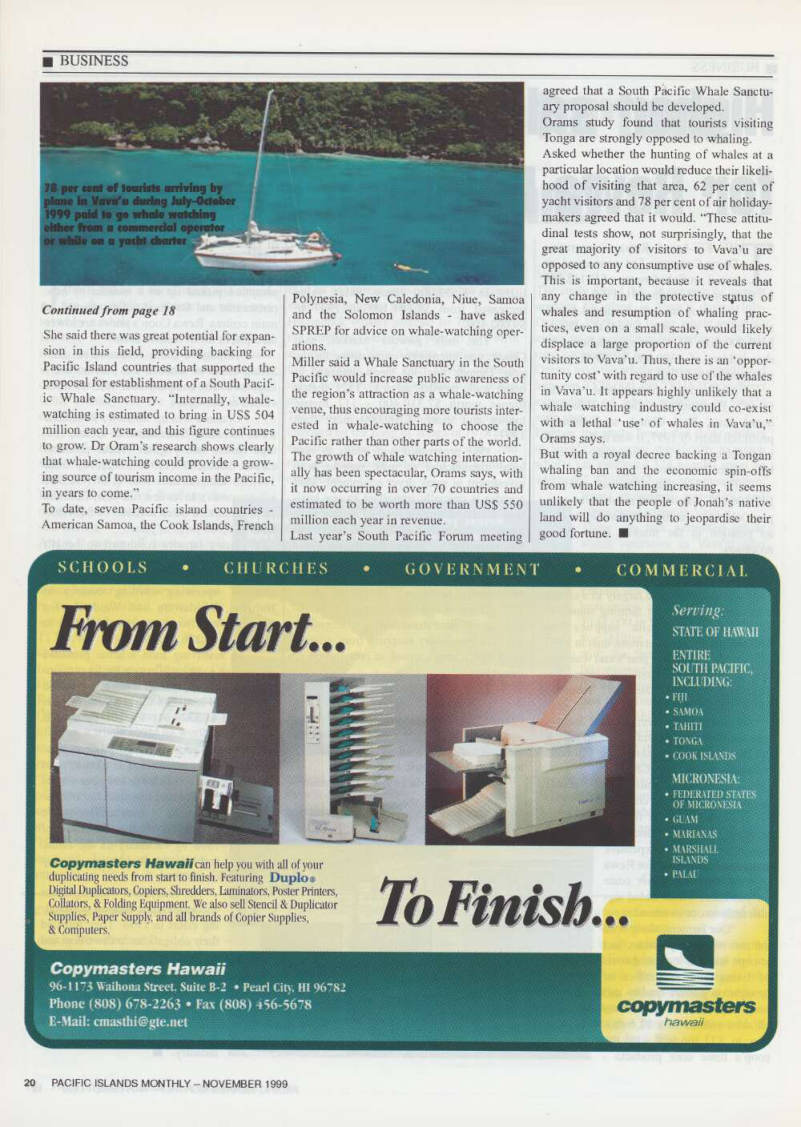
The study found that 78 per cent of tourists arriving by plane in Vava’u during July- October 1999 paid to go whale watching either from a commercial operator or while on a yacht charter.
Grams says the whale watchers contributed between T 578,000 and T 5116,000 in direct expenditure on whale watching in Vava’u each season.
Further, the study found that those visitors to Vava’u who came specifically to watch whales (an estimated 378 people) spent an additional T 5567,847 on accommodation,
food, transport, souvenirs and other items whilst in Vava’u.
There are five permitted whale watch operators in Vava’u who spend an estimated T 554,464 on their whale watch operations.
Employees of those whale watch businesses spend an additional T 544,000 in Vava’u each season.
Sue Miller, Biodiversity Officer with the South Pacific Regional
Environmental Programme
(SPREP), says a new survey is “the first time that the actual value of whale-watching in a Pacific Island country has been quantified.”
Miller said the new figures on the value of whale watching showed
how far-sighted Tonga’s whaling ban was.
“Whaling profits hardly ever flowed back to the Pacific, but whale-watching is plain ly an increasingly important part of Tonga’s economy.”
Continued on page 20
Whales, which flock to Tonga every season, have lead to increased tourist numbers for the country
Continued from page 18
She said there was great potential for expan sion in this field, providing backing for Pacific Island countries that supported the proposal for establishment of a South Pacif ic Whale Sanctuary. “Internally, whale watching is estimated to bring in US$ 504 million each year, and this figure continues to grow. Dr Oram's research shows clearly that whale-watching could provide a grow ing source of tourism income in the Pacific, in years to come.”
To date, seven Pacific island countries - American Samoa, the Cook Islands, French
Polynesia, New Caledonia, Niue, Samoa and the Solomon Islands - have asked SPREP for advice on whale-watching oper ations.
Miller said a Whale Sanctuary in the South Pacific would increase public awareness of the region’s attraction as a whale-watching venue, thus encouraging more tourists inter ested in whale-watching to choose the Pacific rather than other parts of the world.
The growth of whale watching internation ally has been spectacular, Orams says, with it now occurring in over 70 countries and estimated to be worth more than US$ 550 million each year in revenue.
Last year’s South Pacific Forum meeting
agreed that a South Pacific Whale Sanctu ary proposal should be developed.
Orams study found that tourists visiting Tonga are strongly opposed to whaling.
Asked whether the hunting of whales at a particular location would reduce their likeli hood of visiting that area, 62 per cent of yacht visitors and 78 per cent of air holiday makers agreed that it would. “These attitu dinal tests show, not surprisingly, that the great majority of visitors to Vava’u are opposed to any consumptive use of whales.
This is important, because it reveals that any change in the protective status of whales and resumption of whaling prac tices, even on a small scale, would likely displace a large proportion of the current visitors to Vava’u. Thus, there is an ‘oppor tunity cost’ with regard to use of the whales in Vava’u. It appears highly unlikely that a whale watching industry could co-exist with a lethal ‘use’ of whales in Vava’u,’’
Orams says.
But with a royal decree backing a Tongan whaling ban and the economic spin-offs from whale watching increasing, it seems unlikely that the people of Jonah’s native land will do anything to jeopardise their good fortune. ■
78 per cent of tourists arriving by plane in Vava'u during July-October 1999 paid to go whale watching either from a commercial operator or while on a yacht cjarter