Ragg predicts riches in
pp. 17-18 · Read in the full issue
Business
Ragg predicts riches in brewery trade
By Alan Ah Mu
WHEN he found that the German managers locked a toilet for their exclusive use at Samoa Brew eries Ltd, Hugh F. Ragg was clearly upset.
As general manager/director of Carlton Brewery (Fiji) Ltd, Ragg was in Apia in last month to sign a deal for Carlton and United Breweries to buy 12.8 per cent shares of the Samoan brewery off Brauhaase Internation al Management and 4.5 per cent from Grove International.
“What happens when you want to take a piss?” he asked someone before ordering that the facility be kept open for local staff.
With new shares to go with those bought back in July, Carlton increased its SBL majority stake from 51 to 68.3 per cent. But the company has no intention to replace Brauhaase as managers, leaving that to local staff now promoted to senior management
positions.
“As far a§ we are concerned as the investor in the company here, Samoa Breweries is a Samoan company, and it is our intention that it be run by Samoans. We don’t expect to have any expatriates within the company,
we will support the company from Fiji in terms of technical advice
and backup, engineering backup
and product backup,” said Ragg.
“But basically ... it’s going to be run by Samoan people, without interference. Which is a big change from how it was operated in the past,” he said.
Carlton is the major production arm of the brewing giant Fosters
Brewing Group Ltd., which
recorded an after tax profit of about As3so million and with a market capitalisation value of AsB billion.
It bought the majority shares in Samoa Breweries Ltd - producer of
Vailima beer. SBL also holds franchise for Coca Cola products that the Samoan gov ernment relinquished because of economic reform.
Carlton was attracted to Samoa by the com pany tax cut from 35 to 29 per cent and the
abolition of the 15 per cent tax on repatriat ed dividends, both of which become effec tive January next year.
“It encourages investment,” said Ragg.
Carlton’s move creates stronger economic links between Samoa and Fiji - where Carl ton owns 63 per cent of Carlton Brewery (Fiji) Ltd. The Fiji-based company has a brewery in Suva and a distillery in Lautoka.
Being part of a group as big as Fosters means access to “huge support services for technology,” said Ragg and benefits from the company’s buying power.
“Just to give you a small example: Samoa Breweries has being buying malt, which is the major raw material for beer at 90 dollars a ton more than we pay in Fiji, and that’s on an FOB basis so we can immediately get a gain here of 90 dollar per ton Australian.
“Various spare parts could be purchased at a far better price by a huge group rather than by a small individual company.
“The other thing of course is that in the past because the company has been under the management of a German company, Brauhaase, the sheer distance away has
made it very difficult to back up, technical ly, the operation here.
“If you have a major break down for instance that needs specific technical exper tise, instead of having to wait for somebody to come from Germany who might take a
week to 10 days, you’ve got people an hour and a half away in Fiji, you’ve got people four hours away in Australia. And in Aus tralia, in particular, Carlton has a large num ber of machines which are similar to the ones Samoa Breweries use so we already
have the expertise, knowledge of operating,
repairing and so on of this type of sophisti
cated equipment.
“I have to tell you the equipment you have here now is much better than the equipment we’ve got in Fiji.”
Ragg said they will not commit suicide with such a universally accepted product and tamper with Vailima beer or change its name.
But Carlton could add another product or two along the diversification route they took in Fiji where after 35 years of putting out only one brand of beer they now have 17 different products.
“There’s a real opportunity here to do some thing similar: bring in the raw spirit or the bulk spirit from Fiji, mix it here with the spirit and have similar products available here. So that you can buy a gin and tonic or
a vodka and orange or whatev er,” said Ragg.
Carlton has spent about $l3 mil lion Tala on improving equip ment at Samoa Breweries main ly to make the process of clean ing the bottles to packaging elec tronic, largely removing human contact with the product.
“Nothing is broken,” said quali ty control manager, Ray Faa mau, of bottles as they were being packaged by machine, as opposed to smashes resulting from bottles slipping from hands.
Dominion Breweries tried mak ing Vailima under license in
New Zealand, but it flopped said Ragg, “because of the water and because of the container perhaps, they couldn’t completely copy the product here and the product was pretty well rejected by the Samoan commu-
Continued next page
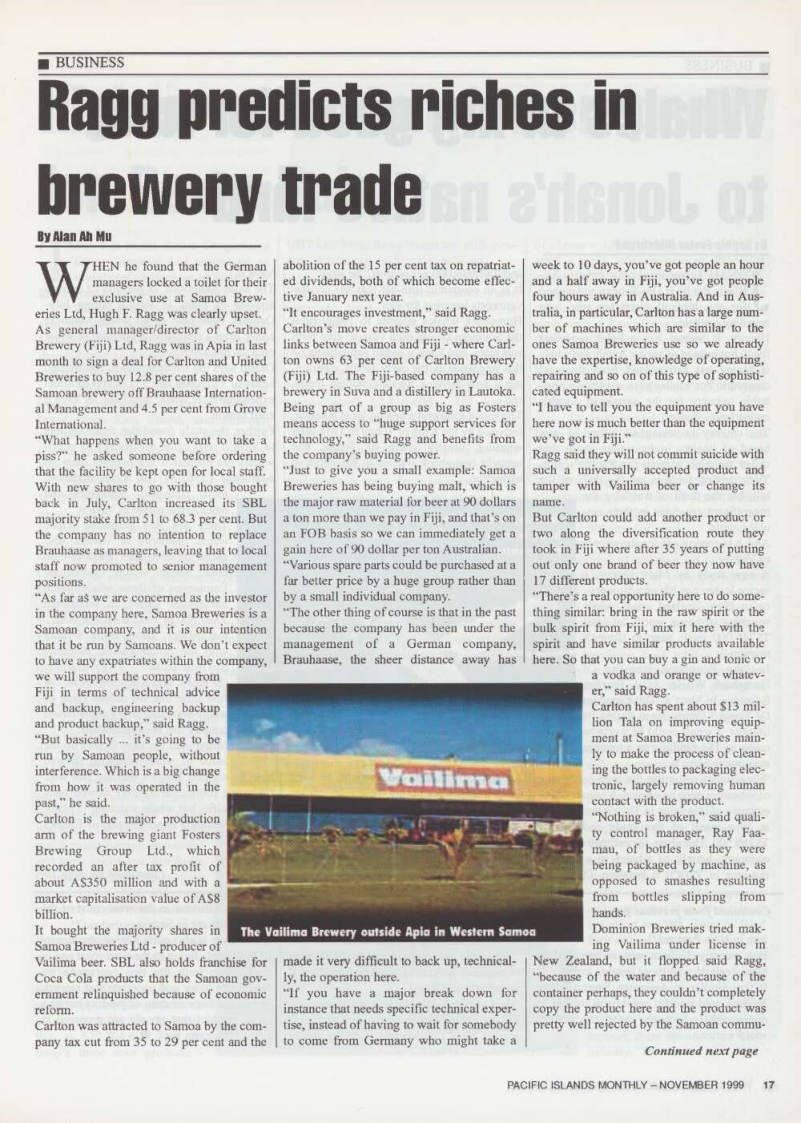
The Vailima Brewery outside Apia in Western Samoa
Continued from previous page
nity in New Zealand.”
But recently Vailima was re-launched in New Zealand with those lessons learnt.
It was similar in American Samoa where Vailima sold poorly, consumers unable to distinguish it from the American brands, said Faamau.
They then increased the alcohol content from 4.9 per cent to 6.7 per cent and Amer ican Samoans took to it, he said.
“We would like to see export to the Samoan community in Australia and further afield if possible,” said Ragg.
“And maybe in conjunction with Carlton in Fiji, we would like to have a look at the US market. Now, I understand, there are almost
as many Samoans in the west coast of the US as there are in Samoa.
“Also there is also quite a large community of Fiji people living in the west coast and in conjunction with the two operations we would like to try and penetrate that market, not with a huge amount of product but as a niche product that people are prepared to pay a little extra for.” ■