PNG back in Australia's fold
pp. 36-37 · Read in the full issue
‘We will do what we can to help Papua New Guinea through this difficult period. It is an illustration in the Australian concept of mate ship. Papua New Guinea and Australia being mates forever’ - Alexander Downer
By Sam Vulum
AFTER the sudden scare of losing its nearest neighbour from under its folds, Australia has pulled out all the stops when it comes to lavishing Papua New Guinea with atten tion.
Two days after Australian Treasurer, Peter Costello, left Papua New Guinea, the Australian foreign minister Alexan der Downer, arrived in Port Moresby.
The tone being pushed: mateship.
Downer said Australia wouldn’t let its “mate” PNG down in the rescue of the economy.
“Papua New Guinea has big problems with its budget, it has problems with the level of its foreign reserves, and it’s going to work hard to solve them.
“The message we have for the new government is that Australia is a country that has special relationship with Papua New Guinea, it has always done, and we won’t let Papua New Guinea down.
“We will do what we can to help Papua New Guinea through this difficult
period.
“It is an illustration in the Australian concept of mateship. Papua New Guinea and Australia being mates forever, and that relationship will continue.”
As minister responsible for the aid budget, Downer announced that a new aid treaty between the two countries, governing aid over the next three years, would be signed in December. Downer said the previous government of Bill
Skate had gone through “a rather difficult period” because it did not want anything to do with International Monetary Fund and the World Bank.
But now, after months of fruitless talks between the IMF, the World Bank and the previous PNG government over economic rescue loans, Australia is stepping in to offer a glimmer of hope for PNG.
The previous government pursued var ious avenues to get funds for economic rescue including the IMF, the World Bank, the Kredit Bank of Belgium and a bond issue sale, but these negotiations failed.
The last attempt by the Skate govern ment to source offshore loans from Tai wan was aborted when it lost office.
But the new government of Sir Mekere Morauta has been given a commitment by Australia of a more concerted effort towards fresh negotiations.
The commitment also marks a “new era” in the relationship between politi cians of both countries - something that had become stale in recent years.
As part of Australia’s commitment, it will immediately advance a lump sum payment of AUDS3O million (about Ksl million) of next year’s budget support grant, which would otherwise have been
paid in monthly installments.
Costello, who visited PNG in July, said after meeting the new prime minister that his country would help the new govern ment’s initiatives to restore the ailing economy, both in the planning and imple mentation stages. He said Australia would also continue to make representations and
work with the World Bank, the IMF and other donors to turn the economy around.
Costello expressed concern about the state of the economy especially the country’s foreign reserves that he said had deteriorated and were now in “sub stantial deficit”.
Commodity exports were also not doing well, he said.
“Sir Mekere has assured me that his government and he are committed to economic restructure, that he sees this as absolutely necessary for securing the country’s future, and I, in turn, assured him that the Australian government stands ready to assist in providing tech nical support and assistance and man power, that we will be looking to the mission of the World Bank and the IMF to discuss a programme for PNG.”
Costello said Australia and the World Bank, the IMF and international mar kets and institutions would be looking to the mini budget planned for this month as a first sign of the govern ment’s direction.
“Australia’s position is, and remains, that it will be engaged in help which will be closely tied to economic restruc ture,” he said.
“Obviously there is a need for enor mous restructuring here in PNG in rela tion to the budget, in relation to the financial situation, and we think that the best chance is for the government to proceed with the programme that Sir Mekere has laid down, as a real oppor tunity to secure the economic future for
PNG. There was discussion secondarily about the need for monies for restructur ing PNG’s debt position and its reserves
position.
“Now such support will involve inter national support, in particular the World Bank and IMF, and most probably would require bilateral contributions in addi tion, and Australia would stand ready if such a programme were put in place to consider assistance as part of that, but that kind of programme would require a restructural programme as not only
negotiated but
implemented.
“Negotiations
for that will begin with the World Bank and IMF missions in two weeks (August),”
Costello said.
He said since Australia repre sented PNG as part of its con stituent in the IMF and World Bank, it was pre pared to take up PNG’s case to them.
He said he
had already
raised the matter with the IMF
managing direc
tor and the World Bank
president in
April.
Costello said he offered to take up those issues, on behalf of PNG, with
both finance chiefs in Washington in September.
He said PNG remained Australia's biggest aid recipient (about AUDS3OO million annually), a level of help sup ported by its people but for which they required value for money.
“It think it (aid) enjoys a considerable amount of support in Australia, but we have to make sure that all of the aid reaches the poor, people that it is intend ed to reach, and that it reaches with full value for money,” he said.
Sir Mekere said he was pleased with the Australian government’s response, saying he was extremely satisfied with the outcome of his meeting with Costello.
The prime minister said he outlined his government’s strategy to achieve monetary and budget stabilisation during
discussions with Costello. “This will pro vide breathing space while the govern ment considers a detailed package of cor rective measures.
“I have advised Mr Costello that the PNG Cabinet endorsed the setting up of an office or commission of privatisation
to co-ordinate, advise, and preside over all activities relating to sale of State assets,” he said.
Sir Mekere welcomed an Australian offer of help by way of assignment of technical experts to help the newly established commission.
Australia also agreed to provide tech nical officers to help treasury and finance officials in PNG review the nation’s policy matrixes, with the aim of re-establishing dialogue with the World Bank and IMF. He said PNG must act
quickly to send the right signals pro moting investor confidence and attracting potential donors.
“I am sure my dis cussions with Mr Costello set the stage for my gov ernment to imple ment it corrective measures pack age.”
During his trip, Costello dropped a few handy hints as to how PNG should manage its economy: He said some key steps would be to: - strengthen the fiscal and bud getary position; - transparency in the presentation of budgets with clear ly defined objec tives; - stabilising the
foreign reserves
position of the Central Bank;
- respecting and guaranteeing the independence of the Central Bank; and - capacity building in institutions to ensure open and transparent delivery of policy Sir Mekere was appointed after Skate stood down mid-year. ■
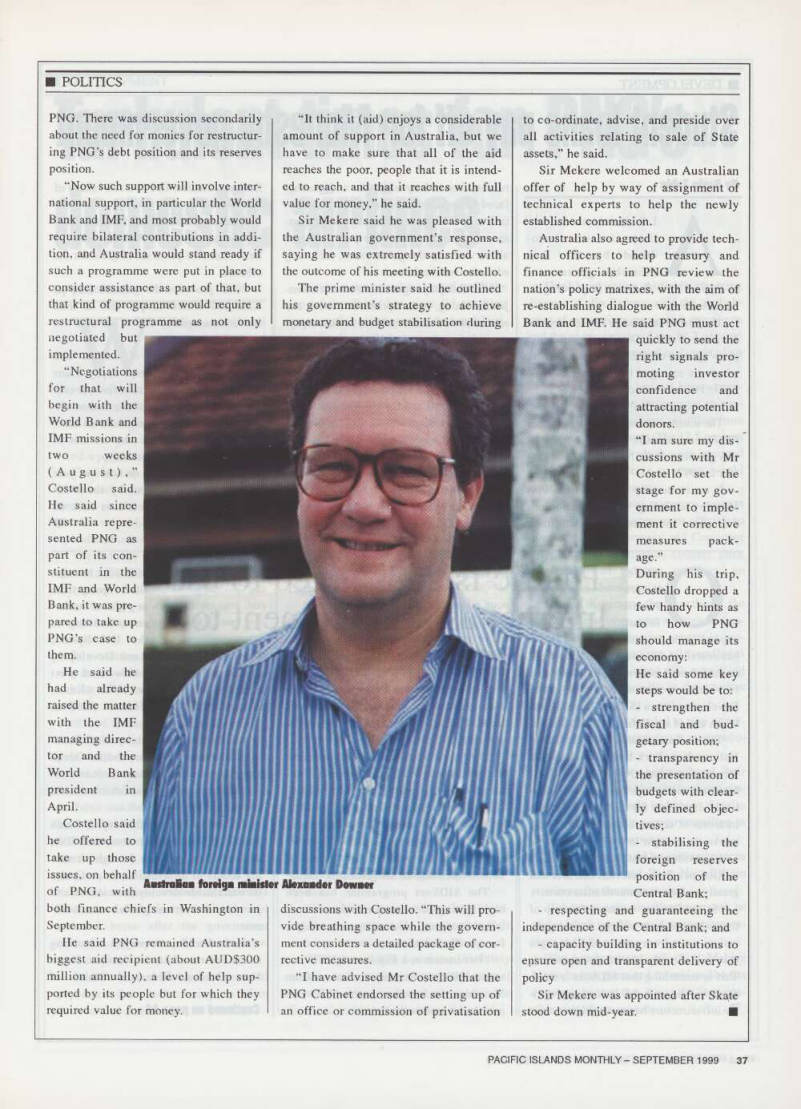
Australian foreign minister Alexnader Downer