Former Solomon police
pp. 34-35 · Read in the full issue
Politics
Former Solomon police commander gets short end of stick
By Michael Field
ethnic troubles. This is spelt out in the latest peace agreement signed in the Solomons, what is called “The Panatina Agreement” after the village in which it was signed. It amounts to a stinging criti cism of Short and what one official called the “brute force” policies of his forces.
He has gone now, his contract expired
FRANK Short was the
pompous, over-bearing,
swagger stick carrying commissioner of the Solomon Islands police - and now he is the official scapegoat for all their
and his post temporarily filled by his deputy, Morton Siriheti. Auckland police commander Rangi Rangihika, who is the highest ranking indigenous Maori in the New Zealand police force, takes over.
A peace monitoring group made up of police from Fiji and Vanuatu will also serve on Guadalcanal to teach the Solomon Island force all about “commu nity policing”
The troubles in the Solomons go back to World War II when the Allies, includ ing the Americans, New Zealanders and Fijians, fought a fierce battle against the Japanese. In that struggle the beachhead camp grew to become Honiara.
After the war it had outgrown the old capital and by independence it was the capital. Hundreds of people from Malaita flooded in; apparently to the growing resentment of the indigenous Guadalcanal
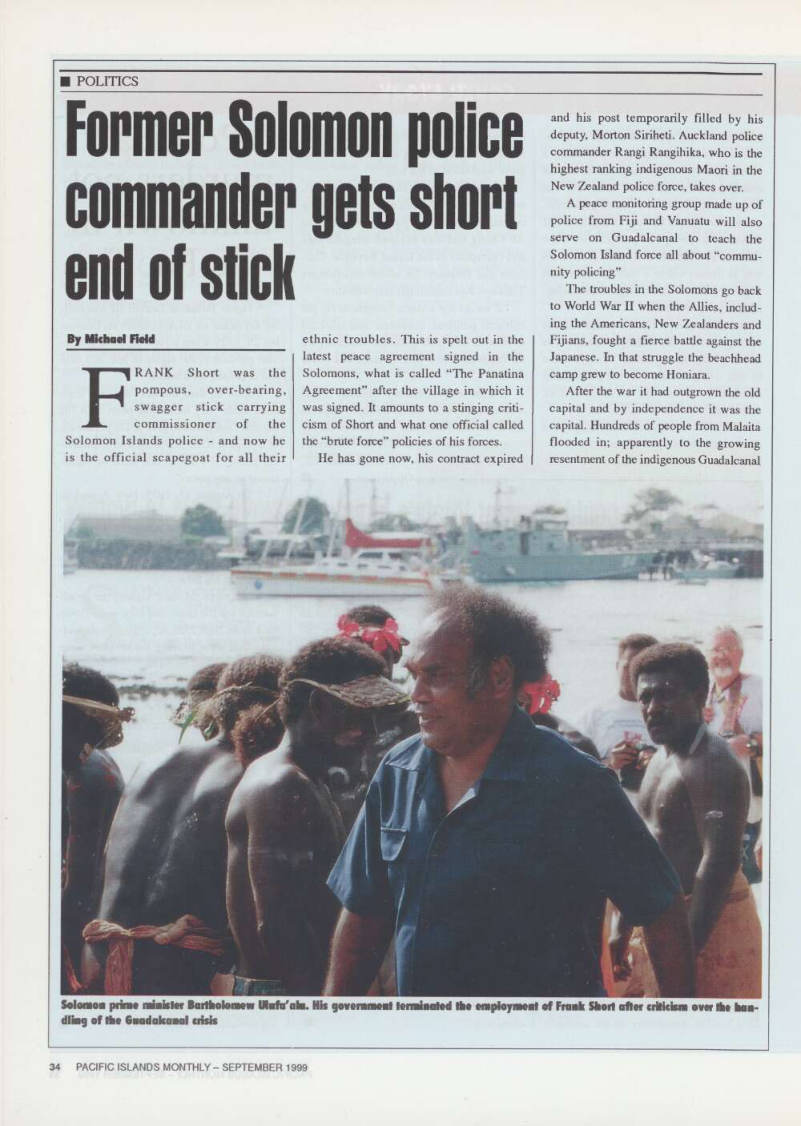
Solomon prime minister Bartholomew Ulufa'alu. His government terminated the employment of Frank Short after criticism over the han dling of the Guadakaual crisis
population. By last year, egged on by the provincial Guadalcanal government of Premier Ezekiel Alebua, a guerrilla force grew up. aimed at driving out the Malai tans. It rejoiced under a variety of names until settling on the interchangeable Guadalcanal Liberation Army or Isatabu
Freedom Fighters.
A series of attacks saw thousands of Malaitans flee from the Guadalcanal
countryside, becoming refugees in
Honiara. Several fatal attacks on villages closed the oil palm industry, sending the police and its para-military Police Field Force onto attack.
Undoubtedly better armed than the
guerrillas their approach, led by Short,
was less than conciliatory.
As the situation worsened Morton Sir iheti advised Short not to take the
approach adopted.
“Siriheti, who has had experience with separatist groups on Bougainville, told Short that brute force was wrong and so Siriheti was virtually fired by Short who
preferred the tough policing options,” a
well-placed diplomatic source said.
When Short’s contract expired in July the government declined to renew it. Short wrote closing briefing papers for the gov ernment but Siriheti declined to pass them on.
In June former Fiji Prime Minister Sitiveni Rabuka and Commonwealth deputy director Ade Adefuye arrived in the Solomons and attempted to broker peace.
Short made no secret of his dislike at the peace route, and his contempt for Rabuka. He urged the Fijian not to say anything and suggested Rabuka was on the militant side.
In the Commonwealth camp Short was quickly identified as the main impediment to a solution and both Rabuka and Ade fuye called for his dismissal, particularly after he nearly destroyed a peace treaty
signing by having police search delegates.
Two peace documents were duly signed and although the oil palm industry remains at a standstill, there were other signs that the conflict was nearing an end.
Then at the end of July on Mount Austen on Honiara's outskirts a fightfight
between the PFF and the militants saw four of the militants killed.
The Commonwealth team quickly returned and by August 12 they had the Panatina Agreement signed.
It is a remarkable indictment of Short’s
gruff style.
Foreign Minister Patteson Oti declined to say whether the Panatina Agreement was aimed at repairing Short’s damage. Other sources however make it clear that this was precisely what it was about and in part the document itself says so.
Policing, it says, was part of the peace and those who signed Panatina “regret that a meeting of this nature did not take place right after the conclusion of the Honiara Peace Accord’’.The Panatina Agreement was signed by Rabuka, Oti, Siriheti, Ale bua and Police Minister Robin Mesepitu.
It said they had a full discussion on the problems of implementation of the earlier accord and noted concerns “about the man ner in which the police had been carrying out its functions of the maintenance of law and order in Guadalcanal”.
It resolved that the police “will hence forth promote a community policing con cept in all parts of Solomon Islands... This policy will combine effective maintenance of law and order with a determination to project and promote a friendly image to the
populace.”
“Minimum force” will be used while “a massive public relations campaign” will be mounted to show that police activities are directed not against law abiding citizens but against “a few criminal elements”.
It said the militants will return to their villages and “will begin a systematic laying down of arms”.
The agreement says the activities of the para-military Police Field Force and the Rapid Response Unit will be scaled down.
“Police activities will be limited to the normal maintenance of law and order. Gov ernment will in due course lift the state of emergency.”
Adefuye, a Nigerian who has quickly
come to learn more about the Pacific than most, told PIM the militants had already begun moving around without arms.“ There is an absolute peace, people are free to move about now,” he said. ■