New tax presents a vat full of problems
pp. 28-29 · Read in the full issue
By Sam Vulum
EARLY fears of dramatic increases in the price of
goods and services being
influenced by the former government’s controversial Value Added Tax (VAT) initiative have become a reality following the intro duction of the new tax system on July 1.
Despite strong widespread opposition
from the public, the former government was able to get it passed by parliament on November 11 last year.
However, since its introduction, prices of all basic goods and services have taken off in a big way. This is despite the fact that many of the increases could be illegal under the regulations of VAT.
Most Papua New Guineans, mainly low income earners, who have been struggling
against rising prices since the devaluation
of the Kina, have been subjected to further strain since the introduction of VAT.
A 10 kilogramme bag of rice, for exam ple, which sold for KlO before the devalu ation, has gone to Kl 3 and now up to KlB in some stores. In others, the price has hit the K2O mark.
The story appeared to be the same for all other goods.
The cost of fuel has gone up by an aver age of six to seven per cent.
Airfares took a tremendous leap. The fares have gone through the roof, rising more than 30 per cent. The national flag carrier, Air Niugini, which recently increased its fares by 20 per cent, has added the extra 10 per cent VAT on top of that cost.
The Port Moresby to Lae fare of K 153 has gone up by K 48.96 to K 201.96 after the addition of the 20 per cent fare increase and the 10 per cent VAT.
The Internal Revenue Commission, responsible for implementing and moni toring of VAT has maintained from the beginning that there should not be any
the past two years since the announcement of VAT to find out their legal obligation to VAT and ultimately to the country and now
are punishing the people;
- because some businesses may not have prepared their stock on hand to absorb the VAT, they are now putting 10 per cent on the prices they had as of July 1.
They should have reduced that stock by 10 per cent before that date; - businesses have not registered with VAT and are illegally collecting a 10 per cent increase in the guise of VAT. This is not VAT at all but fraud; - some price controlled goods and ser vices have had increases given to them by the State, for example, airlines have been given a price increase in tickets on July 2, a day after VAT began. The maximum VAT that the airline industry can charge is six or seven per cent; that is, 10 per cent minus the provincial sales tax o three o four per cent which has now ceased;
price increases. IRC Commissioner David Sode said the VAT Act provided for all busi nesses to reduce their cost of stock on hand pricing by 10 per cent and then impose a 10 per cent VAT.
“If you reduce an item by 10 per cent and then impose a 10 per cent increase, the result is zero,” he said.
However, the IRC now faces the glaring reality that companies have used VAT as an excuse to raise their prices. IRC has estab lished that widespread breach of the VAT Act are being committed and it has the responsibility to penalise those involved. So far, it is still investigating.
Under the Act, all businesses with sales of more than K 100,000 must register with the IRC. The Act also provides for a penal ty fine of K 25,500 for those who fail.
In attempting to explain the rise in prices, Commissioner Sode highlighted the
following:
- businesses may not have bothered over
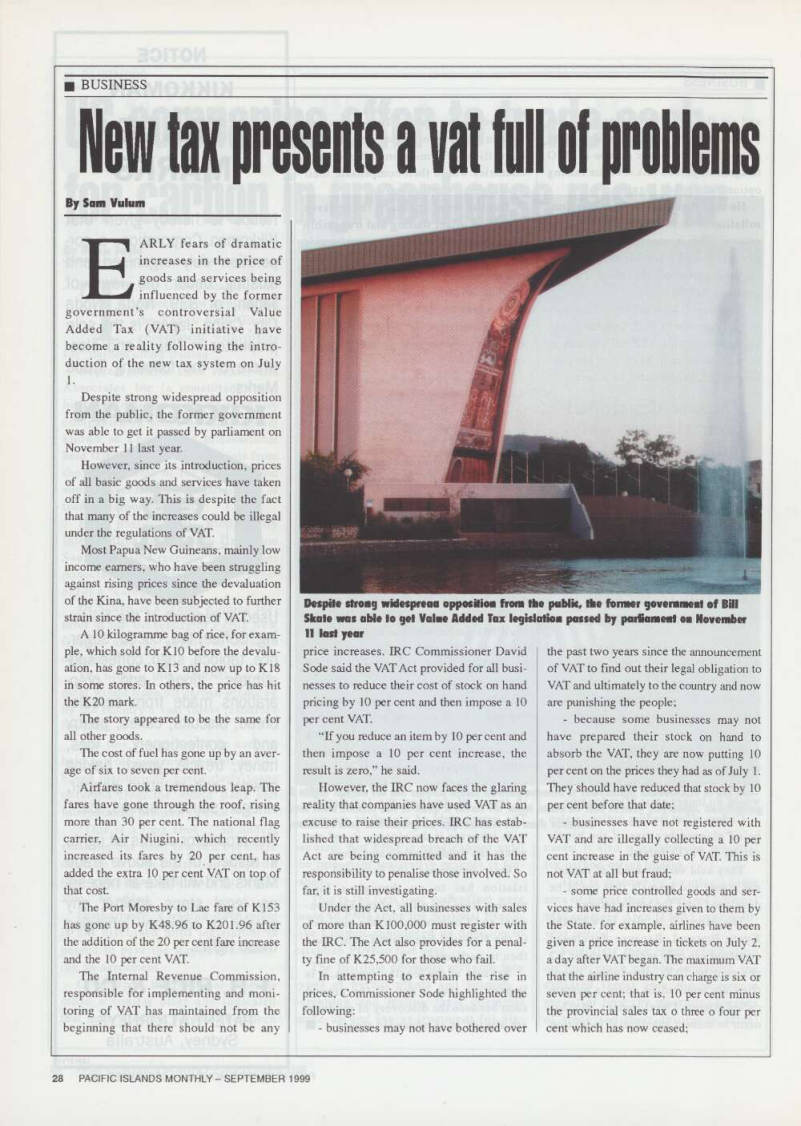
Despite strong widespread opposition from the public, the former government of Bill Skate was able to get Value Added Tax legislation passed by parliament on November 11 last year
- the Kina devaluation will always influence the price of goods and this has been evident at all other times apart from July 1. Most of the stock now being sold by the ships is old stock which will have been imported when the Kina was low.
VAT was introduced to broaden the tax base of the country by reducing the import duty rates to enable manufacturing and local or domestic producers to be more efficient.
Areas free of VAT are education, health, banking fees and interests, the finance industry, export of manufacturing
goods and primary products.
VAT replaces the old 15.5 per cent tax on goods and services, which comprised an import duty of 11 per cent, a drought levy of 1.5 per cent and a provincial sales tax of 3.0 per cent.
Anti-VAT campaigners, including MPs,
Morobe governor Luther Wenge and Cen tral governor Tedi Diro, had foreseen the negative impact but their attempts to delay VAT’s introduction failed.
Governor Wenge, in particular, stood out with this legal action threat over the introduction of VAT in the Morobe
province but his around-the-provinces
anti-VAT campaign could not win enough support.
Both leaders, with several other con cerned MPs staged a rally in Port Moresby in an effort to drum up public support, but their efforts also failed.
The leaders feared that the provinces, who were once benefiting from the three per cent sale tax, might miss out under VAT because all their share of revenue would be distributed from a central trust fund held at the Bank of PNG.
They also argued that although the VAT was good for PNG, the timing was not right, especially when the country was going through all sorts of economic prob lems.
However, the former government, which was under extreme pressure by a forecasted shortfall in its revenue collec tion for 1999 and possible legal action in the event of a delay, could not afford to defer the VAT’s introduction. As it was, it did no help ensure the survival of that gov ernment. ■