US companies offer to trade cash
pp. 26-27 · Read in the full issue
for carbon in greenhouse gas war
By Brian Tobia
TWO United States’ com panies have approached the Papua New Guinea government with offers for “carbon offset trading”.
Representatives from Trexler and Associates Inc (a consultancy and broking company with major utility companies in the US) and another known as Counterpart International held talks recently with officials from the PNG Office of the Environment and Conservation on the possibility of trading carbon for cash.
PNG Institute of Biodiversity Interim Committee chair, Dr Simon Saulei revealed recently that Trexler Associates Inc offered PNG a propos al for a “carbon swap”.
Dr Saulei is a senior Biology lec turer at the University of Papua New Guinea and an expert on climate change.
The offer is that the PNG govern ment would trade off carbon produced by the country’s vast forest resources for cash.
And this money would be used to help pay off government debts to US based institutions, particularly loans obtained from the World Bank and International Monetary Fund.
“This is a long shot ... an under standing has been reached but there needs to be some legislation to uphold that agreement and make it work able,” he added.
Furthermore, a trading mechanism is not discussed until legislation is passed to pave the way for formalis ing an agreement.
Counterpart International officials made a similar offer and indicated that money for the purposes had been
secured. But PNG is handicapped until the important legislative process is fin ished.
This is the first time such offers were made to PNG since the National Execu tive Council announced its decision to establish PINBio last year.
The Institute conducts research into types of herbal plants and animals screening and testing their chemical make-up and use as treatment for dis
eases. It also researches the potential for carbon offset trading.
This is planned by securing a large area of forest that is declared a Forest Management Area (FMA) over a 40year period.
Scientists then input information on how much carbon emissions the declared forest area absorb over a period of time (by measuring species of trees and their absorption rates)
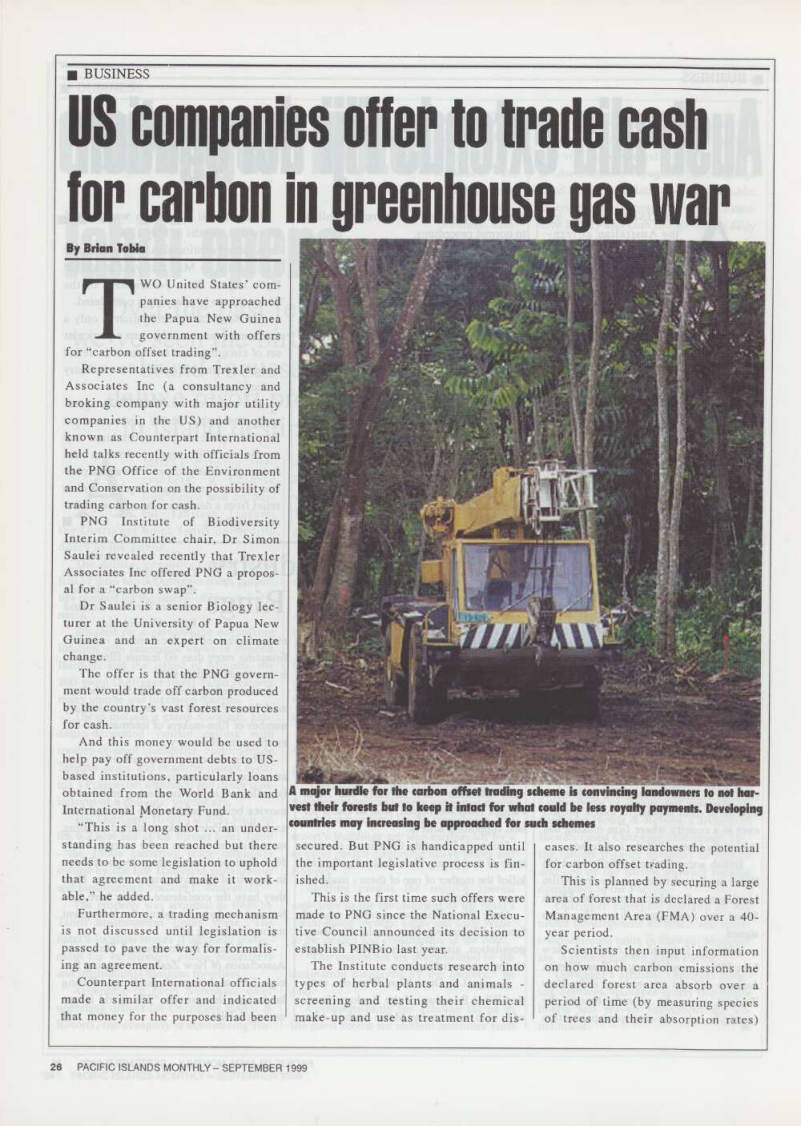
A major hurdle for the carbon offset trading scheme is convincing landowners to not har vest their forests but to keep it intact for what could be less royalty payments. Developing countries may increasing be approached for such schemes
and set the swap or trading rate. But Dr Saulei said the hurdle would be persuading landowner groups in PNG to agree to pursue this revenue raising option rather than logging.
He said there had to be wider con sultation with investors and resource owners. This is necessary because the first project of a similar nature in the southern part of the New Ireland province had failed.
Another US company, Compac, had an agreement with Lak landown ers under which US$2 million was to be paid to them in exchange for con serving 12,000 hectares of forests.
Because developed
countries can only
reduce to about 5.2
per cent by 2020,
developing countries
are required to adopt
a system called Green
Development Mecha
nism to make a sub
stantial reduction in
greenhouse gases
The landowners reneged on the deal and allowed the forest area to be logged. Because of huge royalty ben efits to landowners from logging, it is hard to persuade them to choose car
bon trading.
But Dr Saulei said they could ben efit through royalties from an intact forest or royalties from forest which would no longer exist after logging.
Carbon offset trading option is also being plugged because of the biodi versity in PNG’s forests.
They hold various kinds of medici nal plants and animals that could be developed later for better returns.
The proposal is also in with the Kyoto Protocol. Because developed countries can only reduce to about 5.2 per cent by 2020, developing coun tries are required to adopt a system called Green Development Mecha nism to make a substantial reduction
in greenhouse gases. This conserves forests that can offset or absorb huge quantities of emissions. Developed countries would then compensate their developing country partner.
But the legal approach to the issue of carbon offset trading and ownership of property rights of forest products is proving to be a problem.
Lawyers from the Attorney Gener al’s office are trying two options - a multi-party MOU and a Joint Articles of Association with the International institute of Environment and Develop ment (IIED).
But these options, suggested by an AusAID representative, were not appealling to PNG. PNG believes there is a need to have a mechanism in place through which PINBio must raise its own revenue.
“PNG cannot afford to have the patent of local medicinal plants and herbs taken over by foreign pharma ceutical companies.
“What they will do is make products from our flora and fauna species ... they will therefore own the property rights and only pay us levy,” he added.
This issue was raised with lIED but the PNG parliament has to pass legis lation to safeguard PNG’s rights over its noble products. “While this legisla tion is a long way away, the discovery of noble products are already happen ing and we are missing out,” he said.
State lawyers were advised to look at appropriate legislation to safeguard PNG’s property rights. It is still unclear what stage the lawyers are at in terms of drafting the legislation.
The patent right of a product remains with whoever is developing it and not where the product originated from.
Once developed, the proposed leg islation has to go through a long process from the office of the Environ ment and Conservation to the minister, to the National Executive Council and then to parliament.
Because of the lengthy process, it is imperative that it get off the ground soon because the discovery of products are already at an advanced stage. ■