adaptation and mitigation action
p. 12 · Read in the full issue
AOSIS workshop calls for adaptation and mitigation action
By Giff Johnson
ACTION to mitigate the impact of sea level rise is the “highest priori ty” for small island countries around the world.
Twenty small island countries, together with the United States and other industri alised nations, concluded the first Alliance for Small Islands States (AOSIS) work shop on clean development in Majuro on July 16.
They said that “vulnerability assess ment and adaptation are of the highest pri ority to members of AOSIS,” and called on industrialised nations to support capac ity building and transfer of technology to the smaller nations.
The three-day workshop in Majuro focused on how the “clean development mechanism” agreed to as part of the cli mate change convention in Kyoto, Japan two years ago could be effectively imple mented. It included observers from the US, Australia, New Zealand, England and other European nations who joined in the
final statement.
The statement from the three-day workshop is an excel lent outcome considering the workshop included industri alised nations, and will advance the process for getting action on clean development, South Pacific Regional Environmen tal Program climate change pro ject manager Wayne King said after the meeting concluded.
The hosting of the climate change meeting in the low lying coral atoll nation of the Marshall Islands brought home
the “special vulnerability” of
small islands to climate change
and “underlined the urgency and serious ness of the concerns of AOSIS countries,” the statement said.
While emphasising the importance of domestic actions by industrialised nations to meet pollution reductions guidelines agreed to in the climate change convention, the statement said that the clean develop ment mechanism “can be an important tool for complying with part of these commit-
ment through projects in (developing) countries” which can assist these nations to “achieve sustainable development.”
Under the Kyoto Protocol, industri alised nations can get “credits” toward their agreed-to emission reductions by funding clean development projects in developing nations. But the Majuro meet ing made it clear that such off-shore efforts by industralised nations must have
tangible benefits.
“Certified emission reduc tions generated by the clean
development mechanism
must be additional to that which would have otherwise occurred and should have real, measureable and long term benefits related to the mitigation of climate change,” the final statement said.
The AOSIS meeting called for further work to be done on the issue of adaptation technology, especially for coastal zone management and protection. ■
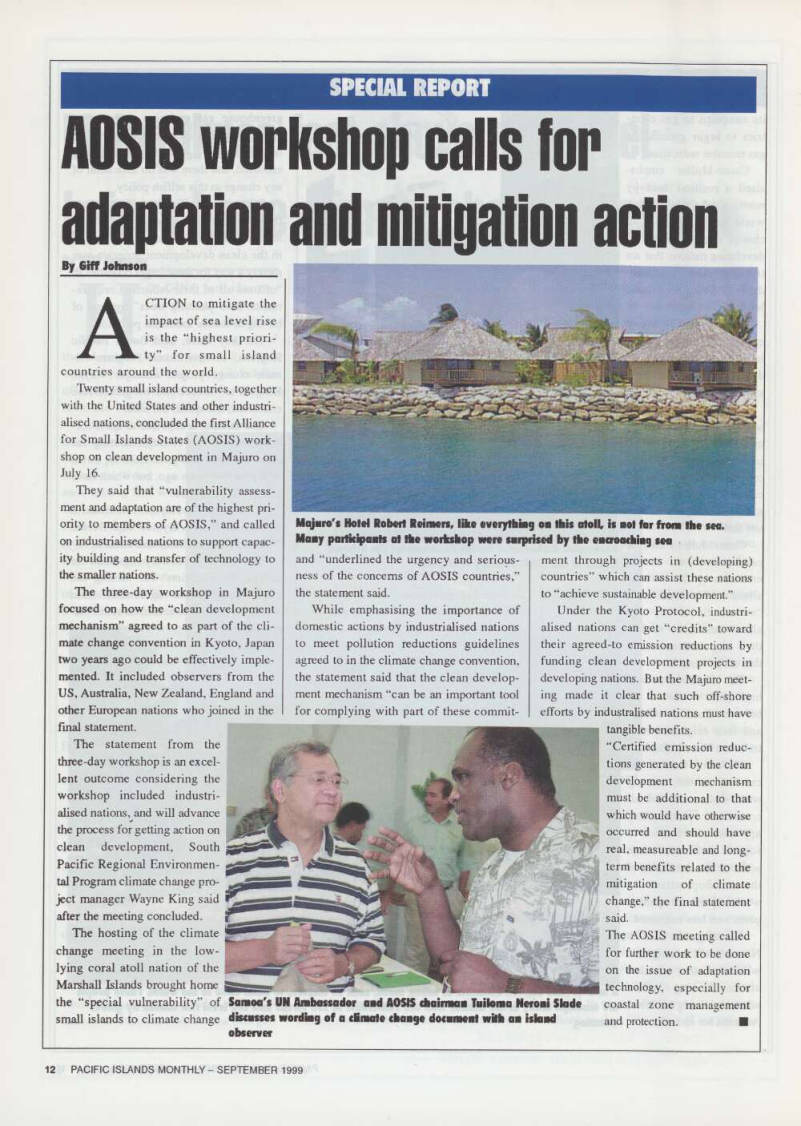
Samoa's UN Ambassador and AOSIS chairman Tuiloma Neroni Slade discusses wording of a climate change document with an island observer
Majuro's Hotel Robert Reimers, like everything on this atoll, is not far from the sea.
Many partkicipants at the workshop were surprised by the encroaching sea