Living three feet above sea level
pp. 10-11 · Read in the full issue
Special Report
Living three feet above sea level brings home climate change message
By GIFF Johnson
HOLDING an interna tional climate change meeting in the low lying atoll nation of the Marshall Islands injected a dose of reality about living at sea level for officials from countries as far distant from the Pacific as Scandinavia.
Landing at Majuro international airport
emphasized the precar ious position of islanders living on mere spits of land who are confronted by cli mate change and sea level rise, Norway’s environment ambas sador told the Alliance of Small Island States (AOSIS) meeting in Majuro in mid-July.
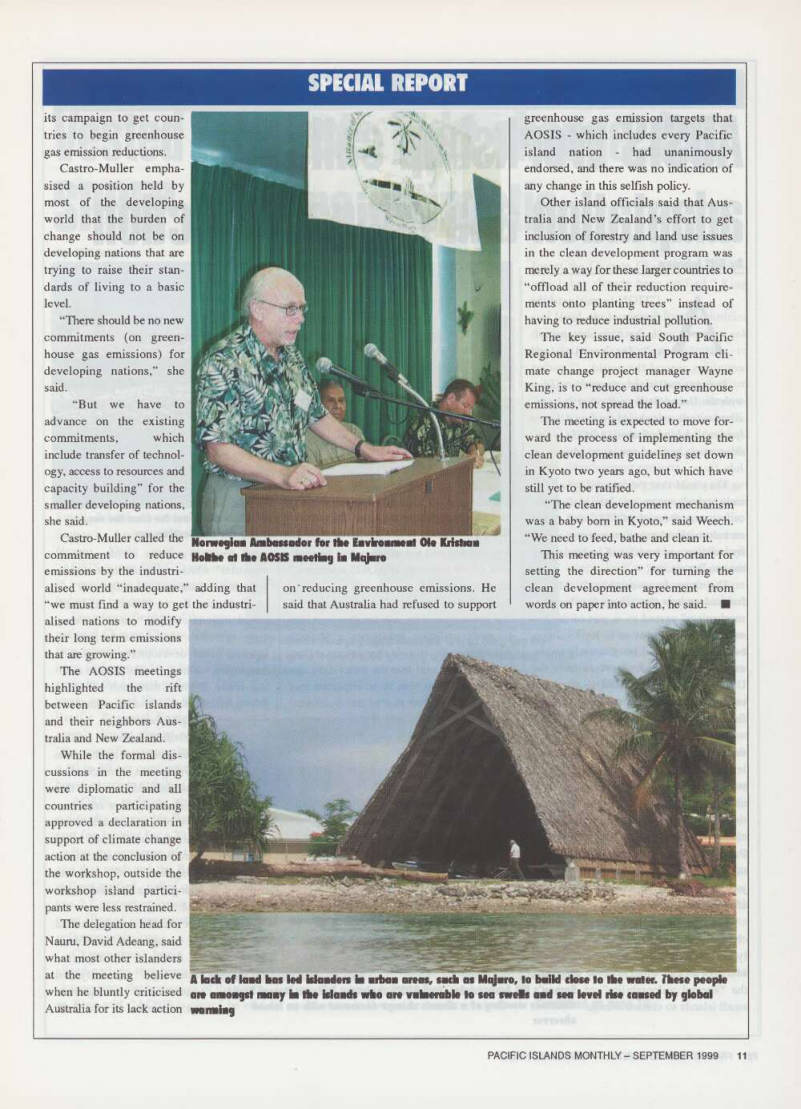
“Landing at Majuro, I was desper ately looking out the window for land,” said Norwegian Ambas sador Ole Kristian Holthe. “All I could see was water on both sides of the plane.”
This atoll nation,
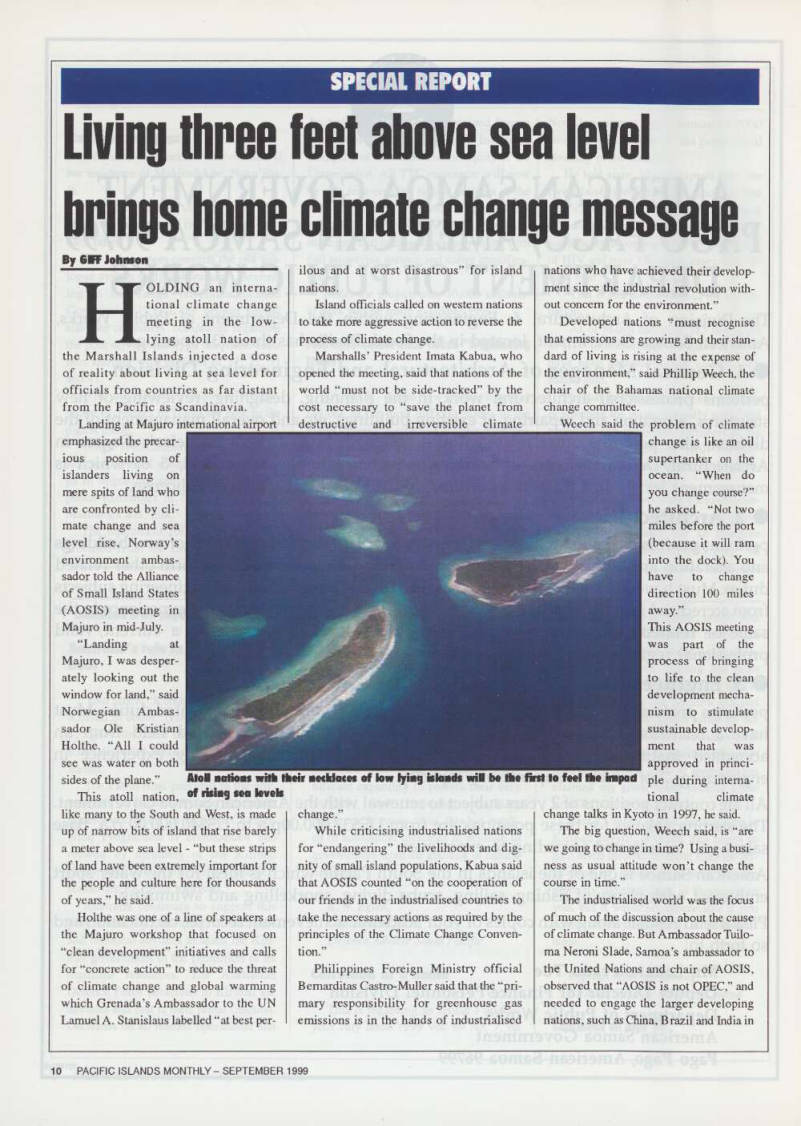
like many to the South and West, is made up of narrow bits of island that rise barely a meter above sea level - “but these strips of land have been extremely important for the people and culture here for thousands of years,” he said.
Holthe was one of a line of speakers at the Majuro workshop that focused on “clean development” initiatives and calls for “concrete action” to reduce the threat
of climate change and global warming
which Grenada’s Ambassador to the UN Lamuel A. Stanislaus labelled “at best per
ilous and at worst disastrous” for island nations.
Island officials called on western nations to take more aggressive action to reverse the process of climate change.
Marshalls’ President Imata Kabua, who opened the meeting, said that nations of the world “must not be side-tracked” by the cost necessary to “save the planet from destructive and irreversible climate
change.”
While criticising industrialised nations for “endangering” the livelihoods and dig nity of small island populations, Kabua said that AOSIS counted “on the cooperation of our friends in the industrialised countries to take the necessary actions as required by the principles of the Climate Change Conven tion.”
Philippines Foreign Ministry official
Bemarditas Castro-Muller said that the “pri mary responsibility for greenhouse gas emissions is in the hands of industrialised
nations who have achieved their develop ment since the industrial revolution with out concern for the environment.”
Developed nations “must recognise that emissions are growing and their stan dard of living is rising at the expense of the environment,” said Phillip Weech, the chair of the Bahamas national climate change committee.
Weech said the problem of climate
change is like an oil supertanker on the ocean. “When do you change course?” he asked. “Not two miles before the port (because it will ram into the dock). You have to change direction 100 miles away.”
This AOSIS meeting was part of the process of bringing to life to the clean
development mecha
nism to stimulate
sustainable develop
ment that was
approved in princi
ple during interna
tional climate
change talks in Kyoto in 1997, he said.
The big question, Weech said, is “are we going to change in time? Using a busi ness as usual attitude won’t change the course in time.”
The industrialised world was the focus of much of the discussion about the cause of climate change. But Ambassador Tuilo ma Neroni Slade, Samoa’s ambassador to the United Nations and chair of AOSIS, observed that “AOSIS is not OPEC,” and needed to engage the larger developing nations, such as China, Brazil and India in
Atoll nations with their necklaces of low lying islands will be the first to feel the impact of rising sea levels
its campaign to get coun
tries to begin greenhouse
gas emission reductions.
Castro-Muller empha sised a position held by most of the developing world that the burden of change should not be on developing nations that are trying to raise their stan dards of living to a basic level.
“There should be no new commitments (on green house gas emissions) for developing nations,” she said.
“But we have to advance on the existing commitments, which include transfer of technol ogy, access to resources and capacity building” for the smaller developing nations, she said.
Castro-Muller called the commitment to reduce emissions by the industri
alised world “inadequate,” adding that “we must find a way to get the industri
alised nations to modify their long term emissions that are growing.”
The AOSIS meetings highlighted the rift between Pacific islands and their neighbors Aus tralia and New Zealand.
While the formal dis cussions in the meeting were diplomatic and all countries participating approved a declaration in support of climate change action at the conclusion of the workshop, outside the
workshop island partici
pants were less restrained.
The delegation head for Nauru, David Adeang, said what most other islanders at the meeting believe when he bluntly criticised Australia for its lack action
on*reducing greenhouse emissions. He said that Australia had refused to support
greenhouse gas emission targets that AOSIS - which includes every Pacific island nation - had unanimously endorsed, and there was no indication of any change in this selfish policy.
Other island officials said that Aus tralia and New Zealand’s effort to get inclusion of forestry and land use issues in the clean development program was merely a way for these larger countries to “offload all of their reduction require ments onto planting trees” instead of having to reduce industrial pollution.
The key issue, said South Pacific Regional Environmental Program cli mate change project manager Wayne King, is to “reduce and cut greenhouse emissions, not spread the load.”
The meeting is expected to move for ward the process of implementing the clean development guidelines set down in Kyoto two years ago, but which have still yet to be ratified.
“The clean development mechanism was a baby bom in Kyoto,” said Weech.
“We need to feed, bathe and clean it.
This meeting was very important for setting the direction” for turning the clean development agreement from words on paper into action, he said. ■
A lach of load has led islanders in urban areas, sach as Majuro, to build close to the water. These people are amongst many in the islands who are vul[?]erable to sea swells and sea level rise cansed by global warming
Norwegian Ambassador for the Environment Ole Kristian Holthe at the AOSIS meeting in Mayjuro