Molokai or bust
pp. 54-55 · Read in the full issue
Yachting
Sony aid pictures by SAIIY ANDREWS
OUR last duty before leaving Honolulu was ‘ 0 I pur
chase a large scale chart of Kaneohe Bay. That done, we sailed, then motor sailed, eastbound and around the coast of Oahu. Four hours later, the wind shift ed on the nose and increased!!
Afraid we might not make it safely inside Kaneohe Bay before nightfall (and because of the many ' reefs we weren’t inter
ested in finding an anchorage after sunset) we considered all the alternatives - then dismissed them. Returning to Honolulu and arriving after dark would be disap pointing. Spending the night at sea didn’t appeal at all. Last option: to keep going and hope for the best.
Rainbows arched optimistically across a wet sky. Straining our eyeballs, we
peered through the tropical down pours and finally found our land mark, the Chinaman’s Hat. We found a suitable spot to anchor moments before darkness com pletely enveloped us.
That evening, the Coast Guard weather channel reported winds blowing 30 knots from the north west with 18 foot seas! Forecasts were for several more days of intermittent rain and unsettled weather. Looking around us, though, I couldn’t complain. The bay, backed by high cliffs, was beautiful, the temperature perfect, and the stars suddenly appeared, one by one, to brighten up the
night sky.
No, we couldn’t complain. Our first month of winter cruising in Hawaii had been
blessed by pleasant weather and fair winds.
All our crossings of the Hawaiian channels had been great - even the treacherous Alenuihaha (Laughing) Channel. We’d cruised the islands from east to west, stop ping at the Big Island, Maui, Lanai, Oahu and Kauai - loved them all!
Recovering quickly from the passage, we
spoiled ourselves with some R & R at Kaneohe’s celebrated sandbar. The activi ties were most taxing: we watched the tide go out, built sandcastles, held Kona and Samoan crabs hostage, and watched the tide come back in. Then we’d start the process all over again. Seven days drifted away in that fashion.
Desirous of being a bit more social, we
sailed into Kaneohe Yacht Club and tied to the seawall. Sev eral old and new friends appeared, and we slipped easi ly into the comfort of daily hot showers and a swimming pool, as well as cold beer and popcorn during happy hour.
By the end of the week, we were ready to try a channel crossing. We headed back to Kaneohe
sandbar, expecting
to depart for Molokai the following morn ing.
Well, it blew 35 knots in the channel with 22 foot seas for the next seven days and seven nights. Fellowship danced on her anchor. Foster protested: Gentlemen don’t cruise to windward. I echoed: I ain’t going nowhere if the wind is higher than our boat is long. Twenty-three days later,
we were still waiting to cross the channel to Molokai. Dur ing the interim, a wind shear, a storm system, squalls, gales and rain galore kept us rock ing. Coast Guard got repeti
tive and boring: “Extremely
high winds will continue to pester the Aloha State”.
Public transportation was cheap, though, so when we needed a change of pace we’d bus ‘round the island.
Clockwise brought us to the fleshpots of Honolulu. Head ing anti-clockwise, we dis covered the surf at Waimea Beach.
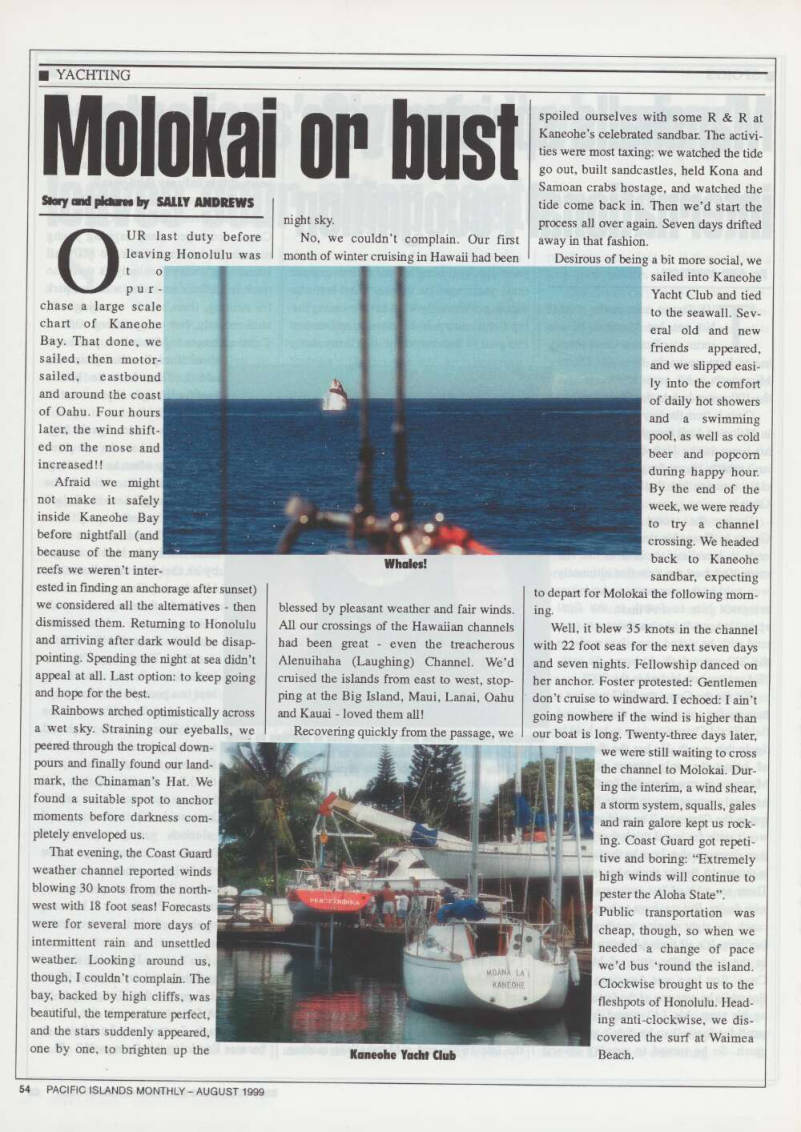
Whales!
Kaneohe Yacht Club
I got proficient at making musubis, a sushi-like delicacy incorporating tinned Spam, rice and generous amounts of wasabi, wrapped in sheets of nori. Spam is a Hawaiian favourite: Spam Chowder,
Spam Fu Young, Spam Slaw, Spam
Quiche, Kahlua Spam ... endless varia tions.
If there’s one thing a cruiser can’t stand, it’s watching water go to waste. But once you’ve filled all the tanks, buckets, pots, tea kettle, and dinghy, what do you do?
With all the rain, we shifted into cleaning mode and while Foster attacked rust and dirt on deck, I mounted an onslaught against must and mold in the galley and laundered everything in sight. When we tired of being industrious, we weighed anchor and shifted half a mile ... back to the sandbar where, marooned on the tem porary islet, we once again made monu ments of coral and constructed immense sandcastles. Before the tide rose and fell
again...
It wasn’t long before we thought we might be going off our rockers ... Remem
ber the Sixties hit by the animals - “We gotta get out of this place, if it’s the last thing we ever do”. Well, the rhythm and refrain pounded continuously through our heads. We began to wonder if we’d ever get to Molokai.
But every cloud has a silver lining. Fel lowship has a good ship’s library - and now we had the luxury of time to rediscover our favourites and to unearth books we’d over looked. Joshua Slocum, Farley Mowatt and James Michener kept us company that month.
The weather moderated eventually, and we left Kaneohe Bay via the Sampan Channel. Southwesterly winds made for a fast crossing to Molokai, although the seas were quite steep and confused off Lau’u Pt.
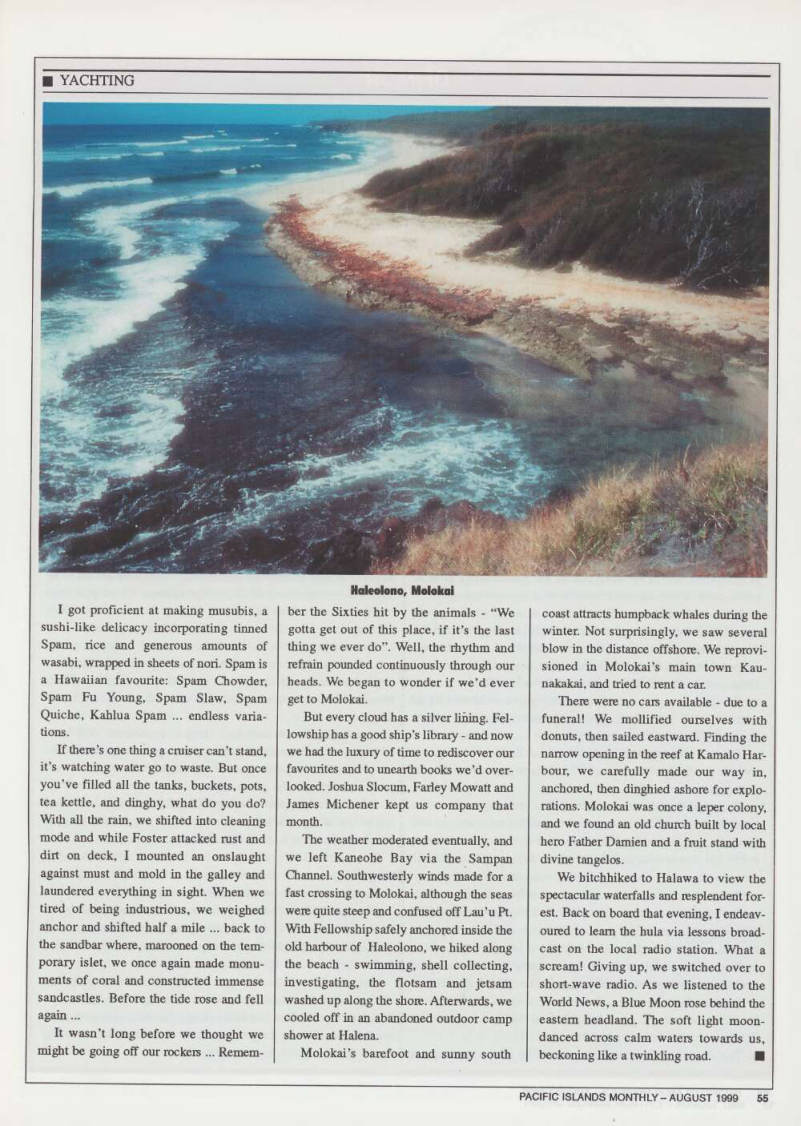
With Fellowship safely anchored inside the old harbour of Haleolono, we hiked along the beach - swimming, shell collecting, investigating, the flotsam and jetsam washed up along the shore. Afterwards, we cooled off in an abandoned outdoor camp shower at Halena.
Molokai’s barefoot and sunny south
coast attracts humpback whales during the winter. Not surprisingly, we saw several blow in the distance offshore. We reprovi sioned in Molokai’s main town Kau nakakai, and tried to rent a car.
There were no cars available - due to a funeral! We mollified ourselves with donuts, then sailed eastward. Finding the narrow opening in the reef at Kamalo Har bour, we carefully made our way in, anchored, then dinghied ashore for explo rations. Molokai was once a leper colony, and we found an old church built by local hero Father Damien and a fruit stand with
divine tangelos.
We hitchhiked to Halawa to view the spectacular waterfalls and resplendent for est. Back on board that evening, I endeav oured to learn the hula via lessons broad cast on the local radio station. What a scream! Giving up, we switched over to short-wave radio. As we listened to the World News, a Blue Moon rose behind the eastern headland. The soft light moon danced across calm waters towards us, beckoning like a twinkling road. ■
Haleolono, Molokai