international recognition
p. 53 · Read in the full issue
Marshalls sprinter gets international recognition
By Giff Johnson
THE fastest man in the world?
Not yet, but Marshall Islands sprint star Roman Cress is start
ing to bum up tracks from the US to Micronesia in his quest to win gold in the 100 meter dash in the Olympics.
Cress is from the tiny island of Kaben in Maloelap Atoll though he now makes his home in the United States. Kaben isn’t exactly known for producing world class runners, but that’s exactly what Cress is.
During the recent South Pacific Games in Guam his time of 10.64 sec onds in a preliminary heat in the 100 metre dash beat the time that ultimately won gold in the competition. An injury relegated him to fourth in the final sprint, but proving he’s a sprinter to con tend with, he picked up a silver medal in the 200 metre dash. At home, he says, “I’d get my butt kicked in the 200”.
Yet for the Cress, the SPG was just a tune up for competing in the track and I field World Championships to be held in Spain this month. He has the distinction of being the only runner from the Micronesian area to qualify for the inter
national competition in Spain. “I want to run in the Olympics,” he said recently. “I won’t settle for less. I think that I’m better than everyone else. I can be the fastest man in the world. But the timing has to be there.
There are a lot of fast sprinters out there with desire. But you have to have the right coach, the right running weather, the right facilities. It’s all timing.”! .iving in the US in the very chilly state of Minnesota, Cress’ first love was American football.
But while he was one of the fastest players on his team, his 140 pound frame was small for football so he didn’t get to play much. So he turned to running several
years ago, beginning serious sprinting about three years ago. He quickly burst into the winning column. By 1998 he was among the top five sprinters in Minnesota, and earlier this year “I dominated the 100 metre dash.
There was no competition,” he said. Turning to a wider field of competition, he headed to lowa to compete with runners from the mid west states in the US and quickly moved into the top five. His best time of 10.3 in the 100 metres brought him world attention and an invitation to Spain. But Cress is on a long term mission. “My goal for 1999 was 10.3 seconds in the hundred,” he said. “Next year, I want to get it down to 10.1. Each year I want to bring it down. It just takes patience
and discipline.”
The son of an American father who was a Peace Corps Volunteer in the Marshalls in the late 1970 s and a Marshallese mother.
Cress observed: “I basically had no coach ing and I ran 10.3 (seconds) in the 100 (metre dash). I want to know how good I can be. To be a world class runner takes 12 years; this is only my third year.”
While he was in the Marshall Islands visiting relatives after the SPG on Guam, Cress encouraged many aspiring young runners. To be a runner in the Marshall Islands isn’t easy: not only is there no track field, there isn’t even a decent park for running, there’s little coaching and, until recently, few competitions. One of Cress’ messages to Marshallese youth was
about discipline and desire. He added, “You have to live a healthy lifestyle if you want to be successful.”
He follows a strict, low fat high fibre diet and works out three times daily when he’s training.
In the Marshalls, “diet is the toughest thing,” he said. “I slack off when I’m here.”
Marshall Islanders, who con sume rice by the bucket, can get by on that kind of a diet at the Micronesian Games level, but it won’t take them higher, he said.
Pointing to Marshallese wrestlers, Cress said “look at the wrestlers. They’re top of the line in the South Pacific. But if they kept to a good diet and had prop er coaching, they’d be top in the world. These guys are rough and tenacious. Look at the medals they win (in regional competi tion).” A disciplined diet will
take an athlete up one notch above natural ability, Cress said. “Quit smoking and drinking alcohol, you go up another notch,” Cress hopes to encourage a few local athletes by helping them go to school in the US where they can get good coach ing and training. People say I have no life,” Cress observed of his rigorous train ing program.
“But I don’t care. I’m doing this for myself, my family and my country. When I used to tell people that I’m going to be one of the fastest runners in the world, they’d laugh. I won’t say I told you so because I’m doing this for myself.” ■
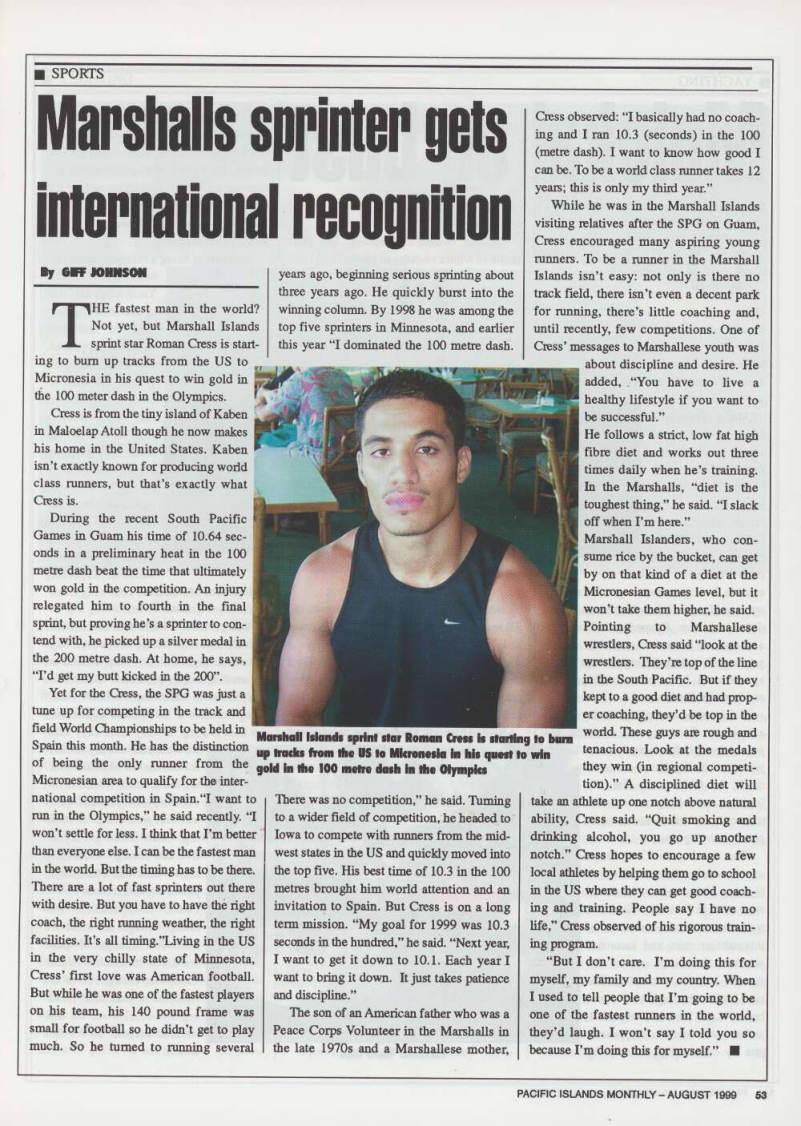
Marshall Islands sprint star Roman Cress is starting to burn up tracks from the US to Micronesia in his quest to win gold in the 100 metre dash in the Olympics