Kokoda Trail: PNG's biggest attraction
pp. 50-51 · Read in the full issue
Tourism
By Sam Vulum
THE infamous Kokoda Trail remains a significant tourist attraction for Papua New Guinea because of its strong links with World War II and the vast diversity it holds in animal and plant life.
It remains close to the heart of many foreign visitors, mainly Australians who have lost more than 600 loved ones who
died fighting the Japanese along the
Kokoda Trail.
Japan also lost an estimated 12,000 soldiers in five months of bloody hand-to hand fighting with the Australians along the trail that runs 240 kilometres from Sogeri Plateau near PNG’s capital Port Moresby over the rugged Owen Stanley Range to Kokoda in the Northern Province.
The trail has recently been targetted by the PNG Tourism Promotion Authority
after establishing that it is one of the most sought-after destinations in the country.
TPA has planned to undertake a famil iarisation tour of the trail by its staff to ensure that factual information is provided to visitors. Staffers Daphne Ibia and Raka Morea were selected to be part of the trail with some Australian trekkers. The trip was still in the planning stage at the time of writing.
“The aim of the exercise is for us to get ourselves familiar with the Kokoda Trail. It is one of the most sought after products by tourists who inquire at the office and by actually trekking the width and length of the trail, our experience will enable us to provide first hand accounts of what it holds for tourist trekkers,” Ibia said.
Their 8-day expedition will cover the actual trek from Kokoda Station through the picturesque Myola Lake, to the historic villages of Kagi, Efogi, Menari and Naoro.
There are six women and nine men in
the team.
The inclusion of the women is nothing new, according to team leader Narai Billy who has been trek leaders in the Koiari mountain ranges for many years.
“I have led many teams where a good number of the trekkers were women. This is also indicative of how safe and bearable the Kokoda trail is as a tourist destina tion,” Billy said.
Some of the highlights of the expedi tion include the Golden Stairways, built during World War 11, Mount Bellamy where mass graves of war casualties were laid, Imita Ridge where the final show down took place between the Japanese and the Allied Forces, and Kokoda Plateau.
During the expedition, the group will be given a taste of true Kolarian hospital ity and “bush tucker” - food traditionally prepared by the guide and team leader Narai Billy.
He says the Kokoda Trail is simply a unique and unifying experience that will cut through the thick of any per son and change him or her for the better upon completion.
Many tourists prefer to trek the Kokoda Trail for its wide range of activities in one package.
You stop over to fish in unspoiled ponds, visit his toric sites from W.W.n, check out the wide variety of orchid species or even laze around for one whole day in one of six main villages along the trail.
The TPA, together with the Papua New Guinea Sports Federation and other relevant government agencies are also preparing to market the trail to the world after it was
included as a route for the Syd ney Olympic torch relay, a 16-
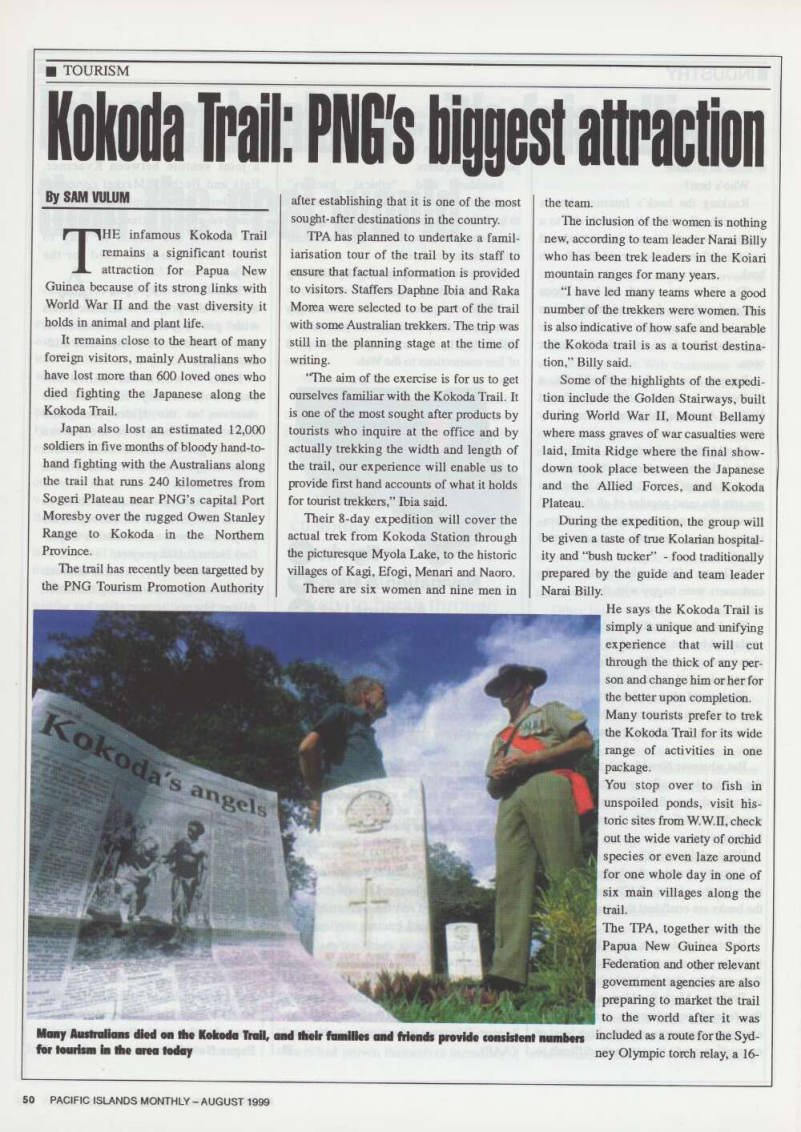
Many Australians died on the Kokoda Trail, and their families and friends provide consistent numbers for tourism in the area today
day sweep through the South Pacific in 2000.
After being lit at a special ceremony in Greece, the Olympic torch will travel to Guam, the Federated States of Micronesia, Nauru and Solomon Islands before arriv ing in PNG.
The relay will then visit Vanuatu, Samoa, American Samoa the cook Islands, Tonga, Fiji and New Zealand before trav elling to Australia.
By extending the run through the Pacif ic, the 2000 Olympics will mark the biggest relay in the history of the games.
By the end of the Australian leg, the torch will have been carried by almost 12000 runners across 60,000 kilometres and through 14 countries.
Australian prime minister John Howard said apart from the Olympic rings, the Olympic torch was the most memorable and evocative Olympic sym bol.
“Just as we want the torch relay in Aus tralia to touch the broadest cross-section of the Australian community and Aus tralian experience, so too do we want to showcase the lives of our near neighbours of the region and help reveal to the world a little more of the rich history and culture of the Oceania region and its people,”
Howard said.
In preparation for the event, about 15 volunteers from the Kokoda Memorial Foundation Pty Limited of Australia were in the country in July upgrading roads in the area.
The foundation is an Australian non profit organisation whose goals are to bring improvements for the Kokoda Trail villages and monuments to the fallen World War II heroes in the area.
The trail is a significant World War II landmark. After Japanese plans for a sea invasion of Port Moresby were checked by the Battle of the Coral sea and Battle of Midway, the Japanese switched to a land assault via the remote mountain trail through jungle and across rivers.
They were repelled by the Australian troops in the five month battle. The Aus
tralians were supported by Papuans,
whom they referred to as the “fuzzy wuzzy angels”. ■