Internet banking - it's friendlier
pp. 48-49 · Read in the full issue
than the real world
AUSTRALIAN banks are find ing cyberspace a more friend
ly place to service and acquire
customers as the ongoing public furore over bank branch closures and fees dent their collective image in the physical world.
Certainly their efforts on the Web are proving a lot more popular, and potential ly more profitable, then even the most
optimistic of early forecasts.
There are already more than 300,000 customers using various bank Internet ser vices and that number is likely to break through one million in total by 2001.
And within five years banks are confi dent they will have a million Internet cus tomers each.
By that time, visiting a bank’s website will be as familiar as visiting a branch or withdrawing money from an ATM or EFT POS machine.
Each of the four major Australiasian banks and St George Ltd, which pioneered Internet banking in Australia through Advance Bank, now has a presence on the Web that matches most of their non-cash branch services and in some areas, such as on-line stockbroking, exceed them.
Neither Westpac Banking Corp nor
Commonwealth Bank of Australia Ltd are shy about projecting usage rates to total millions each within the next five years.
Commonwealth said potentially 100 per cent of its customer base could be ser viced on-line in around five years, even though many of those customers still will do more of their banking face to face than on-line.
“Internet technologies and Internet pro tocols will become the core customer interface,” Commonwealth’s head of on line services Stephen Coulter said.
Westpac’s head of on-line services Jonathan Poole said the bank’s Internet
customer usage was growing so fast that setting a growth target could be counter
productive.
“It’s hard to say, to the point where set ting a figure might be a bit limiting,” Poole said.
Who’s using it?
At this stage the banks agree their Inter net customers mirror, and in some cases exceed, the demographic of the typical Internet user.
There are already
more than 300,000
customers using various
bank Internet services
and that number is
likely to break through
one million
in total by 2001
That is, someone who is tertiary educat ed, has a high income and is more respon sive to new technology than the population average.
It is not coincidental that person is exactly the kind of customer that all the banks want to have because they are poten tially much more profitable than average customers.
Internet users are more skewed to high er incomes, more likely to have a loan, have a credit card, and have higher transaction values and balances.
Commonwealth’s Coulter said such cus tomers are ten times as profitable as the average customer.
And they are also proving to be very
loyal.
St George’s Internet channel manager Rupert Blatch said the bank’s Internet cus tomers had proven themselves incredibly
loyal since Advance began the service in 1995.
Westpac and Commonwealth agree.
And Wizard Financial Service’s Andrew Inwood noted that its research also showed that Web customers were some of the “stickiest” customers in finan cial services.
“They are incredibly sticky, and the more services you offer them the stickier they get - just like they had got caught in a real web,” Inwood said.
Westpac’s Poole said also that the bank’s Internet customers were ten times as profitable as average customers.
Their higher net worth was one of the main reasons Westpac’s Internet opera tions were already profitable on cost-ver sus-revenue basis.
Other banks were more coy in their revenue predictions but Poole said West pac’s Internet operations would be prof itable on that basis by next year.
A key component in Commonwealth’s quick ascent to profitability has undoubt edly been its Internet and phone based dis count stock broking service, Com Sec.
The service, which is the second most visited Internet site in Australia, has been a huge success for the bank and has prompted a raft of copy cat actions by the
other majors.
Both St George and ANZ Banking Corp have already unveiled their intention to offer broking but each of those has teamed up with another player to provide the stockbroking services.
St George has teamed up with HSBC and ANZ is in bed with etrade.
Westpac said it will follow the Com Sec model and have a wholly owned on-line stockbroking service by next year.
National Australia Bank Ltd has had discussions with several brokers about establishing some form of share trading
facility for its customers but it said it was a long way from deciding on the nature of the facility or on a broking firm with whom to form an alliance.
Who’s best?
Ranking the bank’s Internet sites is extraordinarily difficult as each site to a degree reflects the time it was introduced and the different customer profile of each bank.
The first sites tend to have been designed with less features initially but as each is scaled up with new services or upgraded it tends to overtake the earlier ones.
Recent research from New Media, a Melbourne based research house, found National Australia’s site was the most fully featured.
New Media was hardest on St George which it described as having “limited func tion and design” but St George’s site was pro rata the most popular of all the banks’
Internet sites and its proportion of cus tomer usage at three per cent outstripped the others.
St George’s Blatch added that the banks customers were happy with the site’s ser vices.
The low functionality could have been explained by the fact that St George had pioneered most of the services that the other banks’ had since copied.
That could also explain why National Australia’s site was seen as being the most polished - it also being the youngest of the sites.
But whatever New Media’s rankings, all the banks’ internally generated research indicates almost all of their customers are more than satisfied with the services each bank provides.
What might stop it?
Security remains the biggest concern but with the advent of 128 encryption all the banks are confident that issue has been solved.
Potential customers are still concerned but it is now a matter of education more than anything else, the banks believe.
Professor Mark Sneddon, a member of the federal government’s committee on electronic commerce, said the high level of encryption made it extremely difficult to
hack into banks’ computers and they were basically secure. The biggest weakness in the system in fact was the customers’ own personal computers.
Sneddon said “ethical hackers” employed by overseas banks had managed to hack into customer accounts through cus tomer computers but so far there had been little evidence of fraud.
The other barrier potentially limiting growth is the computer itself.
While computer use is increasingly widespread their mainstream presence is still limited by the keyboard and the speed of line connections to the Web.
But as cable delivery of on-line services becomes more widespread so will the Inter net’s access speed and the deliverability of non-keyboard based Internet services such as web TV.
When transferring money or paying a bill is as easy as turning on the TV - or dialling on the mobile (as Commonwealth will offer later this year) the boom will real ly start. Whatever it there going to be next?
(Aap) ■
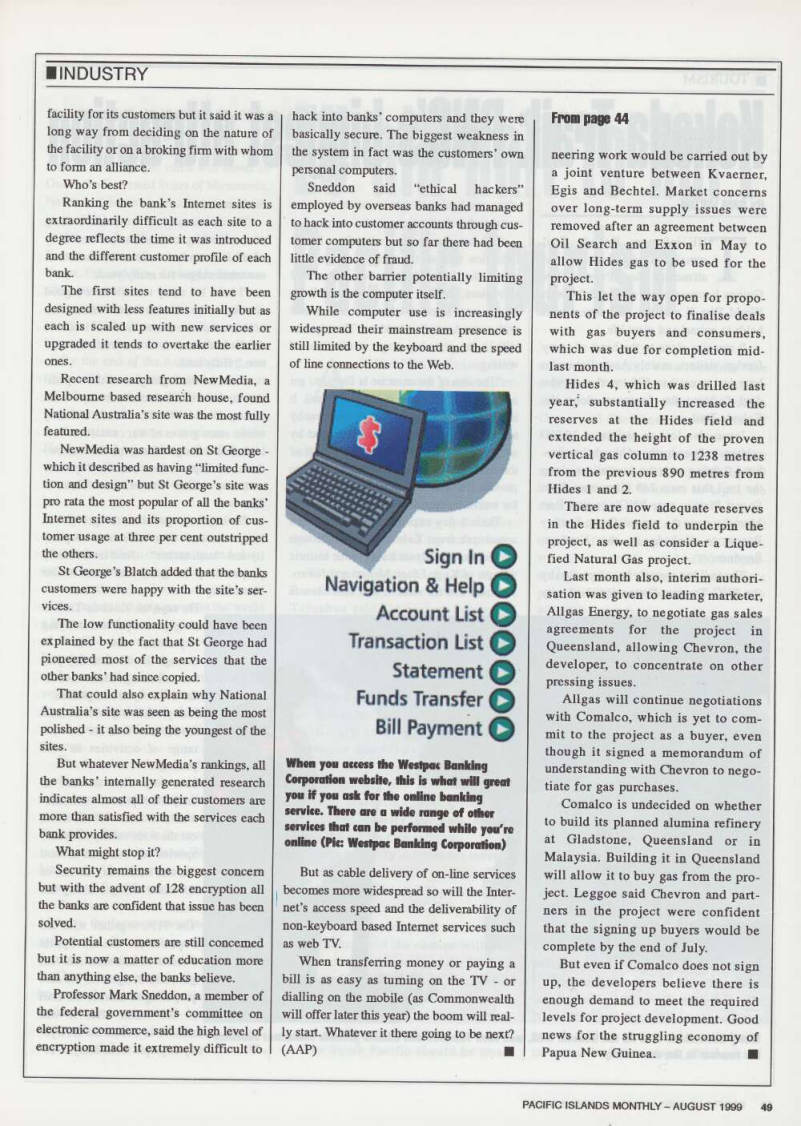
When you access the Westpac Banking Corporation website, this is what will great you if you ask for the online banking service. There are a wide range of other services that can be performed while you're online (Pic: Westpac Banking Corporation)