Questions linger over whether
pp. 42-43 · Read in the full issue
Focus
Questions linger over whether Rongelap will ever be safe
By Giff Johnson
ON March 1, 1954 the sun rose in the West for Rongelap
islanders, bringing hydrogen
bomb fallout, radiation sickness and, ulti mately, forcing the people to evacuate their home islands. The blast at Bikini was 45 years ago, but Rongelap Islander Mwe nadrik Kebinli - and the small group still alive who were on Rongelap that fateful day - remember the day of the Bravo hydrogen bomb test as if it happened yes terday.
Rongelap islanders, with US funding, embarked late last year on the first phase of cleanup and rehabilitation of Rongelap Island, the main island in an atoll that has more than 60 islands. The initial work of the US$B million resettlement project (establishing a base camp, required infra structure including a power plant, reverse osmosis water making units, a dock and runway renovation, and starting remedial radiation-reduction measures) is expected to finish early next year, confronting Ron gelap islanders with the hard choice: to return or not to return.
Many questions linger about the future safety of this atoll, despite conclusions by a number of scientists that, with remedial work, it can be made safe for habitation. A primary reason for the questions is the out right distrust of and hostility toward US
government scientists by Rongelap
islanders. The scientists and doctors who had studied and treated Rongelap islanders since 1954 came from US laboratories whose primary functions were develop ment of nuclear weapons and energy.
Decisions by these US government sci entists and doctors resulted in Rongelap islanders being exposed to unsafe levels of radiation over decades, while all the time the doctors reassured the islanders that everything was fine and they shouldn’t
worry. Finally, earlier this year, the US gov ernment’s Brookhaven National Laboratory, which had operated a medical program for Rongelap and Utrik, another fallout-affect ed atoll, since 1954 - without any outside supervision or peer review - was replaced by a Hawaii-based health organisation that won the contract through a competitive bid which has restored a measure of confidence in the medical treatment islanders are now
receiving.
But that’s just one of the concerns. When Rongelap and US officials agreed to the cleanup and resettlement plan in 1994, they approved an agreement which calls for reducing the exposure to man-made radia tion on Rongelap to 100 millirems per year.
Late last year, however, the Nuclear Claims Tribunal in Majuro adopted - over strenuous objections from scientists from US laborato ries - a much more stringent US Environ mental Protection Agency guideline for cleanup situations of 15 millirem. There is a move to have this standard adopted by the Nitijela (parliament) as the national require ment for all cleanups in the Marshall Islands. The realisation that the earlier 100 millirem agreement is out-of-step with the more health-conscious EPA-standard has Rongelap leaders taking a hard look at the 1994 agreement with the Department of Energy and Department of Interior.
The Marshall Islands’ Chernobyl began in the early morning hours of March 1, 1954, when the Bravo test was exploded on Bikini, about 100 miles to the west of Ron gelap Atoll. Kebinli was up in the pre-dawn hours, preparing breakfast for her family when suddenly the sun appeared to rise in the west. It was the fireball of the Bravo test, at 15 megatons the largest nuclear bomb exploded by the US. But Kebinli and the other 81 Rongelap islanders wouldn’t learn that until they were evacuated two days later.
“A bright light came out of the west and a short time later I heard a sound like thunder,” she said. “The ground began to shake and the pots and pans fell off the table.” Within a few hours, a snow-like ash began falling on Rongelap. Not warned to take precautions, children played in the radioactive powder which fell in the drinking water and contaminat ed the food. Soon after their evacuation, 48 hours after the Bravo test, Rongelap islanders experienced radiation skin bums, nausea and hair loss - symptoms similar to victims of the atomic bombing of Hiroshima.
US Atomic Energy Commission doc tors allowed the people to return home in 1957 to a heavily contaminated environ ment, but one the US officials claimed was safe for resettlement. Brookhaven National Laboratory reports at the time even refer to Rongelap as one of the most radioactive spots on the Earth. For many years Rongelap leaders questioned the safety of the environment. The health concerns reached a peak in the mid-1980s and, in 1985, Rongelap Senator Jeton Anjain led the entire community of about 400 people as they picked up and moved - with the aid of the ill-fated Greenpeace ship Rainbow Warrior - to Mejatto Island
in nearby Kwajalein Atoll, where they
remain today.
While US scientists dismissed Ronge lap islanders’ concerns at the time, subse quent scientific studies have shown that Rongelap Atoll has levels of radiation that
require cleanup. The US Congress voted
a US$45 million resettlement trust fund in the mid-1990s and the first phase of the rehabilitation effort is now seriously underway at Rongelap.
“We want to return home,” Kebinli said. “But because of the radiation people had no choice but to evacuate.” She said that she’s been saddened for many years
by the plight of her fellow islanders who have suffered many health problems as a result of the US nuclear testing program. “But now,” she said, “with our return this week and the raising of the American flag on Rongelap, it’s a sign of working together to resolve our problems.”
The day of the fallout and all of the
subsequent health problems are so interwo ven in the fabric
of Rongelap
islanders’ lives that there is no
removing that
shadow from any discussion about a possible future return home.
US officials from the Interior
Department,
however, state forcefully that this first phase work is aimed at
creating an
opportunity for any of the islanders who want to return home. “We will work together to
make the vision of a return to Rongelap a reality,” said Allen P.
Stayman, the former director of the Office of Insular Affairs in the Interior Department, and now the US chief nego tiator for the Compact with the Marshalls and Federated States of Micronesia. Stay man assured Rongelap leaders of ongoing “US government support for continuing the resettlement project until every mem ber of the Rongelap community who wants to return has that opportunity.” But, he added, the US is not pushing people to return home. That decision is up to islanders to make next year when the US$B million first phase work is complet ed.
Now under construction is a base camp at Rongelap which includes a power plant,
equipment that can produce 10,000 gallons
of fresh water daily, catchment tanks, hous ing for workers and visitors, a new dock and a refurbished airstrip. Top soil in the planned new village area will be scrapped and replaced by crushed coral to reduce radiation exposure, while potassium fertil izer will be spread throughout the island to prevent root crops, such as coconut and
pandanus trees, from picking up cesium 137 that is embedded in the soil. Experi ments at Bikini Atoll by US government scientists have demonstrated that potassi um-based fertilizer acts as a prophylactic, blocking the uptake of as much as 95 per cent of the cesium.
But many Rongelap Islanders are taking a wait and see attitude, wanting to go home but skeptical of scientific predictions that Rongelap can be made safe. Howard Hills,
Rongelap’s Washington-based attorney,
said that phase one - which will include monitoring and testing of both the environ ment and resettlement workers for radiation levels - when it finishes next year will pro vide the basis for the people to make a deci sion about whether they want to return.
Among the issues that islanders are con cerned with is that the US$4O million trust fund so far provided by the US will barely be adequate to rehabilitate Rongelap Island, leaving a question mark over the dozens of other islands, many of which are significantly more contaminated than the main island and were traditionally used for food gathering and copra production.
In addition, the issue of 100 mil lirem exposure versus 15 mil lirem exposure will loom large
as Rongelapese
begin looking at
a possible future resettlement.
Health concerns aside, cleaning up the island to the 15 millirem standard will be much more cost ly than original ly planned. The limited US
funding,
Matayoshi said,
is not enough by their estimate to complete reha bilitation of the main island, let alone any other
islands. Matayoshi said that no decisions will be made until the first phase is com pleted and scientific monitoring data becomes available so that Rongelap islanders can see if the remediation efforts are, in fact, reducing radiation levels on the island.
Still, there is a powerful pull for the people to return home, despite the linger ing radiation. Marshall Islands President Imata Kabua, who flew out from Majuro to attend the brief return to Rongelap, summed up the feelings expressed by many Rongelap elders. “Even if you have money,” he said referring to compensation that Rongelap has received from the US for nuclear test damages, “if you’re not able to live on your home islands, the money means nothing.” ■
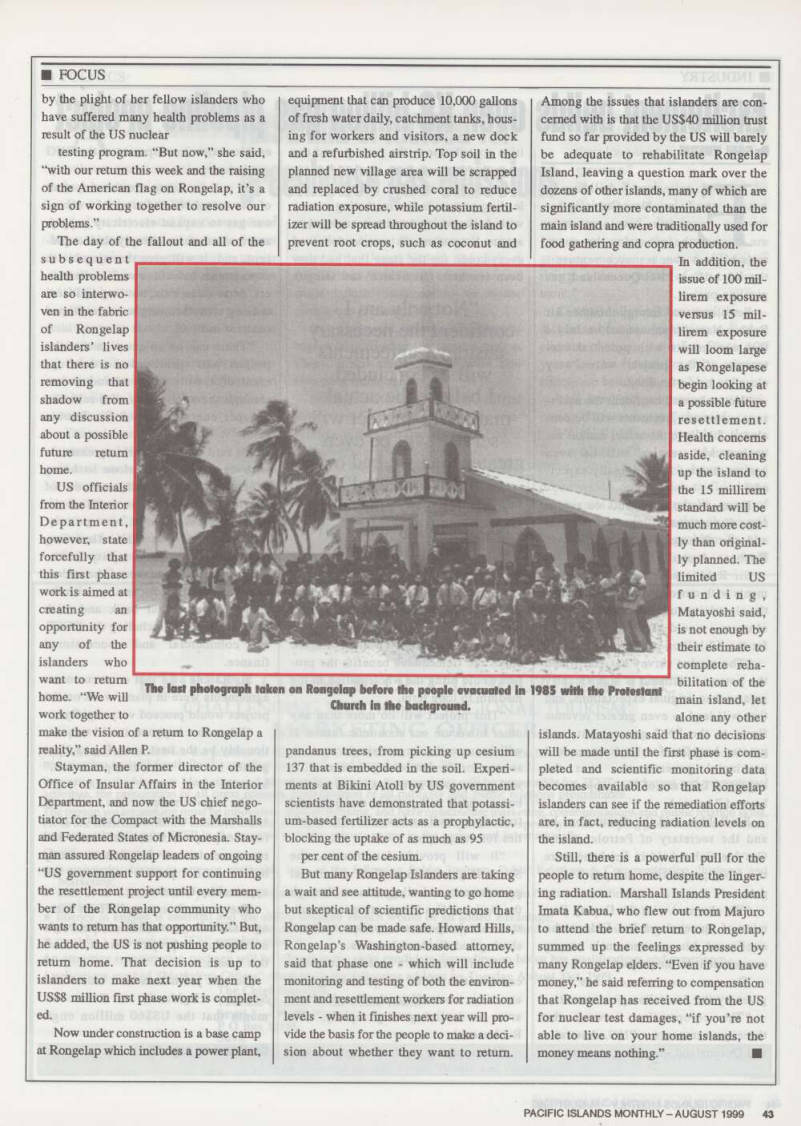
The lasi photograph taken on Rongelap before the people evacuated in 1985 with the Protestant Church in the background.