Media under fire for coverage of Guadalcanal crisis
pp. 40-41 · Read in the full issue
By Michael Field
AS far as one senior figure in the Royal Australian Navy was concerned, the whole Solomons drama was a media invention.
“In my office the articles have become
an object of ridicule and amusement,” Lieutenant Com mander Peter Briers said from his seconded office in the Forum Fisheries Agency on the hill overlooking Honiara.
Briers and other expatriates in Honiara made if plain they did not like the small band of international media in town.
While they vented them selves at the Yacht Club, the government, led by Minister of State Alfred Sasako and Police Commissioner Frank Short, used press conferences to blame the foreign press for
what happened.
Short, an Englishman who served in apartheid South Africa, was given to carrying a stick around with him. With his closely clipped moustache, carefully ironed white uniform and headmaster manner it was little wonder that most decided early on in the crisis that he had to go.
He managed to get a gagging! writ against the weekly
Solomon Voice that had a letter from a for mer British training adviser to the Solomon’s police, named as C M Hosking.
It is believed to outline criticism and back ground of Short, an Englishman who served in the South African police force during the apartheid era.
Short also attacked Rabuka at one stage and then accused the media of not doing their job - and then had reporters thrown out of a court room when they were doing just that.
It was unconvincing, however, given that the government itself had declared the State
of Emergency - and later draconian media control powers. For the state owned
Solomon Islands Broadcasting Corporation
(SIBC) and the privately owned Solomons Star the crisis was difficult to cover. For safety reasons neither wanted to send their staff into the countryside where the militants
operated.
There was, also, a severe personality clash; SIBC general manager Johnson Hon imae used to work for former Prime Minis ter Solomon Mamaloni while Sasako, a for mer journalist too, takes a dictatorial atti tude.
Sasako and Short went out of their way to claim all was calm and orderly - with Short even denying what everybody else could see; that Honiara had thousands of
refugees.
Short attacked the international press for coverage of an incident in which, it was
reported, a young child was killed by mili tants. The story as reported said the child’s father tried to protect him, but the bush knife went through the man’s body.
The child, Short said, was not dead at all, just “seriously injured” and this was an example of media carelessness. Just four
days before Sasako had announced the death, saying it was a Malaitan child and a Malaitan old man. Sasako is from Malaita.
Sasako one day claimed pub licly that Guadalcanal Provin cial Premier Ezekiel Alebua had disappeared and when that was reported - and Alebua attacked him for it - Sasako, author of the statement, than proceeded to beat up SIBC for reporting his original state ment.
For a brief period even the media wondered at the real extent of the guerrillas; no one independent had seen them.
At about the same time Short was hosting a media conference
saying the guerrillas were frag
menting and becoming weaker,
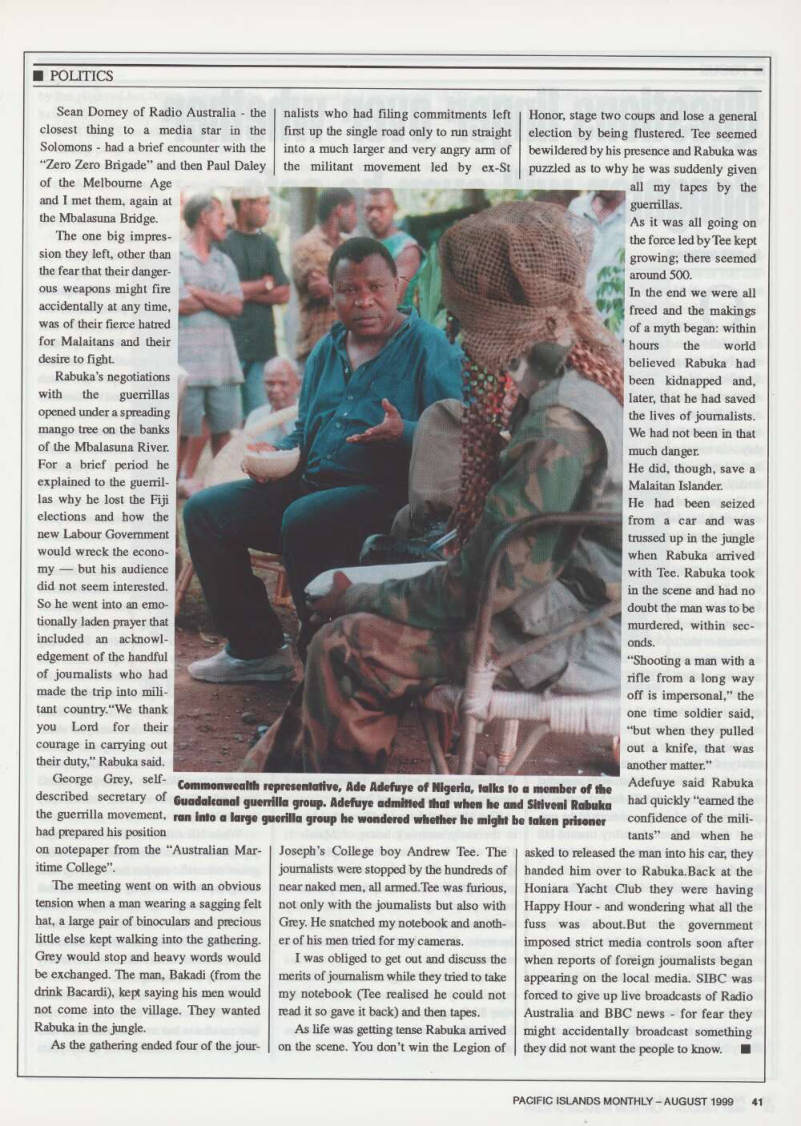
the Commonwealth team of Sitiveni Rabuka and Ade Ade fuye had gone across the Mbal asuna Bridge - and into the arms of a large guerrilla group.
Adefuye of Nigeria admitted later he was shaking and Rabuka
wondered whether he might be taken pris oner. The till then non-existent group, Rabu ka believed, might have as many as 20,000 people in it.
“We were told there was no command structure, they were disorganised, every man for himself sort of thing... But the group we met... was very well organised,”
Rabuka said. “There was a commander, his 2-I-C, there were 215 young men, most of them armed with shot guns and point two two weapons. Telescopic sights, binoculars, compasses. They are aware of how to use these things.”
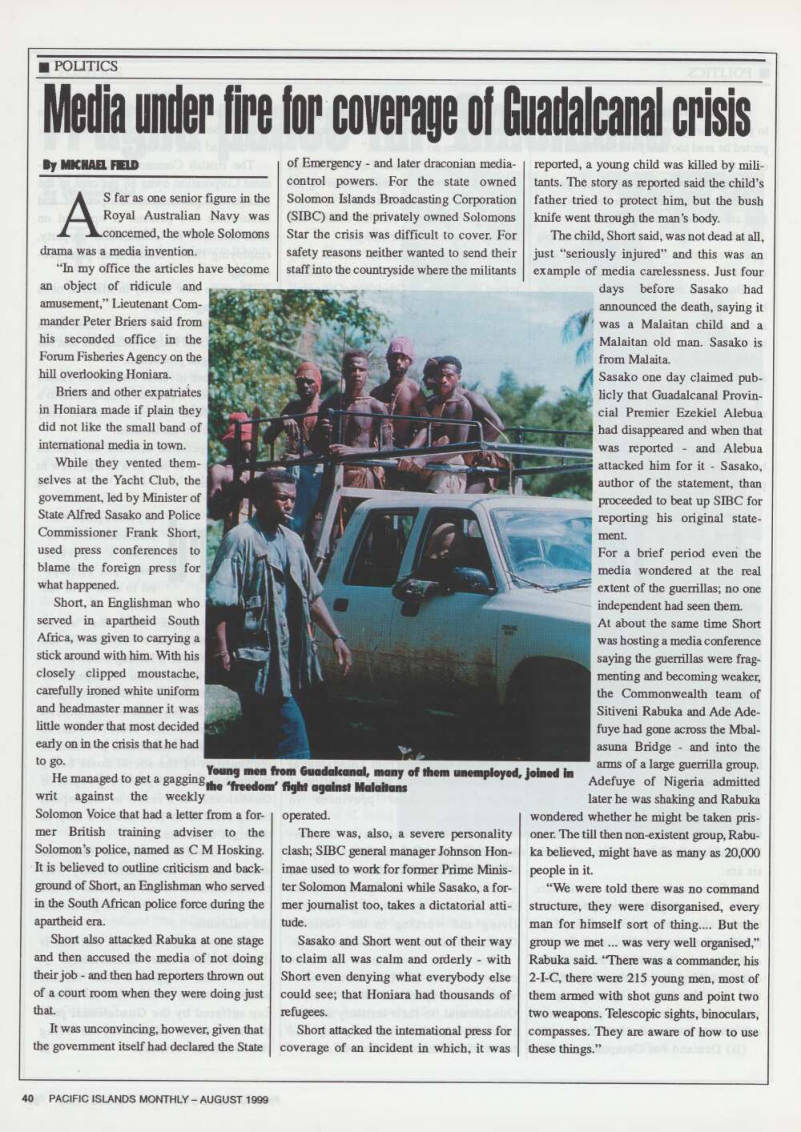
Young men from Guadalcanal, many of them unemployed, joined in the 'freedom' fight against Malaitans
Sean Domey of Radio Australia - the closest thing to a media star in the Solomons - had a brief encounter with the “Zero Zero Brigade” and then Paul Daley
of the Melbourne Age and I met them, again at the Mbalasuna Bridge.
The one big impres
sion they left, other than the fear that their danger ous weapons might fire accidentally at any time, was of their fierce hatred for Malaitans and their desire to fight.
Rabuka’s negotiations
with the guerrillas opened under a spreading mango tree on the banks of the Mbalasuna River.
For a brief period he explained to the guerril las why he lost the Fiji elections and how the new Labour Government would wreck the econo my but his audience did not seem interested.
So he went into an emo tionally laden prayer that included an acknowl edgement of the handful of journalists who had made the trip into mili tant country.“We thank you Lord for their courage in carrying out their duty,” Rabuka said.
George Grey, self described secretary of the guerrilla movement, had prepared his position
on notepaper from the “Australian Mar
itime College”.
The meeting went on with an obvious tension when a man wearing a sagging felt hat, a large pair of binoculars and precious little else kept walking into the gathering.
Grey would stop and heavy words would be exchanged. The man, Bakadi (from the drink Bacardi), kept saying his men would not come into the village. They wanted Rabuka in the jungle.
As the gathering ended four of the jour
nalists who had filing commitments left first up the single road only to run straight into a much larger and very angry arm of the militant movement led by ex-St
Joseph’s College boy Andrew Tee. The
journalists were stopped by the hundreds of near naked men, all armed. Tee was furious, not only with the journalists but also with Grey. He snatched my notebook and anoth er of his men tried for my cameras.
I was obliged to get out and discuss the merits of journalism while they tried to take my notebook (Tee realised he could not read it so gave it back) and then tapes.
As life was getting tense Rabuka arrived on the scene. You don’t win the Legion of
Honor, stage two coups and lose a general election by being flustered. Tee seemed bewildered by his presence and Rabuka was puzzled as to why he was suddenly given
all my tapes by the guerrillas.
As it was all going on the force led by Tee kept growing; there seemed around 500.
In the end we were all freed and the makings of a myth began: within hours the world believed Rabuka had been kidnapped and, later, that he had saved the lives of journalists.
We had not been in that much danger.
He did, though, save a Malaitan Islander.
He had been seized from a car and was tressed up in the jungle when Rabuka arrived with Tee. Rabuka took in the scene and had no doubt the man was to be murdered, within sec onds.
“Shooting a man with a rifle from a long way off is impersonal,” the one time soldier said, “but when they pulled out a knife, that was another matter.”
Adefuye said Rabuka had quickly “earned the confidence of the mili tants” and when he
asked to released the man into his car, they handed him over to Rabuka. Back at the Honiara Yacht Club they were having Happy Horn: - and wondering what all the fuss was about. But the government imposed strict media controls soon after
when reports of foreign journalists began
appearing on the local media. SIBC was forced to give up live broadcasts of Radio Australia and BBC news - for fear they might accidentally broadcast something they did not want the people to know. ■
Commonwealth representative, Ade Adefuye of Nigeria, talks to a member of the Guadalcanal guerrilla group. Adefuye admitted that when he and Sitiveni Rabuka ran into a large guerilla group he wondered whether he might be taken prisoner