Fragmented regional shipping
pp. 32-33 · Read in the full issue
could hinder Free Trade Area
By Sophie Foster Hildebrand
BEING closer to other Forum Island countries was not necessarily an advantage when competing with producers from the rest of the world, a recent study has found.
This was because shipping avail
ability and costs had a nega tive effect on Forum Island exporters - a problem which foreign suppliers of products imported into the region did not share.
Because of this, Island exporters face a significant disadvantage when competing with foreign companies, a paper titled “Shipping in the Forum Region” found.
The report was presented at the Forum Economic Min isters’ Meeting in Apia, Samoa last month.
It found that inter-Forum Island Country (FIC) ship ping rates tend to be apprecia bly higher than long-haul rates from the rest of the world. This, it said, was because costs per tonne-mile got smaller as distances increased.
For this reason, it was cheaper per mile for an importer to send goods from
the United States, than it was to send goods between FICs.
“It does seem that rates paid by FIC shippers do fall very sharply as length of voyage increases. Given that voy ages within the Region are shorter and traffic densities than is the case on international services, it is entirely
predictable that rates per TEU (twenty foot container equivalent unit) mile will be higher for Regional than for interna tional services,” the paper said.
But it added that a systematic analy sis of the relationship between length of voyage and rate per mile using 1999 data indicated that the negative relation ship was stronger for FIC traffic than had been suggested by earlier studies.
The paper said that TEU per mile rates fell by as much as 90 per cent from the shorter-haul to the long-haul ser vices.
The paper, prepared for the Forum Secretariat by Professor David Forsyth and Dr Nicholas Sisto, provided an
overview of shipping services in the Forum region. It also assessed the shortcomings in maritime services and suggested policy measures that would help enhance regional trade and devel opment of the private sector.
The report found that FIC exporters competitiveness was affected by the
availability of shipping services.
“Even in a decade when tariff rates
have fallen sharply, if shipping ser vices to and from a particular location are very infrequent, irregular or unre liable then the ultimate impact of transport-related costs on total costs may be heavy,” the paper said.
It said producers could incur sig
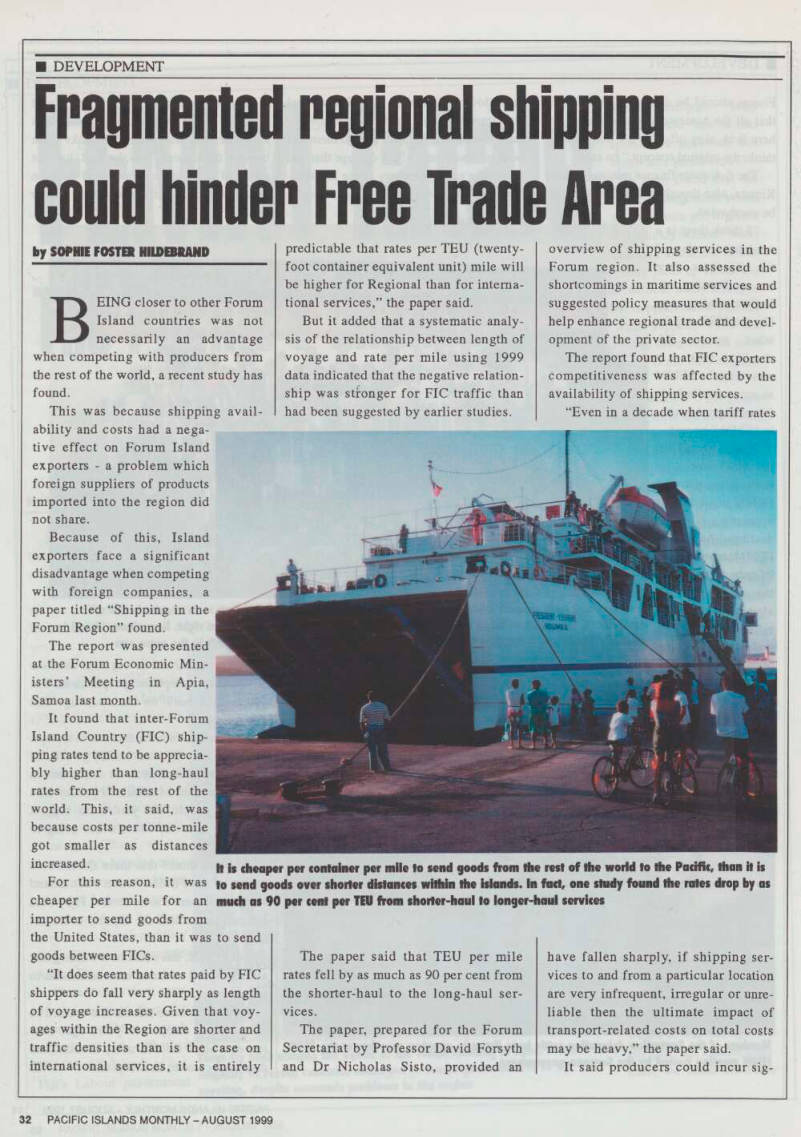
It is cheaper per container per mile to send goods from the rest of the world to the Pacific, than it is to send goods over shorter distances within the islands. In fact, one study found the rates drop by as much as 90 per cent per TEU from shorter-haul to longer-haul services
nificant costs through delays in avail ability of transportation and orders may be lost because of inability to deliver on schedule.
It said that while shipping costs per container may have fallen, the need to use lengthy routings in some cases because of a lack of port-to-port ser vices could also significantly add to costs.
It gave the example of the increase in shipping costs caused by the absence of direct services from Fiji to the three MSG countries to the West.
The study found that one effect of the formation of an FTA would be to increase the demand for intra-FIC freight transportation, almost all of which would be in the form of shipping.
A simulation exercise found that an FTA would increase the amount of trade
between FICs, increase FIC exports, and marginally reduce imports from the rest of the world.
The increase in trade between FICs is expected to be about US$l2.6 mil lion.
But the study found that while ship ping services to the rest of the world were adequate, the regional shipping map was fragmented.
“Given that much of the increase in trade expected to result from the forma tion of a FTA involves PNG imports, and imports and exports of Vanuatu, it appears that a problem of adequacy of shipping services may arise,” the paper said.
It added that is this was the case, some of the benefits expected from the FTA might be lost.
The report said that it was possible
that the potential increase in the import trade of PNG and Vanuatu from other FICs “may be sufficient to render a viable direct service from the three Western MSG countries to the rest of the FICs - a case of demand induced supply of a kind fairly common in mar ket economies.”
But it said that the projected increase in the trade of FSM, Nauru, Marshall Islands and Palau was so small that the lack of good shipping links to other FICs would have little bearing on the overall impact of the FTA.
Shipping has always been a vehicle for trade in the region, from the early islanders to the colonialists and now the neo-colonialists.
Now, though, the very competitive ness of businesses in the region could hinge on it. ■